
By Latitude · March 23, 2026
Key Takeaways
-
AI agents fail on 63% of complex multi-step tasks in production — not due to model capability but due to interaction-level failure patterns between steps.
-
A 20-step workflow with 95% per-step reliability succeeds only 36% of the time overall; compounding failures are invisible at the individual step level.
-
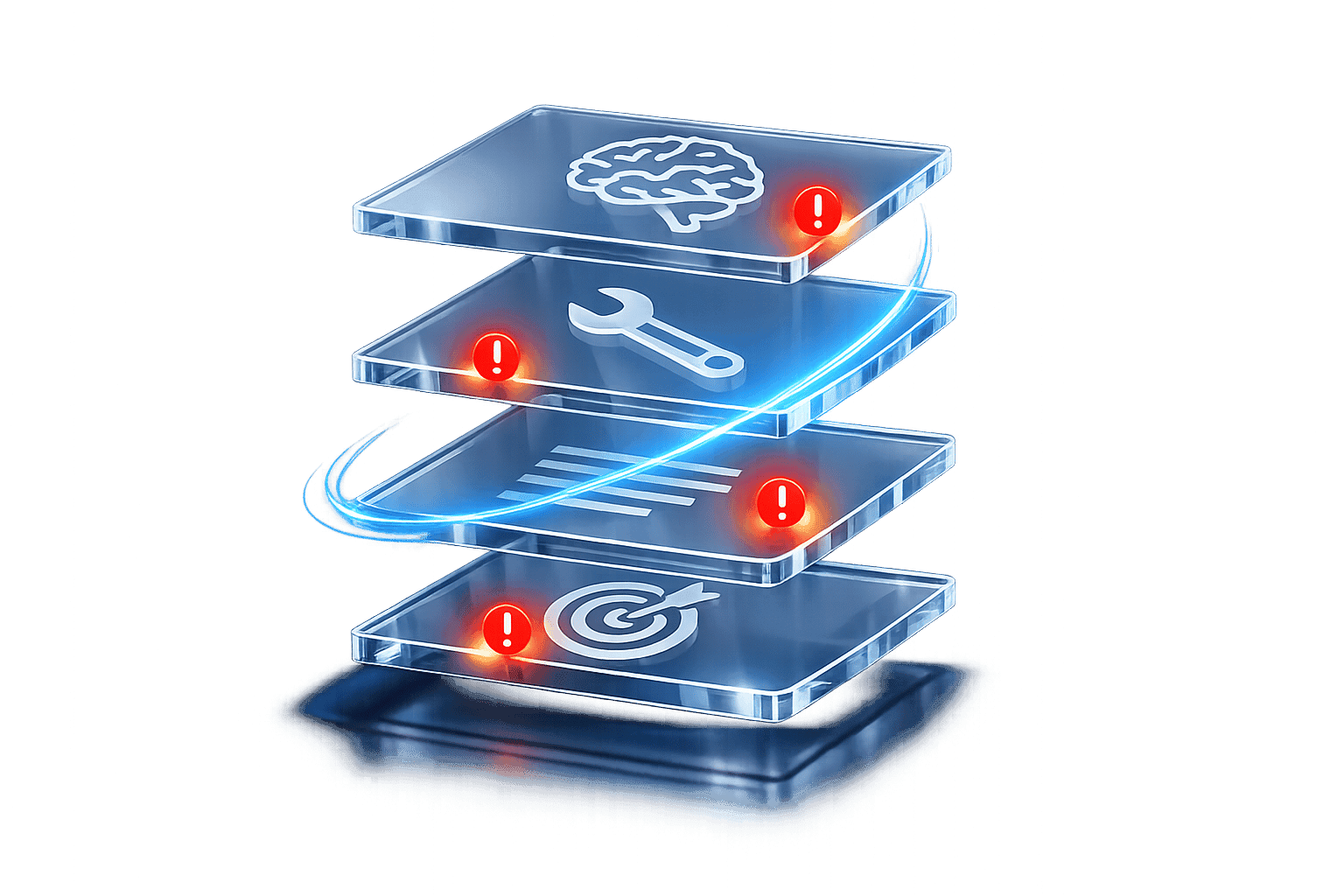
Production failures cluster into four categories: reasoning drift, tool call failures, context window saturation, and goal misalignment.
-
Dev-time tests miss these patterns because real user inputs differ from synthetic benchmarks and production distribution shifts over time.
-
Systematic failure detection requires prioritized annotation queues, human-validated failure modes, and automatic eval generation from annotated issues.
-
Latitude’s GEPA algorithm converts annotated production failures into runnable regression evals automatically — growing the eval library without requiring engineers to write eval logic for each new pattern.
Most teams treat agent failures as isolated bugs — something unexpected happened in a specific session, you find the logs, you patch the prompt, you move on. This approach has a structural problem: the failure wasn’t isolated. It was an instance of a pattern that has been appearing in your production traffic for days or weeks. You fixed the symptom. The pattern is still running.
Production agent failures are not random. They’re predictable, they recur, and once you know what to look for, you can detect them systematically before they affect users. This guide breaks down the four primary failure pattern categories, explains why standard testing misses them, and shows how failure clustering turns production chaos into a structured improvement loop.
The Production Gap: Why Dev-Time Testing Misses What Matters
The failure modes that appear in production agents are structurally different from the ones that appear in development testing. There are three reasons for this gap.
1. Real user inputs differ from synthetic test cases
Test suites are written by engineers who have a mental model of how the agent will be used. Real users — especially in early production — probe the agent in ways the team didn’t anticipate. They use ambiguous phrasing, shift context mid-session, provide partial information, and combine instructions in unexpected sequences. A synthetic benchmark built from the team’s assumptions about usage patterns will not cover the edge cases that real usage generates.
Research on production agent systems shows that agents are failing on complex, multi-step tasks at rates that would surprise most teams. One analysis found that AI agents fail on 63% of complex multi-step tasks in real-world conditions — not because the underlying model is incapable, but because the failure modes appear in the interaction between steps, not at any single step.
2. Compounding errors are invisible at the step level
The math of multi-step agent failure is unforgiving. A 20-step agent workflow where each step has 95% reliability succeeds only 36% of the time overall. At 99% per-step reliability — which is unusually high — a 20-step workflow still only succeeds 82% of the time. Real-world agents operating on complex tasks routinely have per-step error rates closer to 10-20%, making end-to-end success rates substantially lower than teams expect.
The critical insight: these compounding failures are invisible at the individual step level. Every step may look reasonable in isolation. The failure only becomes visible when you trace the causal chain — when you can see that a misinterpretation at step 3 silently corrupted the context that steps 4 through 8 were reasoning from. Evaluation frameworks that score individual LLM calls will miss this class of failure entirely.
3. Production distribution shifts from development assumptions
The inputs, context, and edge cases in production drift from what the team tested at development time. This drift compounds over time: as the agent gets used more, the tail of unusual inputs grows, and the failure modes your original test suite was built around become a smaller fraction of the actual failure landscape. Teams that don’t have a mechanism to continuously update their eval set from production data find that their regression tests gradually become less relevant to what’s actually failing.
The Four Failure Pattern Categories
After analyzing production agent failures across different system architectures and use cases, failures cluster into four primary categories. Understanding these categories is the first step toward detecting them systematically.
Category 1: Reasoning Drift
What it is : The agent’s reasoning path diverges from the intended goal over the course of a multi-turn session. Early turns appear coherent. Later turns pursue a subtly different objective, or apply a constraint from an early turn inappropriately to later context.
Why it happens : LLMs are next-token predictors. In multi-turn contexts, they build on what came before. If the representation of the task that gets established in early turns is slightly off — a missed nuance, an ambiguous phrase resolved incorrectly — subsequent reasoning reinforces that framing. The agent isn’t hallucinating; it’s coherently reasoning from a slightly wrong premise.
Production signature : Traces where the user’s final message expresses frustration or correction (“that’s not what I asked for”), or where the agent’s final output doesn’t address the original request. Often appears in sessions with 5+ turns.
How to detect it : Requires full-session trace analysis. The gap between the user’s initial request and the agent’s final action must be evaluated at the session level, not the individual call level. Human annotators reviewing production traces can identify reasoning drift cases far more reliably than automated metrics alone, because understanding whether the agent “got it right” often requires domain knowledge that a generic LLM judge doesn’t have.
Category 2: Tool Call Failures
What it is : The agent calls a tool incorrectly — wrong parameters, malformed schema, invalid authentication — or handles a tool’s error response incorrectly. The failure may be silent: the tool returns an error that the agent logs but doesn’t surface to the user, and subsequent reasoning proceeds as if the tool call succeeded.
Why it happens : Tool integration is fragile by nature. Schema drift occurs when a dependency update changes how tool schemas are generated, making them incompatible with the LLM provider’s format. Authentication rot occurs when tokens expire or keys rotate. Real-world examples have shown the same schema incompatibility appearing simultaneously across multiple major projects after a version update, affecting production systems mid-operation.
Production signature : Tool call error rates spike after deployments or dependency updates. Silent failures appear as sessions where a tool call error occurred but the agent continued without signaling the problem to the user. A particularly dangerous variant: the agent fabricates a response rather than surfacing that the required tool call failed.
How to detect it : Tool call logging with structured error tracking. The key is not just capturing that a tool call failed, but understanding the causal chain — whether the failure was surfaced, whether the agent’s downstream behavior was corrupted, and whether similar tool failures are clustering around specific tools or conditions.
Category 3: Context Window Saturation
What it is : In long multi-turn sessions or complex agentic workflows, the context window fills up. Information from earlier turns gets truncated or lost. The agent begins reasoning without access to context it needs, producing responses that contradict earlier decisions or miss constraints established at the start of the session.
Why it happens : Even with large context windows, the relationship between context length and model performance is not linear. Research on attention mechanisms consistently shows that models perform worse on information in the middle of long contexts than on information at the start or end — the “lost in the middle” phenomenon documented across multiple model families. For agents managing long workflows, this isn’t a theoretical concern; it’s a production failure mode that shows up predictably in sessions above a certain turn or token count.
Production signature : Failures correlate with session length. Annotators reviewing traces find that the agent “forgot” an instruction or constraint that was established in turn 1 by turn 15. Output quality degrades as conversation length increases.
How to detect it : Session-length-stratified analysis of production traces. Comparing annotation error rates against session token counts reveals whether context saturation is a significant failure driver. This requires the ability to filter and compare production traces by session characteristics — not just review individual logs.
Category 4: Goal Misalignment
What it is : The agent optimizes for a proxy metric or instruction rather than the actual user goal. It completes the literal task while missing the intent. In agentic systems with sub-goals, a sub-agent optimizing its narrow objective can produce outputs that are locally correct but globally wrong — the “specification gaming” problem applied to multi-agent pipelines.
Why it happens : Instructions are inevitably imprecise. Users describe what they want in natural language, which is ambiguous. The model interprets instructions based on training distributions, which may not match the specific domain or use case. In multi-agent systems, sub-agent instructions are generated by the orchestrator, which introduces another layer of potential misalignment between the original user intent and what gets executed.
Production signature : User satisfaction feedback correlates poorly with automated quality metrics. The automated metrics score the output highly (the agent did follow the instructions technically); users mark the output as low quality because it missed what they actually wanted. This disconnect between automated metrics and user satisfaction is one of the clearest diagnostic signals for goal misalignment.
How to detect it : Requires human evaluation — specifically, domain expert annotation against real user intent rather than against a rubric derived from the agent’s instructions. This is a core reason why human-in-the-loop annotation, grounded in actual user needs, produces eval sets that automated metrics alone cannot replicate.
How Failure Clustering Turns Patterns Into Evals
Knowing the failure pattern categories is necessary but not sufficient. The operational challenge is: given thousands of production traces per week, how do you efficiently identify which traces contain meaningful failures, classify them by pattern, and turn them into evaluations that will catch regressions?
The manual approach — reviewing traces individually, maintaining a shared document of failure examples, hand-writing eval cases — breaks down at production scale. The time cost is too high, coverage is too low, and the eval dataset becomes stale as new failure patterns emerge.
Systematic failure detection requires three components working together:
1. Prioritized annotation queues
Not all production traces deserve equal review attention. Anomaly signals — unusual session lengths, unexpected tool error rates, low automated quality scores, user signals like session abandonment or explicit negative feedback — should surface the traces most likely to contain meaningful failures for human review. The goal is to direct expert attention where it’s most valuable, not to have annotators review a random sample.
2. Human-validated failure modes
The criteria for what constitutes a failure in a specific production context lives in domain experts’ heads, not in a generic rubric. A support automation agent and a code generation agent have completely different standards for what counts as “reasoning drift” or “goal misalignment.” This means failure identification cannot be fully automated. Human annotators need to define what bad looks like for their specific system — and that definition needs to be captured in a structured, repeatable form, not in individual reviewer notes.
When an annotator identifies a production trace as containing a failure, that annotated trace should become a tracked issue: a named failure mode with a state, a frequency count (how often is this pattern appearing?), a link to the traces that exemplify it, and end-to-end tracking from first detection to verified resolution.
3. Automatic eval generation from annotated issues
Once a failure mode is annotated and tracked as an issue, the next step is converting it into an evaluation that can run continuously to catch regressions. Manually writing evaluations from annotated issues is feasible when the issue count is small; at scale, it’s the bottleneck that keeps teams’ eval sets perpetually behind their actual failure landscape.
Latitude’s GEPA (Generative Eval from Production Annotations) algorithm addresses this bottleneck directly: as domain experts annotate production outputs, the system automatically generates evaluations aligned with the annotated failure patterns and refines them over time as more annotations come in. The eval library grows automatically as the annotation process continues — without requiring engineers to write eval logic for each new failure pattern they discover.
The result is an eval suite that reflects the actual distribution of production failures, not a static benchmark built from hypothetical failure scenarios at development time. When the team deploys a model update, they run the same eval suite — and the pass rate tells them whether the update introduced regressions on the failure patterns their agent has actually exhibited, not the ones they assumed it would exhibit.
Measuring Whether Your Evals Are Working
There’s a second-order problem that most teams don’t address: even if you have an eval suite, how do you know it’s actually detecting real failures?
Eval quality measurement — the ability to quantify how well your evaluations align with human judgments on real production data — is the final piece of the loop. An eval that passes doesn’t mean the agent is working correctly; it might mean the eval isn’t testing for the failure mode it’s supposed to detect.
The standard metric for measuring eval alignment with human judgment is the Matthews Correlation Coefficient (MCC) — a balanced measure that accounts for true positives, false positives, true negatives, and false negatives, and is robust even when the failure rate in production is low (which it typically is). Tracking MCC across an eval suite over time shows whether evaluations are drifting away from human-validated ground truth — which happens naturally as both the model and the user behavior evolve.
Building the Closed Loop
The full workflow from production failure to pre-deployment test looks like this:
-
Observe : Production traces flow into your observability system with full session context — all turns, all tool calls, all intermediate reasoning steps.
-
Surface : Anomaly signals prioritize which traces need human review. High-signal traces surface to annotation queues automatically.
-
Annotate : Domain experts review prioritized traces and classify failures using the taxonomy that fits your system. Annotated failures become tracked issues with states and frequency counts.
-
Generate : From annotated issues, evaluations are created automatically and refined over time as annotation coverage grows.
-
Test : Before deploying a model update or prompt change, the eval suite runs against the new version. Pass rates on each failure category tell you whether you’ve introduced regressions on patterns your system has actually exhibited.
-
Verify : After deployment, production monitoring checks whether the issues previously tracked as resolved have stayed resolved or regressed — closing the loop between pre-deployment testing and post-deployment validation.
The key constraint in this loop is step 3: human annotation is the rate-limiting step, and it’s not automatable without losing alignment with domain-specific quality standards. Everything else in the loop can be accelerated with tooling. The annotation step benefits from tooling that prioritizes the right traces, captures annotations in structured form, and converts them automatically into tracked issues and evals — but the human judgment at the center cannot be replaced by automated scoring.
Starting Before You Have a Systematic Process
If your team is still at the stage of reviewing traces in a logging tool and filing Slack messages about failures, the path forward isn’t a full platform overhaul. It’s establishing the habit of treating every production failure as a potential test case.
The highest-leverage practice at any stage: when a production failure reaches you — through user feedback, manual trace review, or automated alerts — capture it as a structured failure case, not just a Slack message. Write down what the input was, what the agent did, what the correct behavior would have been, and which failure category it belongs to. Even maintaining this in a spreadsheet is a foundation.
Every failure that reaches users without becoming a pre-deployment test case is a regression waiting to happen again. The teams that close this loop systematically — converting production incidents into eval cases reliably and at scale — are the ones that achieve stable, measurable improvement in agent quality over time. The ones that don’t find that every model update is a quality gamble.
Frequently Asked Questions
What are the most common AI agent failure patterns in production?
Production AI agent failures cluster into four primary categories: (1) Reasoning drift — the agent’s reasoning path diverges from the intended goal over a multi-turn session, appearing in sessions with 5+ turns. (2) Tool call failures — wrong parameters, malformed schema, silent error handling, or chained corruption when a failed tool call is not surfaced. (3) Context window saturation — information from earlier turns is truncated, causing the agent to “forget” constraints and contradict earlier decisions. (4) Goal misalignment — the agent optimizes for the literal instruction rather than the actual user intent, scoring well on automated metrics while satisfying users poorly. Research suggests AI agents fail on 63% of complex multi-step tasks in real-world conditions due to these interaction-level failures.
Why do dev-time tests miss production agent failures?
Dev-time tests miss production failures for three structural reasons: (1) Real user inputs differ from synthetic test cases — users probe agents in unpredicted ways that no benchmark constructor anticipated. (2) Compounding errors are invisible at the step level — a 20-step agent workflow where each step has 95% reliability only succeeds 36% of the time overall; these failures are invisible to step-level scoring. (3) Production distribution shifts from development assumptions — as the agent gets more use, the tail of unusual inputs grows and original test cases become less representative.
How does failure clustering convert production patterns into evaluations?
Failure clustering converts production patterns into evaluations through three components: (1) Prioritized annotation queues that surface the traces most likely to contain meaningful failures — session length outliers, unusual tool error rates, low quality scores. (2) Human-validated failure modes where domain experts annotate what “bad” looks like for their specific system and capture it as tracked issues with lifecycle states. (3) Automatic eval generation — in Latitude, GEPA converts annotated issues into runnable regression tests automatically, so the eval library grows from real failures without requiring engineers to write eval logic for each new pattern.
Latitude’s 30-day free trial is designed for teams at exactly this inflection point: you have agents in production, you’re finding failures that your existing tests don’t catch, and you need a structured way to turn that production signal into an eval library that actually reflects what’s breaking. The annotation queue, issue tracker, and GEPA eval generation are available from day one — no synthetic benchmark setup required. Start your free trial →