
Running large language models (LLMs) in production is challenging. Unlike traditional apps, LLMs can confidently output incorrect answers without triggering error logs. That’s why observability tools for LLMs are becoming essential. These tools help teams monitor performance, detect issues, and ensure quality in AI workflows.
Here’s a quick breakdown of the 7 top tools in 2026:
-
Langfuse: Open-source and self-hosted, ideal for compliance and detailed tracing.
-
LangSmith: Built for LangChain users, offering seamless integration and managed services.
-
Braintrust: Focused on quality testing with CI/CD pipeline integration.
-
Helicone: Simple proxy-based setup for cost tracking and logging.
-
Latitude: Debugging multi-turn agents with auto-generated evaluations.
-
Confident AI: Quality metrics for non-engineers, great for cross-functional teams.
-
Arize Phoenix: Best for RAG pipelines with retrieval-specific metrics.
Quick Comparison
| Tool | Core Focus | Best Fit | Free Tier | Starting Price |
|---|---|---|---|---|
| Langfuse | Tracing / Compliance | Teams needing self-hosting | 50,000 events/mo | $29/mo |
| LangSmith | LangChain Native | LangChain-heavy users | 5,000 traces/mo | $39/seat/mo |
| Braintrust | Evaluation / CI-CD | Teams focused on quality testing | 1M spans/mo | $249/mo |
| Helicone | Cost Control | Startups prioritizing cost insights | 10,000 requests/mo | $79/mo |
| Latitude | Debugging | Complex multi-turn agents | 5,000 traces/mo | $299/mo |
| Confident AI | Quality Metrics | PMs and QA teams | 2 seats, 1 GB/mo | $19.99/seat/mo |
| Arize Phoenix | RAG Pipelines | Retrieval-heavy workflows | Unlimited (self-hosted) | $50/mo (managed) |
Choose based on your team’s priorities: quick setup, compliance, quality testing, or debugging complex workflows. Combining tools can also provide better coverage for cost control and evaluation.
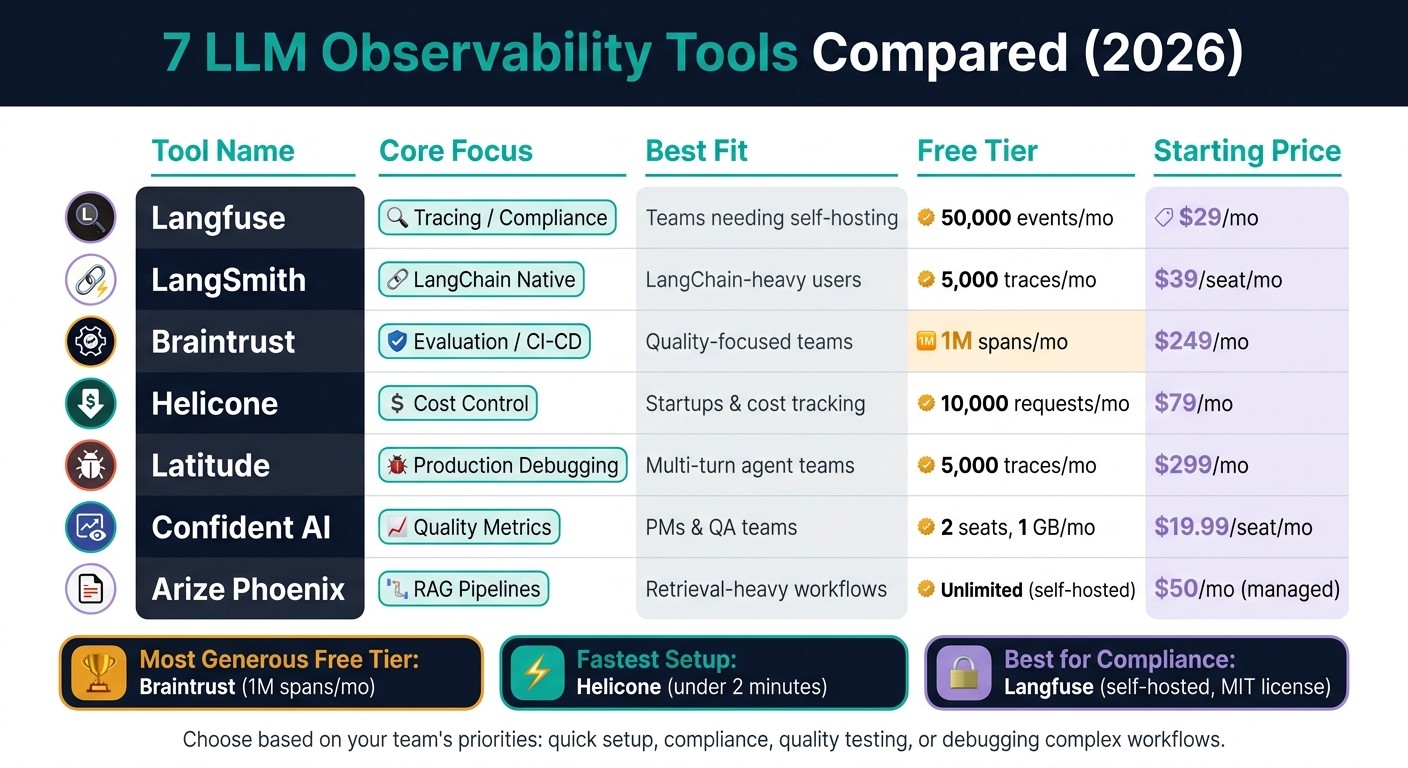
7 LLM Observability Tools Compared: Pricing, Features & Best Fit (2026)
Key Dimensions for Evaluating LLM Observability Tools
Evaluation Dimensions
LLM observability tools serve a range of purposes, from monitoring costs and latency to assessing output quality. Understanding these differences is essential when selecting the right tool for your needs.
Here are the main factors that differentiate these tools:
-
Tracing depth: Does the tool provide full span-level traces across complex, multi-step agent chains, or is it limited to single-turn request/response logs?
-
Evaluation maturity: Can the tool apply research-based metrics - like faithfulness, relevance, or hallucination detection - directly to live traces?
-
Production readiness: Does it support advanced features such as quality-aware alerting, PII redaction, or compliance certifications like SOC 2 and HIPAA?
-
Integration method: Tools like Helicone offer a proxy-based setup, enabling integration with just a base URL change in under two minutes. Others, such as Langfuse and Braintrust, use SDK-based integrations, delivering deeper span-level visibility.
-
Hosting options: Some tools are cloud-only, while others allow self-hosting. This distinction is critical for teams with strict data residency or regulatory compliance needs.
“If your ‘LLM observability’ looks indistinguishable from traditional APM - just with tokens instead of SQL queries - you are monitoring infrastructure, not AI behavior.” - Kritin Vongthongsri, Co-founder, Confident AI
The growing adoption of OpenTelemetry has made it easier for tools like Langfuse and Arize Phoenix to integrate into enterprise observability stacks seamlessly.
The next step? Matching these dimensions to the unique needs of different team profiles.
Matching Tools to Team Profiles
Your team’s stage, priorities, and tech stack will heavily influence the choice of an observability tool. For instance, a healthcare enterprise with strict compliance requirements will have vastly different needs than a small startup rolling out its first AI-powered feature.
| Team Profile | Recommended Tool | Primary Benefit |
|---|---|---|
| Early-stage startup | Helicone | Cost tracking & quick setup |
| Regulated enterprise | Langfuse (self-hosted) | Data residency & compliance |
| LangChain-heavy stack | LangSmith | Seamless integration with LangChain |
| Quality-critical team | Braintrust | Regression prevention & CI/CD gates |
| Complex agent workflows | Latitude | Efficient debugging for multi-turn agents |
| RAG-focused team | Arize Phoenix | Drift detection & retrieval performance |
Startups often prioritize low-cost solutions and easy setup. For example, Braintrust offers 1 million free spans per month, while Langfuse’s cloud tier supports up to 50,000 observations at no cost. On the other hand, enterprises typically seek robust features like RBAC (role-based access control), SSO (single sign-on), audit logs, and governance across multiple providers.
A great example comes from Humach, a voice AI enterprise. In early 2026, they adopted Confident AI for evaluation-centric tracing and automated dataset curation. This decision led to 200% faster deployments while maintaining high-quality standards.
Comparing 7 Leading LLM Observability Tools
When it comes to LLM observability tools, the differences often boil down to tracing capabilities, production readiness, and how well they align with team priorities. Here’s a closer look at how seven tools stack up.
Langfuse
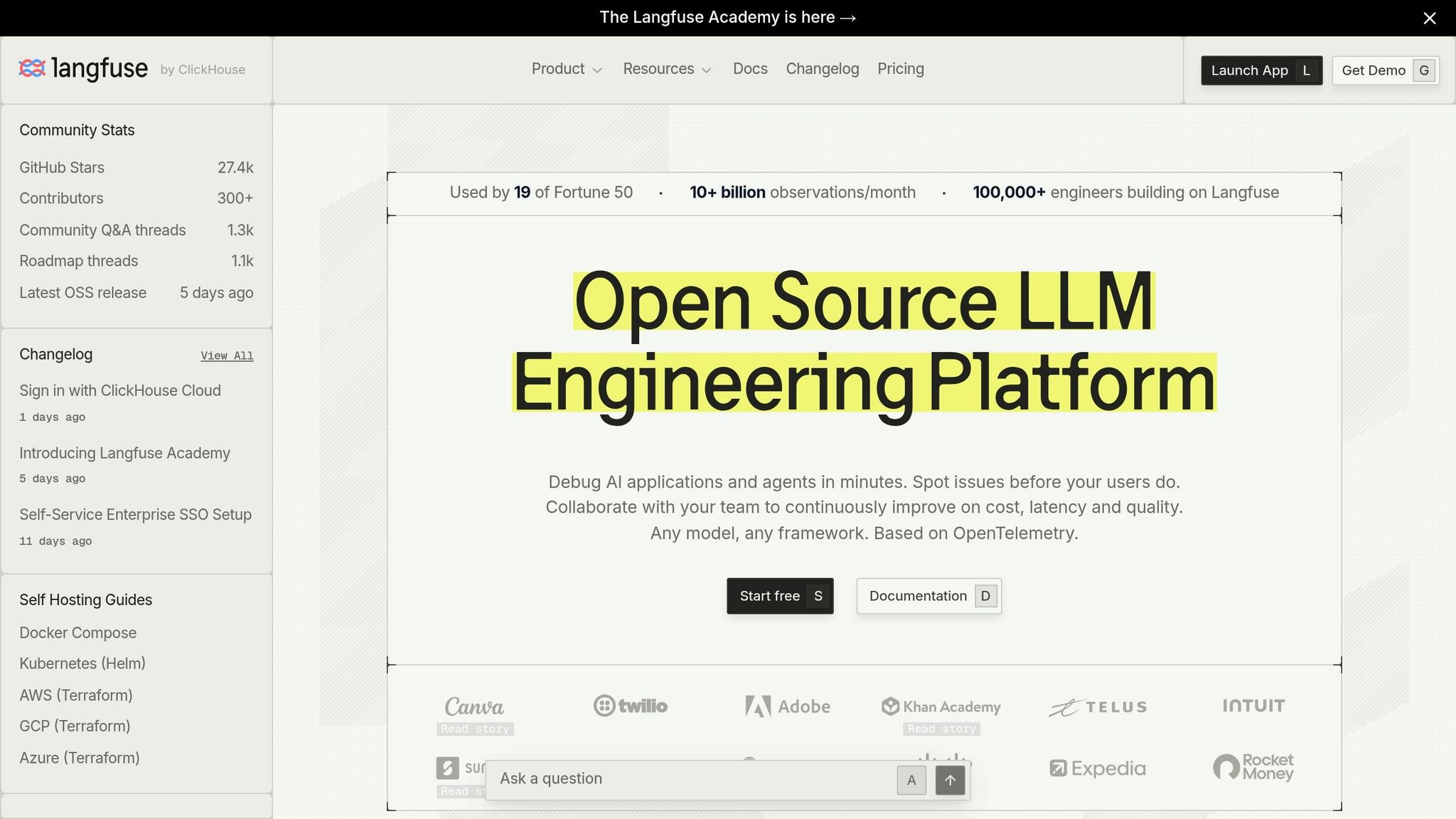
Langfuse is an open-source, framework-agnostic observability platform with a focus on data residency and detailed tracing. It works with LangChain, LlamaIndex, and raw SDKs, making it a strong choice for teams needing compliance with strict data residency rules (e.g., in the EU or UAE). Built on OpenTelemetry, it integrates seamlessly with enterprise observability stacks, adding a latency overhead of about 10–30 ms. While self-hosting is free, it does require your team to handle operations. Alternatively, cloud hosting starts at $29/month.
“The wrong move is picking by GitHub stars or ‘we already use LangChain’ - pick by what your traces look like and where governance will land in 12 months.” - Particula Tech
LangSmith
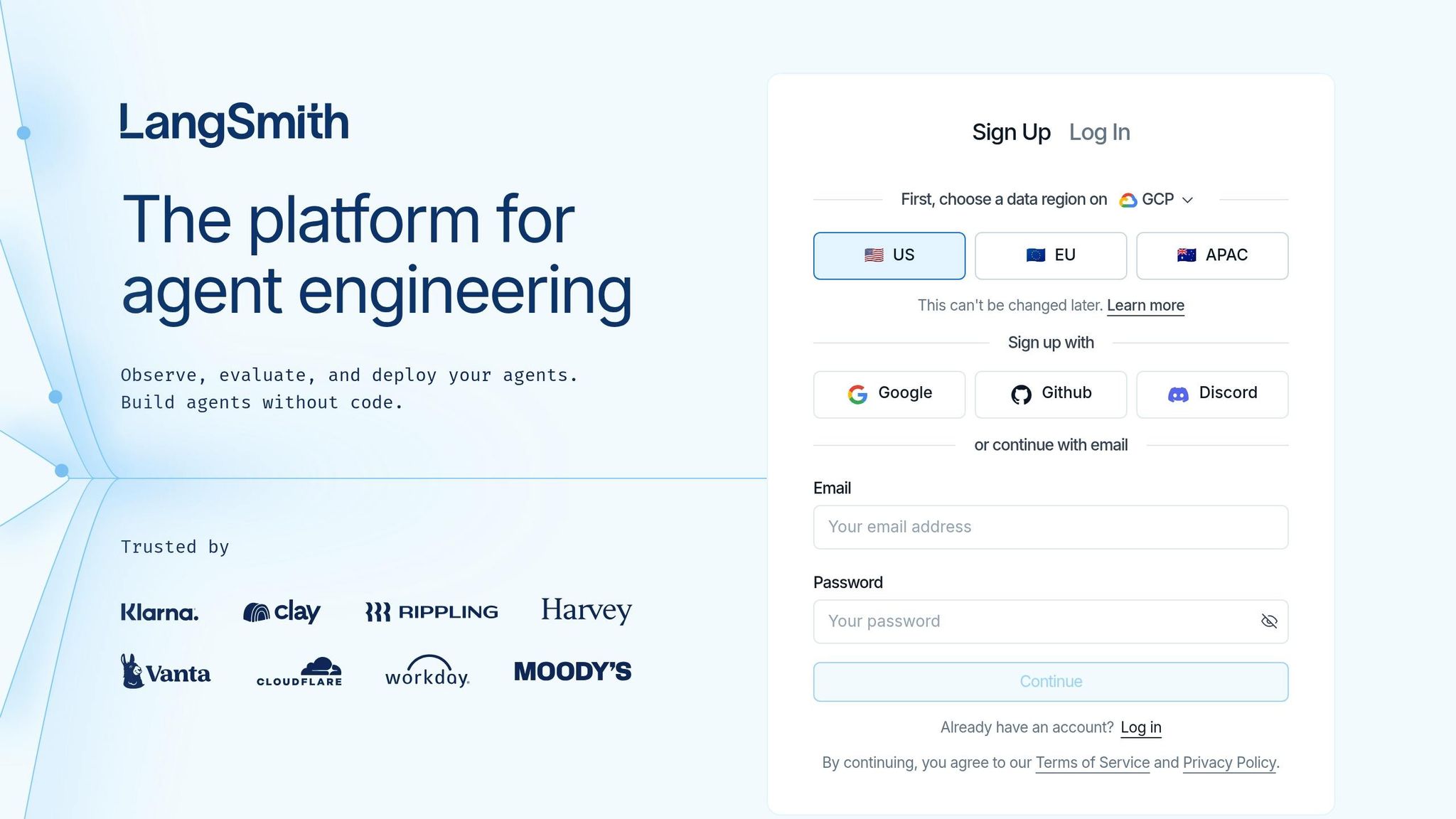
LangSmith simplifies the process of tracing for LangChain and LangGraph stacks. With just one environment variable, it provides zero-configuration tracing and clear visualizations of agent states. However, LangSmith is primarily a managed cloud service, with self-hosting available only for enterprise clients. This setup may not suit teams with strict data residency needs or those not using LangChain frameworks. LangSmith handles over 1 billion events daily and is trusted by about 35% of the Fortune 500. Pricing starts at $39 per seat per month after a free tier of 5,000 traces.
Braintrust
Braintrust integrates quality evaluation directly into the CI/CD pipeline, using “golden sets” for regression testing. Its strong market backing was evident when it raised $80 million in a Series B round in February 2026, reaching an $800 million valuation. The platform offers a free tier with 1 million trace spans per month, while its Pro plan costs $249/month.
Helicone
Helicone offers an easy setup for logging, cost tracking, rate limiting, and caching - all achieved by changing a single API base URL. According to TokenMix Research Lab:
“Helicone is the ‘smallest thing that works’… you point your SDK at their proxy, and suddenly every request is logged, rate-limited, cached, and cost-analyzed.”
Its built-in caching can cut API costs by 20%–30% in production environments, making the $79/month Pro plan a cost-effective option. However, Helicone operates at the request level, so it may lack the depth needed for analyzing multi-step agent reasoning.
Latitude
Latitude specializes in production debugging by identifying AI failures and auto-generating evaluations from real-world issues. Its alignment metrics allow teams to track evaluation quality over time, which is particularly helpful for multi-turn agents. The platform offers a free tier with 5,000 traces per month, while the Team plan costs $299/month, providing 200,000 traces, unlimited annotation queues, and evaluations.
Confident AI
Confident AI focuses on quality observability, offering over 50 research-backed metrics like faithfulness and hallucination detection. These metrics are applied directly to live data, making it accessible even to non-engineers. For instance, Humach, a voice AI company working with clients like McDonald’s and Visa, reported cutting deployment times by 200% using Confident AI’s tools. Pricing starts at $19.99 per seat per month after a free tier.
Arize Phoenix
Arize Phoenix is designed for teams managing RAG pipelines. This open-source tool, built on OpenInference conventions, offers retrieval-specific metrics like precision, recall, and drift detection, which go beyond what general observability tools provide. While self-hosted deployments are free and unlimited, the managed cloud version (AX Pro) starts at $50/month. The tradeoff? Its user interface isn’t as polished as commercial alternatives like LangSmith or Braintrust.
Head-to-Head Comparison
Looking at these tools side-by-side highlights the trade-offs and strengths each one brings to the table.
Feature Comparison
The biggest difference among the tools lies in their primary focus. Langfuse and LangSmith prioritize tracing, while Braintrust and Confident AI lean toward evaluation. Helicone stands apart as a proxy/gateway tool, and Latitude along with Arize Phoenix address more specific needs, such as production debugging and workflows centered around retrieval-augmented generation (RAG).
| Tool | Core Focus | Tracing Depth | Evaluation Depth | Agentic Support |
|---|---|---|---|---|
| Langfuse | Tracing / OSS | Full-span | Custom | Moderate |
| LangSmith | LangChain Native | Full-span | Custom | Strong (LangGraph) |
| Braintrust | Evaluation / CI-CD | Full-span | Deep (research-backed) | Moderate |
| Helicone | Proxy / Cost Control | Request-level | Minimal | Limited |
| Latitude | Production Debugging | Full-span | Auto-generated evals | Strong (multi-turn) |
| Confident AI | Quality Observability | Full-span | Deep (research-backed) | Moderate |
| Arize Phoenix | RAG Pipelines | Full-span | Retrieval-specific | Moderate |
Langfuse and LangSmith require users to define their own evaluation logic, while Braintrust and Confident AI provide built-in metrics backed by research. Next, let’s see how these tools integrate with existing systems and their hosting options, both critical for scalability and compliance.
Integrations and Hosting Options
As of 2026, OpenTelemetry (OTel) has emerged as the standard for portability. Langfuse and Arize Phoenix seamlessly integrate into enterprise observability systems as OTel-native tools, while LangSmith offers an OTel bridge. Braintrust has OTel support planned for the future. For industries with strict regulations - like healthcare, finance, or those under GDPR or UAE PDPL - Langfuse and Arize Phoenix stand out for their self-hosting capabilities. LangSmith and Braintrust also provide self-hosting, but only under enterprise agreements.
| Tool | Primary Integration | OTel Native | Best Hosting for Data Control |
|---|---|---|---|
| Langfuse | SDK / OTel | Yes | Self-hosted (MIT license) |
| LangSmith | LangChain Native | Bridge | Managed Cloud / BYOC |
| Braintrust | SDK / API | Roadmap | Managed Cloud |
| Helicone | Proxy (URL swap) | Partial | Managed Cloud |
| Latitude | SDK | No | Managed Cloud |
| Confident AI | SDK | No | Managed Cloud |
| Arize Phoenix | OTel / OpenInference | Yes | Self-hosted (OSS) |
Pricing and Team Fit
Pricing and team compatibility play a huge role in selecting the right tool. Free tiers vary significantly. Braintrust leads with a generous free tier of 1 million spans per month, while Arize Phoenix offers an unlimited self-hosted option. On the other hand, Helicone’s free tier, capped at 10,000 requests per month, may not suffice for larger workloads.
| Tool | Free Tier | Entry Paid Plan | Best Fit |
|---|---|---|---|
| Langfuse | 50,000 events/mo | $29/mo | Teams of all sizes needing strong data control |
| LangSmith | 5,000 traces/mo | $39/seat/mo | Teams deeply integrated with LangChain/LangGraph |
| Braintrust | 1M spans/mo | $249/mo | High-growth teams focused on evaluation and prompt iteration |
| Helicone | 10,000 requests/mo | $79/mo | Startups prioritizing cost and latency insights |
| Latitude | 5,000 traces/mo | $299/mo | Teams debugging intricate, multi-turn agents |
| Confident AI | 2 seats, 1 GB/mo | $19.99/seat/mo | PMs and QA teams working cross-functionally |
| Arize Phoenix | Unlimited (self-hosted) | $50/mo (AX Pro) | ML engineers tackling RAG-heavy workflows |
LangSmith and Confident AI use seat-based pricing, which can add up for larger teams, while usage-based models like Langfuse and Latitude offer more predictable scaling. The LLM tools gaining traction in 2026 aren’t just tracking requests - they’re helping teams pinpoint why their AI systems fail and how to address those issues. This comparison provides a solid foundation for selecting the observability tool that aligns with your operational and compliance needs.
How to Choose the Right LLM Observability Tool
Selecting the best LLM observability tool starts with understanding your team’s unique setup and priorities.
Matching Tools to Team Needs
For early-stage startups focused on shipping quickly and staying budget-friendly, Helicone is a great choice. Its setup takes less than two minutes - just a simple URL swap. On the other hand, teams in sectors like healthcare or finance, where strict data privacy regulations (e.g., GDPR) apply, might prefer Langfuse or Arize Phoenix. These tools offer fully self-hosted options, ensuring your prompt and response data remain within your infrastructure.
If your team struggles with quality drift or regression , consider Braintrust or Confident AI. Braintrust, for instance, has demonstrated strong market traction, having raised $80M in Series B funding in February 2026, with a valuation of $800M. Confident AI leans the other way — it’s an AI quality platform aimed at enterprises standardizing evals and observability across the org, so multiple product teams measure against one consistent standard, with native red teaming and AI governance on the same platform. For teams managing complex multi-turn agents in production, Latitude is a compelling option. It auto-generates evaluations based on real production failures rather than relying on synthetic benchmarks, addressing a very specific need.
When to Combine Tools
Sometimes, combining tools provides the best results. Many teams pair a cost-control tool with another that offers detailed debugging and evaluation capabilities. For example, Helicone can handle cost monitoring and semantic caching, potentially cutting API costs by 20–30%. Meanwhile, tools like Latitude or Langfuse can provide deeper insights for debugging and evaluation.
“A common pattern is to run one tool focused on debugging and another focused on cost or evaluation.” - Glassbrain
For teams heavily invested in LangChain , LangSmith can serve as the primary tracing tool. When stricter CI/CD evaluation gates are required, supplementing it with Braintrust makes sense. However, be cautious - using multiple proxies or SDKs can increase latency per call, so aim to keep your monitoring stack lean and efficient.
A Simple Decision Framework
Here’s a quick guide to help you decide:
-
What’s your main challenge? Whether it’s debugging, cost control, or quality issues, focus on tools designed to tackle your biggest pain point.
-
Do you need quick deployment or detailed insights? Proxy-based tools like Helicone are fast to set up, while SDK-based options like Langfuse or Latitude offer deeper insights but require more time.
-
Do you have strict data residency needs? If so, self-hosted tools like Langfuse (MIT-licensed) or Arize Phoenix (ELv2) are ideal.
-
Are you tied to a specific framework? LangChain or LangGraph users will find LangSmith most seamless, while Langfuse or Arize Phoenix work better for teams with diverse stacks.
This decision-making process is increasingly important. According to Gartner, by 2028, investments in LLM observability will account for 50% of GenAI deployments, a significant jump from 15% in early 2026. Choosing the right tool now can set your team up for long-term success.
Conclusion
By 2026, the landscape of LLM observability has grown into a competitive market, offering a wide range of tools. These tools cover everything from basic cost monitoring to advanced evaluation pipelines. There’s no one-size-fits-all solution - the best choice depends on your tech stack, team size, and the specific challenges you’re tackling.
The tools highlighted here bring different strengths to the table. Some shine with self-hosting options and flexible frameworks, while others focus on easy integration or quick setup. Then there are those, like Latitude, that stand out by generating evaluations directly from real-world production failures, helping teams catch quality drift using research-backed methods.
This shift reflects a broader trend: moving beyond basic logging to more thorough evaluation. While tracking your model’s actions is essential, the real value lies in ensuring it performs reliably and identifying issues before users do. These tools are designed to not only monitor performance but also diagnose and address real-world AI behavior to meet future demands.
Choose a solution that addresses your current challenges, and keep an eye on how your governance needs evolve over time. Teams that start early with proper instrumentation and maintain continuous evaluation will be better positioned to deliver dependable AI performance in the years ahead.
FAQs
What should I instrument first to get useful LLM observability?
To effectively manage and optimize your AI workflows, begin by instrumenting your prompts and model outputs. This means tracking the entire request flow, including prompts, responses, and any tool calls. Why is this important? It allows you to pinpoint potential issues like hallucinations or retrieval errors, ensuring your system operates smoothly.
Another key step is to integrate cost tracking from the start. Monitoring token usage helps you stay on top of expenses and avoid budget overruns. Tools like Langfuse and Helicone are particularly useful here. They provide solutions for tracing and logging, making debugging simpler and helping you maintain high-quality outputs.
How do I measure hallucinations and “faithfulness” in production?
Tracking how well a model’s outputs align with its input prompts and context is key to understanding its accuracy and reliability. In 2026, LLM observability tools play a crucial role in this process. These tools use metrics, trace analysis, and evaluation frameworks to monitor and assess performance.
For instance, tools like Latitude help identify failure modes, log them as bugs, and create evaluations based on production issues. This approach not only speeds up debugging but also improves the detection of responses that stray from the intended input or context.
Can I run LLM observability on-prem for data residency and compliance?
By 2026, many LLM observability tools offer on-premises deployment options, catering to organizations prioritizing data residency and compliance. For instance, Langfuse provides an open-source, self-hostable solution, while Braintrust supports hybrid or fully self-hosted setups, ensuring that prompts, traces, and evaluation data remain within your infrastructure.
Additionally, tools like Arize AI and LangSmith allow for customizable deployment configurations, giving businesses the flexibility to adapt to their specific requirements. These options make it easier to maintain control over sensitive data while leveraging advanced observability features.