

LLMs often perform well in controlled tests but falter in unpredictable settings. This gap highlights the importance of expert feedback to improve their reliability. Unlike general user feedback, experts identify specific issues like factual inaccuracies or nuanced errors in specialized fields (e.g., law or medicine).
Key Takeaways:
-
Reliability includes correctness, relevance, safety, and faithfulness.
-
General benchmarks don’t reflect performance in specialized tasks.
-
Expert feedback pinpoints subtle issues and improves evaluation systems.
-
Even small expert teams outperform large groups of generic reviewers.
Evidence: Studies show expert feedback can improve accuracy by over 20% in areas like healthcare and customer support. Real-world case studies, such as Polaris in patient care, demonstrate safety scores exceeding 99% due to expert involvement.
How It Works:
-
Experts refine data quality and evaluation metrics.
-
Observability tools help identify and address failures.
-
Feedback loops improve models through fine-tuning and regression testing.
Best Practices:
-
Define clear goals with experts to set evaluation standards.
-
Use structured annotation systems to organize feedback.
-
Integrate feedback into production systems for continuous improvement.
Evidence: Expert Feedback Enhances LLM Reliability in Production
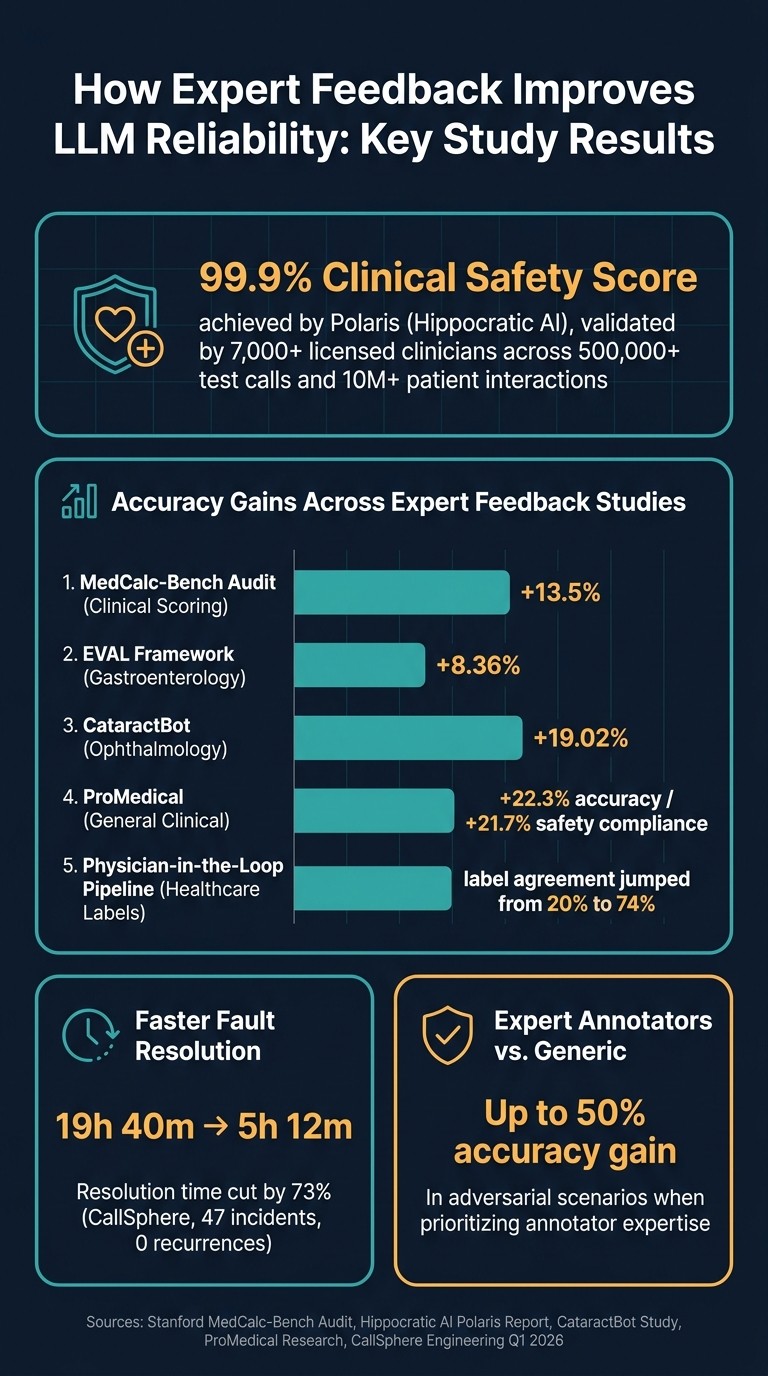
Expert Feedback Impact on LLM Accuracy: Key Study Results
Key Studies and Findings
In healthcare, a Stanford University audit of MedCalc-Bench, a well-regarded clinical benchmark, uncovered a surprising issue: 27% of the original test labels were incorrect. When a physician-in-the-loop pipeline was introduced, label agreement with physician ground truth jumped from 20% to 74%. Training on these corrected labels further boosted performance by 13.5 percentage points.
Junze (Tony) Ye from Stanford Graduate School of Business highlighted the risks of unchecked errors:
“LLM-assisted benchmarks can propagate systematic errors into both evaluation and post-training unless actively stewarded.”
These insights are not confined to research - they are backed by real-world applications.
Case Studies of Expert Feedback Loops
From April to September 2024, Sankara Eye Hospital in Bangalore tested CataractBot, a chatbot designed to assist cataract surgery patients. Over 24 weeks, 7 experts reviewed nearly 2,000 messages, improving the chatbot’s answer accuracy from 65.6% to 84.6%, all without retraining.
In another example, Hippocratic AI reported on Polaris, their system built for patient-facing care, in February 2026. Polaris, validated by over 7,000 licensed clinicians across more than 500,000 test calls , was deployed in over 10 million patient interactions. The results? A 99.9% clinical safety score and a 50% reduction in automatic speech recognition (ASR) errors compared to standard enterprise systems. Subhabrata Mukherjee from Hippocratic AI explained their approach:
“Treating interaction intelligence (tone, pacing, empathy, clarification, turn-taking) as first-class safety variables, we drive measurable gains in safety, documentation, [and] task completion.”
Measuring the Impact
Expert feedback doesn’t just enhance accuracy - it also speeds up fault resolution. The table below highlights measurable improvements across various frameworks:
| Study / Framework | Domain | Measurable Impact |
|---|---|---|
| MedCalc-Bench Audit | Clinical scoring | +13.5% accuracy via expert-corrected labels |
| EVAL Framework | Gastroenterology | +8.36% accuracy via expert-aligned rejection sampling |
| CataractBot | Ophthalmology | +19.02% accuracy over 24-week deployment |
| ProMedical | General clinical | +22.3% accuracy; +21.7% safety compliance |
| Polaris | Patient-facing care | 99.9% clinical safety score; 50% reduction in ASR errors |
Another compelling example comes from CallSphere’s engineering team. In Q1 2026, they introduced a structured “trace → reproduce → fix” workflow for their voice and chat agents. Over 47 incidents, they added 41 regression cases, cutting resolution time from 19 hours and 40 minutes to just 5 hours and 12 minutes. Even better, none of these bugs recurred.
These results underline an important takeaway: expert feedback doesn’t just improve the quality of model outputs - it also shortens the time it takes to identify and address failures in production.
How Expert Feedback Improves LLM Reliability
Improving Data and Label Quality
When labels are inaccurate, model performance suffers. Expert corrections can directly address these issues, significantly enhancing outcomes. In fact, prioritizing annotator expertise can improve model accuracy by up to 50% in adversarial scenarios. Ignoring annotator reliability risks introducing noise from less trustworthy sources, undermining the model’s effectiveness.
Experts also play a key role in establishing clear evaluation metrics, such as “accuracy” and “safety.” By creating measurable and repeatable standards - often through evaluation contracts like explicit grading rubrics with defined weights and pass thresholds - they transform vague goals into actionable benchmarks. This structured approach lays the groundwork for better monitoring and evaluation during production.
Improving Observability and Evaluation
Expert feedback isn’t just about training; it also shapes how models are monitored post-deployment. When experts develop evaluation rubrics and annotate real-world production traces, they help engineering teams pinpoint failures and understand their root causes more effectively.
This is where observability platforms shine. Tools like Latitude - an AI observability platform - are designed to track, flag, and evaluate production issues. These platforms identify failure patterns in real-world traffic, send problematic traces to annotation queues for expert review, and even generate evaluations based on these insights. As Harrison Chase, CEO of LangChain, explains:
“In software, the code documents the app; in AI, the traces do.”
If traces act as the “documentation” for an AI system, then expert-reviewed traces are like carefully proofread documentation, catching potential issues before they affect users.
Refining Models Through Feedback
Once data quality and monitoring systems are in place, expert feedback becomes a powerful tool for refining model behavior. By leveraging expert-annotated data and robust observability, teams can iteratively enhance performance through methods like:
-
Supervised Fine-Tuning (SFT): Expert-corrected examples directly update model weights.
-
Reinforcement Learning from Human Feedback (RLHF): Expert rankings train a reward model that guides further learning.
The table below highlights common feedback methods and their use cases:
| Feedback Method | Primary Goal | Data Type | Scalability |
|---|---|---|---|
| Rating/Scoring | Benchmarking | Quantitative (1–5, binary) | High (can be automated) |
| Iterative Review | Correction/Improvement | Qualitative (edits, comments) | Low (requires expert time) |
| Preference Ranking | Reward model training | Comparative (A vs. B) | Medium |
| Span-level Feedback | Fine-grained tuning | Highlighted text segments | Medium |
High-quality annotations enable teams to apply these methods effectively. For example, asking experts to label at least 20 diverse examples in an annotation queue can help align LLM prompts and identify common failure points early. This small, cost-efficient step enhances evaluation accuracy while keeping processes scalable.
Best Practices for Collecting Expert Feedback
Set Clear Reliability Goals
Before seeking expert feedback, it’s crucial to define what “good” means for your specific use case using prompt engineering principles. Many teams struggle to create clear quality standards, as domain experts often rely on intuition rather than concrete definitions to evaluate output quality.
To tackle this, hold structured discussions with subject matter experts (SMEs) and review real-world model failures instead of relying on abstract definitions. Analyzing actual mistakes helps uncover implicit standards, which can then be translated into measurable criteria for a clear evaluation rubric. Think of this process as creating an evaluation contract - a document outlining what is being assessed, how judgments are made, and how scores contribute to final decisions.
As the product evolves, revisit these evaluation contracts. SME roles often shift over time, from designing criteria in the early stages to scoring outputs at scale and eventually auditing rubrics to ensure they still reflect current definitions of quality. With well-defined goals in place, use a structured schema to consistently capture expert insights.
Build Structured Annotation Schemas
A well-designed annotation schema not only organizes feedback but also helps identify errors that might otherwise go unnoticed. For example, research on scholarly Q&A systems revealed 20 distinct error patterns across seven categories once a structured expert-derived schema was implemented. Without such a framework, subtle issues like nuanced hallucinations, citation errors, or chronological misrepresentations can easily slip through the cracks.
To ensure consistency, include anchor examples for every scoring level and provide complete execution traces so reviewers have the context they need. Evaluating a single response in isolation can lead to misjudgments, as surrounding information often plays a critical role.
“The central challenge in post-training today is the faithful encoding of expert requirements into the evaluation itself.” - Tadhg Looram et al., PortexAI
Cost is another important consideration. If you’re using model-based juries for evaluation, compact model juries can cut costs to around 4.2%–5.6% of frontier model expenses. However, they tend to show higher internal disagreement (28.7%–32.4% split rate compared to 6.1%–11.5% for frontier juries). Understanding this tradeoff can help you decide when human expert reviews are worth the additional expense.
Use Observability Platforms to Integrate Feedback
Isolated feedback collection doesn’t scale effectively. The key is integrating expert reviews directly into your production environment, ensuring that real-world failures - not randomly sampled outputs - drive the annotation process.
Platforms like Latitude excel in this area. Latitude automates the identification of failure modes, groups similar issues, and routes them to annotation queues for expert review. It also generates evaluations based on actual production problems rather than synthetic benchmarks. For instance, in April 2026, Boldspace’s CEO Dan shared that adopting Latitude’s observability and evaluation loop for their smart kitchen devices led to a 4% boost in conversions and a 56% increase in their custom “average vibe” quality metric. This shift from generic logs to a reliability loop grounded in real failures made all the difference.
To maximize the impact of expert feedback, integrate annotations directly into your CI/CD pipelines. This ensures that identified failures automatically become test cases, blocking deployments when regressions occur. Pair this approach with alignment metrics like the Matthews Correlation Coefficient (MCC), which measures how well automated evaluators align with human judgment. Over time, this creates a feedback loop that becomes increasingly precise without demanding significantly more expert hours.
Design Patterns for Expert-in-the-Loop Systems
The way experts provide feedback can vary significantly, and the timing and method of their involvement have a direct impact on both the safety and efficiency of a system. Here, we’ll break down three key patterns that are particularly useful, each tailored to different operational needs.
Offline Expert Feedback Loops
This approach involves experts periodically reviewing logged production traces to identify failure patterns. These patterns are then converted into automated regression tests, which are integrated into the CI/CD pipeline. The major advantage here is scalability - experts focus only on the most relevant traces rather than sifting through every output. Over time, this process builds a robust library of test cases, allowing automated evaluators to improve and ensuring that past errors are addressed and prevented in the future.
“Evals encode the behavior we want our agent to exhibit in production. They’re the ‘training data’ for harness engineering.” - Vivek Trivedy, LangChain
While this method is highly effective for long-term improvements, it’s not suitable when immediate validation is required.
Real-Time Expert Escalation
In high-stakes scenarios, immediate human intervention is essential. For example, when an LLM is about to perform an irreversible action - such as deleting production data, executing a financial transaction, or sending out a legally sensitive message - a human must intervene before the action is carried out.
The key difference here lies in the system’s architecture. Simply instructing the model to “ask for permission” isn’t enough. Instead, there must be a structural safeguard - a gate that prevents any action until it has been explicitly approved by a human.
“‘We told it to ask permission’ is not the same as ‘it cannot act without permission.’ The first is an instruction. The second is an architectural constraint.” - Cordum Governance Guide
Real-time escalation systems often use a dispatcher or Safety Kernel to hold tasks until they’ve been reviewed and approved. This enforcement mechanism exists outside the model itself, ensuring that no prompt injection or model drift can bypass it. To prevent reviewers from becoming overwhelmed and rubber-stamping approvals, only high-stakes actions - like transactions over $10,000, destructive database changes, or flagged low-confidence outputs - should require human intervention.
Observability-Driven Feedback Workflows
Both offline loops and real-time escalation depend on identifying the right traces for review. Randomly sampling outputs wastes time, while centralized logging and anomaly detection help surface the most critical traces. This ensures experts focus their attention on novel or high-risk issues.
Platforms like Latitude take this concept even further. They automatically cluster failure modes and route them into annotation queues, saving experts from manually combing through logs. Latitude also generates evaluations directly from production failures, keeping the evaluation suite aligned with real-world behavior rather than synthetic benchmarks. As Harrison Chase, Co-founder and CEO of LangChain, explains:
“In software, the code documents the app; in AI, the traces do.”
Here’s a comparison of these three patterns in practice:
| Pattern | Safety Level | Throughput | Ideal Use Case |
|---|---|---|---|
| Offline Feedback Loop | Moderate | High | Long-term model improvement, regression testing |
| Real-Time Escalation | Highest | Lower | Irreversible actions, high-stakes decisions |
| Observability-Driven | Moderate–High | High | Continuous improvement, surfacing unknown failure modes |
Most teams find that a combination of all three patterns works best. Offline loops help with systematic improvements, real-time gates safeguard high-risk actions, and observability tools ensure experts focus on the most important issues. Together, these strategies enhance the reliability of LLMs while prioritizing safety in production environments.
Conclusion: Expert Feedback as a Foundation for Reliable LLMs
Creating reliable LLMs hinges on incorporating domain expert feedback to turn failures into actionable insights. This “expert-in-the-loop” method ensures feedback aligns with the specific needs of an application, allowing teams to identify failures more effectively, make confident updates, and create evaluation suites that genuinely define what “good” means.
Experts bring attention to subtle failures that generic metrics - like “helpfulness” or “coherence” - often miss. For instance, a domain expert analyzing production traces might notice an agent repeatedly mixing up product variants. These insights can then inform automated judges, calibrated against expert-validated ground truths, to scale this understanding across thousands of outputs.
The table below highlights how expert feedback plays a role at each stage of the LLM lifecycle:
| Evaluation Stage | Role of Expert Feedback | Long-Term Impact |
|---|---|---|
| Early Development | Defining “what good looks like” | Sets the foundation for quality standards |
| Production | Annotating failure clusters | Identifies edge cases for more robust test suites |
| Model Iteration | Regression testing with validated criteria | Prevents recurring bugs in future versions |
| Scaling | Calibrating LLM-as-judge | Enables precise, large-scale monitoring |
The practical approach is clear: focus on high-impact failure clusters rather than random sampling, use structured rubrics for consistent annotations, and integrate every expert-reviewed trace into your evaluation datasets. Tools like Latitude streamline this workflow by surfacing failure modes, routing them for expert annotation, and generating evaluations directly from real-world production issues instead of relying solely on synthetic benchmarks.
Expert feedback is not just a one-time solution - it’s a continuous process that strengthens evaluation, fine-tunes automated judges, and builds confidence in deployment. Teams committed to building dependable LLM-powered products don’t stop at observing failures - they turn every misstep into a safeguard for the future.
FAQs
When do I need domain experts vs. regular reviewers?
Domain experts play a key role when precision hinges on specialized knowledge, safety protocols, or meeting regulatory standards. Their insights are crucial for evaluating complex, field-specific outputs that general reviewers might struggle to assess effectively. Leveraging their expertise ensures evaluations are both thorough and accurate in these high-stakes scenarios.
How many experts are needed to improve reliability?
Usually, having 2–3 domain experts review high-impact failure clusters is sufficient to develop effective evaluation criteria and improve reliability. By concentrating on specific failure modes rather than random samples, efforts are directed toward making more precise and meaningful improvements.
How do I turn expert feedback into regression tests?
To transform expert feedback into regression tests, start by gathering data on production failures. Then, classify the different types of failure modes and use these classifications to create evaluators. Experts play a key role by analyzing traces, identifying failure categories, and outlining what ideal behavior should look like. With this information, leverage tools to build automated evaluators and thoroughly check their accuracy. The final step is to integrate these evaluators into your CI/CD pipeline. This helps catch regressions early and ensures your model continues to perform well under real-world conditions.