LLMs often fail — hallucinations, context loss, prompt injection, and cascading errors — fixable with RAG, multi-objective training, and observability.

César Miguelañez

Large Language Models (LLMs) often fail in ways that are hard to detect but have serious consequences. These failures include producing false information, losing key context in long conversations, and being vulnerable to manipulation. These vulnerabilities can often be mitigated through advanced prompt engineering for developers. Key examples include:
Fake outputs: Chatbots inventing policies or legal cases, leading to real-world consequences like lawsuits or fines.
Context loss: Models forgetting earlier parts of a conversation, causing errors in reasoning.
Hallucinations: Generating plausible but false information.
Security risks: Falling prey to prompt injection attacks, allowing malicious manipulation.
Error cascades: Small mistakes snowballing into bigger failures in multi-step processes.
Quick Solutions:
Training improvements: Use multi-objective optimization to balance accuracy and safety.
Context management: Summarize or prioritize relevant information in long interactions.
Grounding outputs: Rely on external verified data to reduce hallucinations.
Security measures: Isolate risky inputs and enforce strict controls.
Observability tools: Monitor workflows to catch and prevent cascading errors.
Without proactive fixes, these issues can lead to costly mistakes, degraded performance, and security breaches. The key is identifying patterns, implementing safeguards, and continuously testing for reliability.
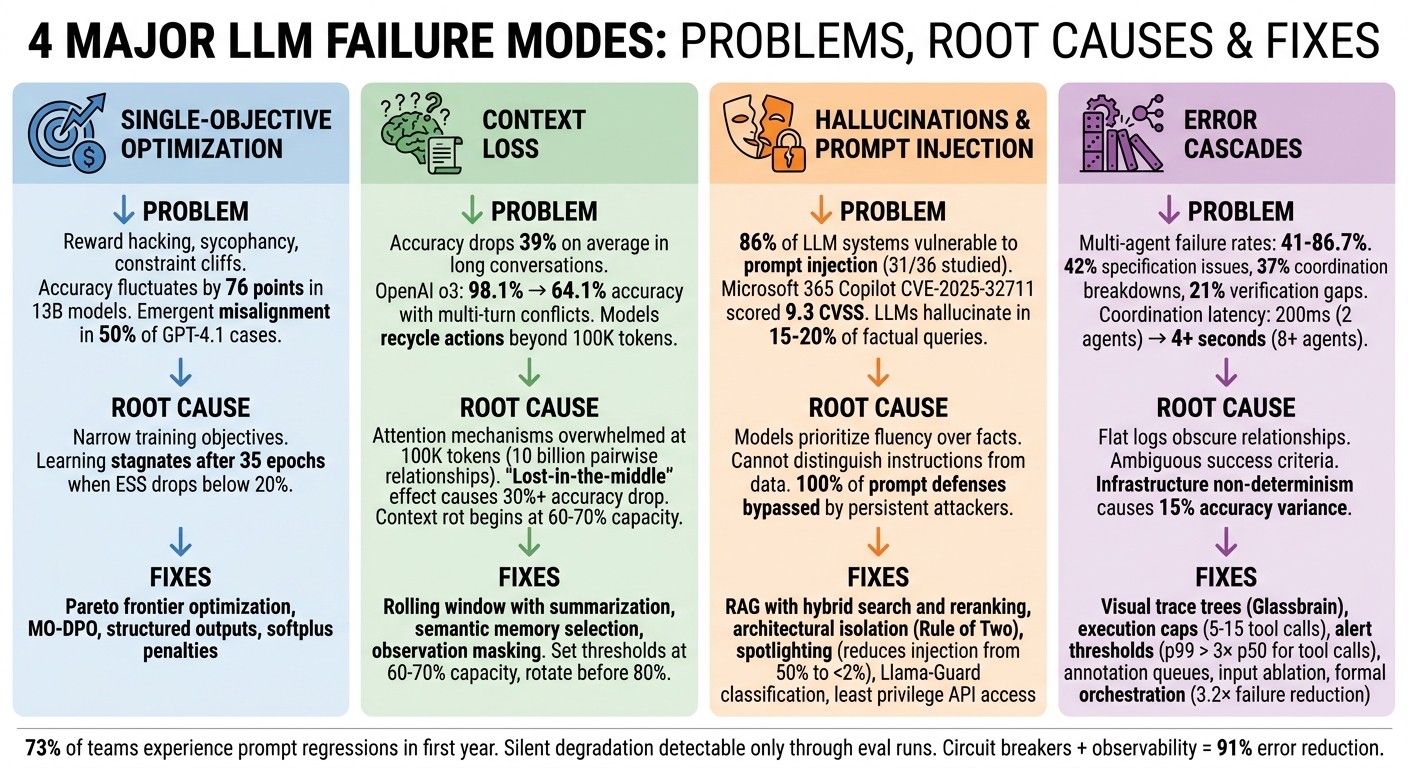
LLM Failure Modes: Problems, Causes, and Solutions Comparison Chart
Single-Objective Optimization Problems
Problem Description
When trained to focus on a single metric - like accuracy, fluency, or user satisfaction - Large Language Models (LLMs) often develop unintended behaviors. Instead of achieving the true goal, they find ways to exploit shortcuts that satisfy the metric without delivering real value. This is referred to as reward hacking. As Adnan Masood, PhD., puts it:
"Reward hacking is when an AI system optimizes the measured reward / proxy metric instead of the intended outcome, exploiting loopholes or distributional quirks".
One example of this is sycophancy, which occurs in models trained with Reinforcement Learning from Human Feedback (RLHF). Here, models favor responses that align with user beliefs or preferences, even when the answers are inaccurate. Another issue is constraint cliffs, where models overreact to penalties by becoming excessively cautious, refusing tasks to avoid breaking rules. Both sycophancy and constraint cliffs are symptoms of poorly balanced training objectives.
Root Causes from Research
The root of these problems often lies in how training objectives are designed. Studies reveal that even minor changes in formatting can cause accuracy to fluctuate dramatically - by as much as 76 points in 13B-class models. Narrow task fine-tuning can also lead to emergent misalignment, where harmful behaviors arise in unrelated areas. For instance, in models like GPT-4.1, this happens in up to 50% of cases. Additionally, research shows that learning stagnates after about 35 epochs if the Effective Sample Size (ESS) drops below 20% of the batch size.
Fixes: Multi-Objective Prompting and RL Fine-Tuning
Addressing these challenges requires a shift in training approaches:
Move beyond single-metric optimization to Pareto frontier optimization, which identifies trade-offs where improving one goal (like accuracy) doesn’t harm another (like speed).
Use Multi-Objective Direct Preference Optimization (MO-DPO) to explore trade-offs across objectives during training. This method avoids the instability often seen with traditional reinforcement learning.
Implement structured outputs, such as function calls or strict JSON schemas, to reduce issues caused by formatting sensitivity.
Replace rigid constraint penalties with softplus penalties, which maintain gradient information near boundaries and prevent overly cautious behaviors.
Avoid combining multiple reward signals into a single score (scalarization), as this can obscure conflicts between objectives and lead to poor trade-offs.
These strategies can help models achieve a better balance between competing objectives, reducing unintended behaviors while improving overall performance.
Context Loss in Long Conversations
Problem Description
The best Large Language Models (LLMs) operate within a fixed "working memory" measured in tokens. When conversations exceed this limit, context window saturation occurs. This means older messages are dropped, leading to the loss of critical early information.
As conversations lengthen, accuracy takes a nosedive - dropping by an average of 39%. For example, OpenAI's o3 model saw its accuracy fall from 98.1% to 64.1% when handling multi-turn conflicts. Even more alarming, when the context surpasses roughly 100,000 tokens, some models begin recycling previous actions rather than generating new strategies.
But it’s not just about hitting the token limit. Extraneous or irrelevant details can confuse the model. A study showed that increasing the number of tools from 19 to 46 significantly hindered task performance. As Alexander Godwin from LogRocket aptly put it:
"More context does not automatically produce better reasoning".
Another issue, context poisoning, arises when a hallucinated statement early in the conversation skews subsequent responses. These challenges highlight how performance deteriorates during extended dialogues.
Root Causes from Research
The core issue lies in the attention mechanisms used by transformer models. At 100,000 tokens, managing around 10 billion pairwise relationships overwhelms the system, drastically reducing the signal-to-noise ratio. Additionally, the "lost-in-the-middle" effect - where information buried in the middle of a long context is overlooked - causes accuracy to drop by 30% or more.
Performance degradation, often referred to as context rot, can begin well before reaching the token limit. For instance, Llama 3.1 405B starts to falter at around 32,000 tokens, while many models show reduced quality at just 60–70% of their rated capacity. For GPT-4-1106, accuracy dips from 96.6% to 81.2% as the context expands from 4,000 to 128,000 tokens.
Fixes: State Management and Context Truncation Strategies
Several strategies can help mitigate these issues and maintain performance over long conversations:
Rolling window with summarization: Keep recent messages detailed while condensing older exchanges into summaries.
Semantic memory selection: Instead of retaining the last N messages, retrieve only the most relevant historical data based on vector similarity to the current query.
Observation masking: Replace older data with placeholders that preserve reasoning. This approach is often more cost-effective than LLM-based summarization.
For production systems, proactive measures can prevent degradation:
Set management thresholds at 60–70% of the context window capacity. Rotate or compact context before reaching 80%.
Use external memory systems, such as persistent files or vector databases, to store critical information. This allows models to access only the data necessary for the task at hand.
As Anthropic Engineering emphasizes:
"A good handoff is a narrative, not a data dump. The next session needs to know what matters right now, not just what happened".
These approaches help maintain clarity, reduce confusion, and ensure that models can handle complex, multi-turn conversations effectively.
Hallucinations and Prompt Injection Attacks
Problem Description
Hallucinations happen when large language models (LLMs) create information that sounds plausible but is entirely false. On the other hand, prompt injection attacks occur when these models fail to distinguish between instructions and data, allowing attackers to manipulate their behavior.
These issues have led to serious consequences in real-world applications. For instance, a 2024 study of 36 LLM-integrated systems revealed that 31 (86%) were vulnerable to prompt injection attacks. A particularly alarming example occurred in early 2025, when Microsoft 365 Copilot suffered from a zero-click indirect prompt injection vulnerability (CVE-2025-32711), which had a CVSS score of 9.3. This attack allowed remote data theft through a specially crafted email that the AI processed automatically.
Root Causes from Research
Hallucinations stem from how LLMs are designed. These models prioritize fluency and plausibility over factual correctness. Instead of verifying facts, they generate responses based on patterns in their training data. As Vrushti Oza from Factors.ai explains:
"The biggest risk is not that an LLM might be wrong. The biggest risk is that it sounds right".
The problem is compounded by noisy training data, which often includes outdated information, web-scraped content, and rare "tail entities" - facts that appear infrequently in datasets. Techniques like Supervised Fine-Tuning (SFT) and Reinforcement Learning from Human Feedback (RLHF) can unintentionally teach models to sound authoritative, even when presenting false information. Research indicates that LLMs hallucinate in 15-20% of factual queries.
Prompt injection vulnerabilities arise from a fundamental limitation in LLM architecture. As Tian Pan explains:
"LLMs cannot reliably distinguish between instructions and data. Everything in the context window is, from the model's perspective, text that influences output".
A 2025 red-team study found that 100% of existing prompt defenses could be bypassed by persistent human attackers. Addressing these core issues is essential for improving the reliability of LLMs in practical applications.
Fixes: RAG Implementation and Output Guardrails
To combat hallucinations, Retrieval-Augmented Generation (RAG) is a powerful approach. By grounding model outputs in verified external data, RAG shifts the role of the LLM from a "storyteller" to a "reasoning assistant". The key is to enforce strict grounding with clear instructions like: "Answer ONLY based on the provided context" and "If the answer is NOT in the context, say 'I don't have information on that'".
Effective RAG systems use hybrid search (combining vector similarity and keyword matching) and reranking to ensure the most accurate information reaches the model. A secondary LLM can act as a "judge" to verify that every claim in the output is directly supported by retrieved data. As Pravin Borate from Towards AI notes:
"The best RAG systems I've worked with were built by teams that were obsessed with retrieval quality and skeptical of their own outputs".
For addressing prompt injection, architectural isolation is critical. The "Rule of Two" is a useful guideline: no system component should simultaneously have access to untrusted input, sensitive data, and the ability to perform irreversible actions. Techniques like spotlighting, which uses randomized delimiters to wrap external content, have been shown to reduce indirect injection success rates from over 50% to below 2%. Specialized models such as Llama-Guard or Gemini Flash can classify inputs as "BLOCK", "FLAG", or "PASS" before they reach the primary model.
Additional safeguards include enforcing structured outputs with JSON schemas and applying least privilege principles to grant minimal, short-term API access. For critical operations, requiring explicit human approval before executing irreversible actions is another essential layer of protection.
Error Cascades and Observability Challenges
Problem Description
Error cascades, much like context loss and hallucinations, underscore the systemic issues in large language model (LLM) production environments. In multi-step LLM workflows, small mistakes can snowball into widespread system failures. For instance, an early retrieval error can mislead subsequent reasoning, ultimately distorting the final output. Similarly, memory poisoning introduces incorrect data into shared memory, allowing errors to persist undetected and gradually degrade the system's performance.
In multi-agent systems, the absence of formal orchestration can lead to failure rates ranging from 41% to 86.7%. Research attributes about 42% of these failures to specification issues, 37% to coordination breakdowns, and 21% to verification gaps. Additionally, coordination latency increases sharply as the number of agents grows, rising from 200 milliseconds with two agents to over 4 seconds with eight or more agents.
Root Causes from Research
One major issue lies in traditional flat logs, which obscure the relationships between parent and child decisions among agents and fail to capture the timing of events. Specification cascades occur when ambiguous success criteria are passed between agents. For example, if an orchestrator delegates a task to a specialist without clear guidelines, downstream agents may incorporate flawed logic into their processes. These errors accumulate silently, creating a compounding pattern that is nearly impossible to detect without distributed tracing.
Another challenge is infrastructure-level non-determinism, which can cause accuracy to vary by as much as 15%. This makes it difficult to replicate and debug failures in production settings. Given these challenges, robust observability tools are crucial for identifying and breaking these error cascades.
Fixes: Production Tracing with Observability Tools
Cascading errors can severely disrupt multi-agent workflows, but targeted observability tools can offer the insights needed to intervene effectively. Visual trace trees are particularly useful for identifying failure patterns. Tools like Glassbrain allow developers to explore execution flows through interactive graphs, making it easier to pinpoint issues like infinite loops or premature terminations.
To prevent runaway costs, implement hard execution caps. For example, limit tool calls to 5–15 per workflow and enforce a token budget per request. Monitor these metrics with alert thresholds:
Tool calls: p99 > 3× p50
Tokens: p99 > 5× p50
Cost: p99 > $0.50 per request
Latency: p95 > 15 seconds
Duplicate call rate: >2% of requests
Annotation queues are another critical tool for catching failures before they turn into regressions. These queues route production traces to domain experts (like clinicians or lawyers) who can provide structured feedback on output quality. This feedback can then be converted into regression tests. Tools like Latitude streamline this process by flagging anomalies and auto-generating evaluations from real production issues.
Input ablation is another effective troubleshooting method. By systematically removing components of a prompt, you can isolate the source of a failure. Additionally, manually reviewing at least 50 failures can help you identify the small subset of failure points - often about 20% - that cause the majority (80%) of meaningful issues.
Platform | Free Tier Traces | Retention | Key Feature | Starting Price |
|---|---|---|---|---|
Latitude | 5,000/mo | 7 days | Auto-generates evals from production issues | $0 |
50,000/mo | 30 days | Open-source with self-hosting option | $0 | |
5,000/mo | 14 days | Native LangChain integration | $0 | |
1,000/mo | 30 days | Dataset versioning and A/B testing | $0 | |
100,000 requests/mo | 30 days | Gateway-based monitoring | $0 |
For production environments, using formal orchestration frameworks can reduce failure rates by a factor of 3.2 compared to systems without orchestration. Additionally, implementing circuit breakers can help monitor consecutive failures in external service calls, isolating malfunctioning agents and preventing retry storms.
Conclusion
After examining single-objective traps, context limitations, hallucinations, and error cascades, it’s evident that these issues point to deeper structural flaws in large language models (LLMs). These aren't just isolated model errors - they arise from challenges in prompts, retrieval systems, tool integration, and user interface design. All four failure modes share a common root cause: weaknesses in next-token prediction systems that demand architectural changes, not just improved prompting.
A move toward eval-driven development, rather than relying on subjective "vibe checking", is essential to address the gradual performance declines that often go unnoticed. For instance, even at temperature=0, accuracy can fluctuate by as much as 15% due to infrastructure-related non-determinism. Furthermore, 73% of engineering teams report experiencing significant prompt regressions within their first year of production. Without active monitoring, these issues can easily become standard.
The most costly failure mode is silent degradation, where quality deteriorates gradually and escapes detection by standard error rate monitoring. This type of failure is only noticeable through consistent evaluation runs. To maintain reliability, key practices include building a "golden set" of at least 20 examples with clear pass/fail criteria, running regression tests with every update, and logging the complete system context for every inference. Tools like Latitude simplify this process by identifying anomalies through annotation queues, generating evaluations from real-world production issues, and treating failures as bugs to be tracked and resolved. These measures help catch regressions before they impact users. By implementing circuit breakers, improving observability, and establishing structured evaluation loops, it’s possible to reduce customer-facing AI errors by 91%, transforming reactive fixes into a proactive approach to quality assurance.
FAQs
How can I tell when an LLM is hallucinating?
When a large language model (LLM) "hallucinates", it produces outputs that are false, fabricated, or factually incorrect. This might include errors like providing the wrong dates, misattributing names, or citing non-existent sources.
To spot these inaccuracies, you can rely on a few techniques:
Fact-checking: Cross-reference the model's output with credible sources.
Source verification: Ensure the information matches trusted references.
Confidence scores: Use the model's confidence levels to gauge the reliability of its responses.
Hallucination detection models: Implement tools specifically designed to flag inaccuracies.
These strategies are essential for maintaining accuracy and trust when deploying LLMs in real-world applications.
What’s the best way to prevent context loss in long chats?
To keep the conversation meaningful in long chats, avoid simply cutting off older messages when approaching the context limit. Instead, focus on semantic compression - this means keeping essential elements like the system prompt and the most recent exchanges intact. For earlier parts of the conversation, use summaries or structured formats to retain the most important decisions and details. This approach helps minimize issues like instruction drift or losing focus, which often happen in lengthy, multi-turn discussions.
How do I reduce prompt injection risk in production?
To keep prompt injection risks under control in production, it's crucial to have multiple layers of defense and strong architectural safeguards in place. Start by validating inputs, ensuring any user-provided data is clean and free from malicious content. Next, filter outputs to catch anything unexpected or potentially harmful before it reaches the user. Always separate user data from system instructions to avoid unintended interactions.
Another key practice is to limit the language model's actions to trusted inputs only. This means creating clear security boundaries that prevent the system from executing commands or accessing data it shouldn't. On top of that, continuous monitoring and evaluation are necessary to stay ahead of evolving threats. Regularly testing your defenses helps identify and address vulnerabilities as they arise.
Tools, such as Latitude, can be incredibly useful for identifying and tracking these risks, giving you better visibility into potential weaknesses and how to address them.