
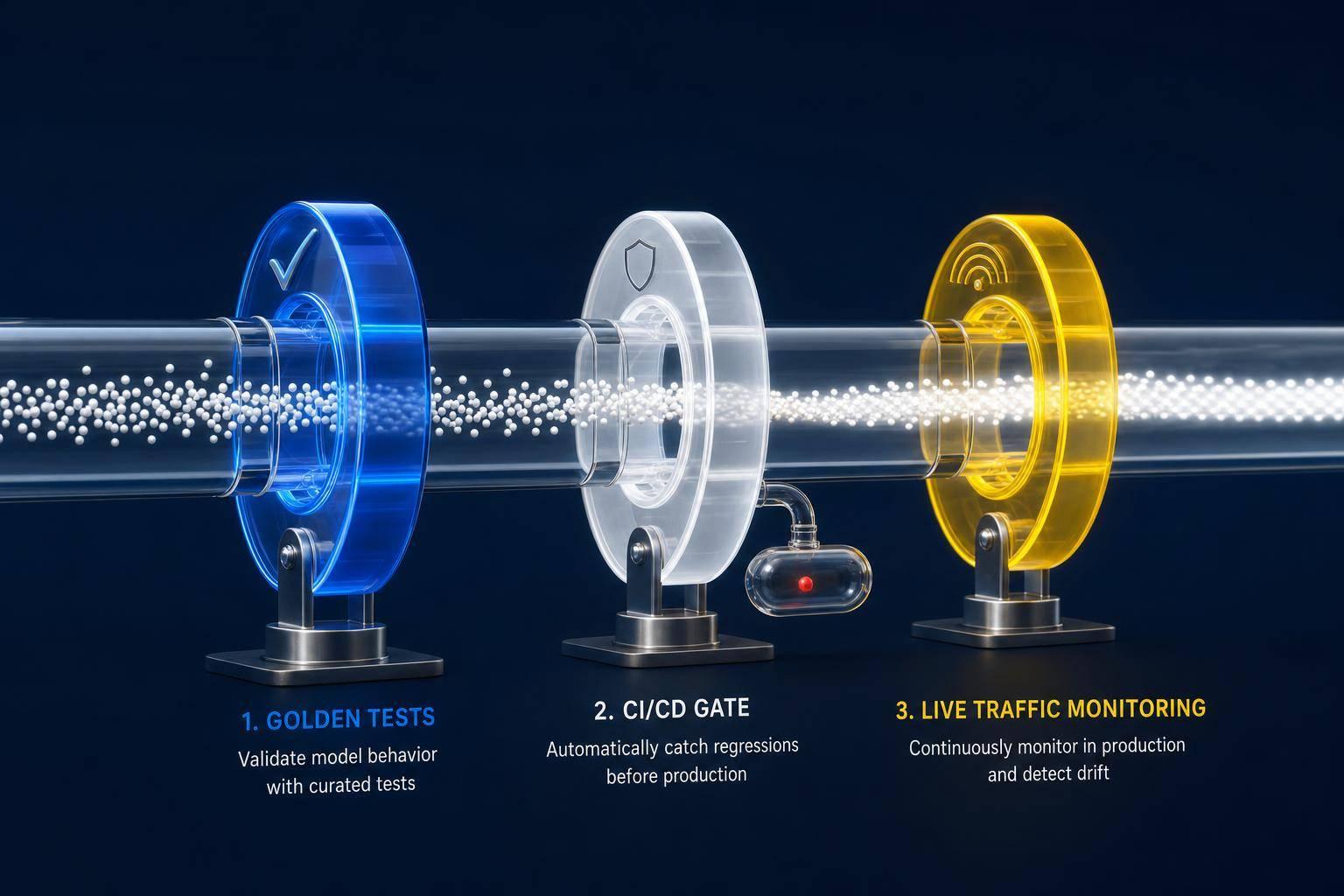
If I had to boil this down to one point, it’s this: benchmark scores do not keep an LLM system safe in production - behavior checks do.
When I read this piece, the main message was clear: if I want an LLM app to stay usable after launch, I need to test how it acts under normal traffic, bad inputs, prompt attacks, and live regressions. That means I should define the behaviors that matter, build a small reviewed test set from production traces, score outputs with the right checker, and use those checks in both CI/CD and production.
Here’s the short version:
-
Test behavior, not exact wording
-
Cover five areas: correctness, safety, groundedness, stability under input changes, and user experience
-
Turn every policy and past incident into a test
-
Build lean golden sets: about 50–100 reviewed cases for core paths
-
Run each case more than once: often 3 runs , sometimes 3–10
-
Use strict gates for severe failures: unsafe output and jailbreak success should be 0%
-
Sample live traffic after release: often 1%–5% , with deeper checks for high-risk flows
-
Feed production failures back into the suite
A few numbers stood out to me. The article says repeated runs can cut false alarms by about 60%. It also notes that 78% of AI agent failures are behavior regressions, not clean crashes. And for LLM judges, I should not trust them by default - I should compare them to human labels and look for about 80%–85% agreement first.
What I like about this approach is that it treats LLM quality like release control, not guesswork. Every bad output should become a future test. That is the loop : log it, label it, add it, and block it next time.
If I were putting this into practice today, I’d start with a small versioned golden set in Git, score structure with rules, score meaning with a pinned judge model, and block merges when the candidate branch slips against main.
| Area | What I’d check | Example gate |
|---|---|---|
| Correctness | Did the model finish the task? | Task success > 95% |
| Safety | Did it avoid harmful output? | 0% unsafe output |
| Groundedness | Did it stay tied to source context? | Hallucination rate < 2% |
| Input stability | Did minor wording changes break behavior? | Low variance across paraphrases |
| User experience | Was the response clear, on-tone, and the right length? | Rubric score above team threshold |
So in plain English: behavioral testing means checking whether the system acts the way you need it to act when people actually use it. And if I skip that, I’m not testing risk - I’m guessing.
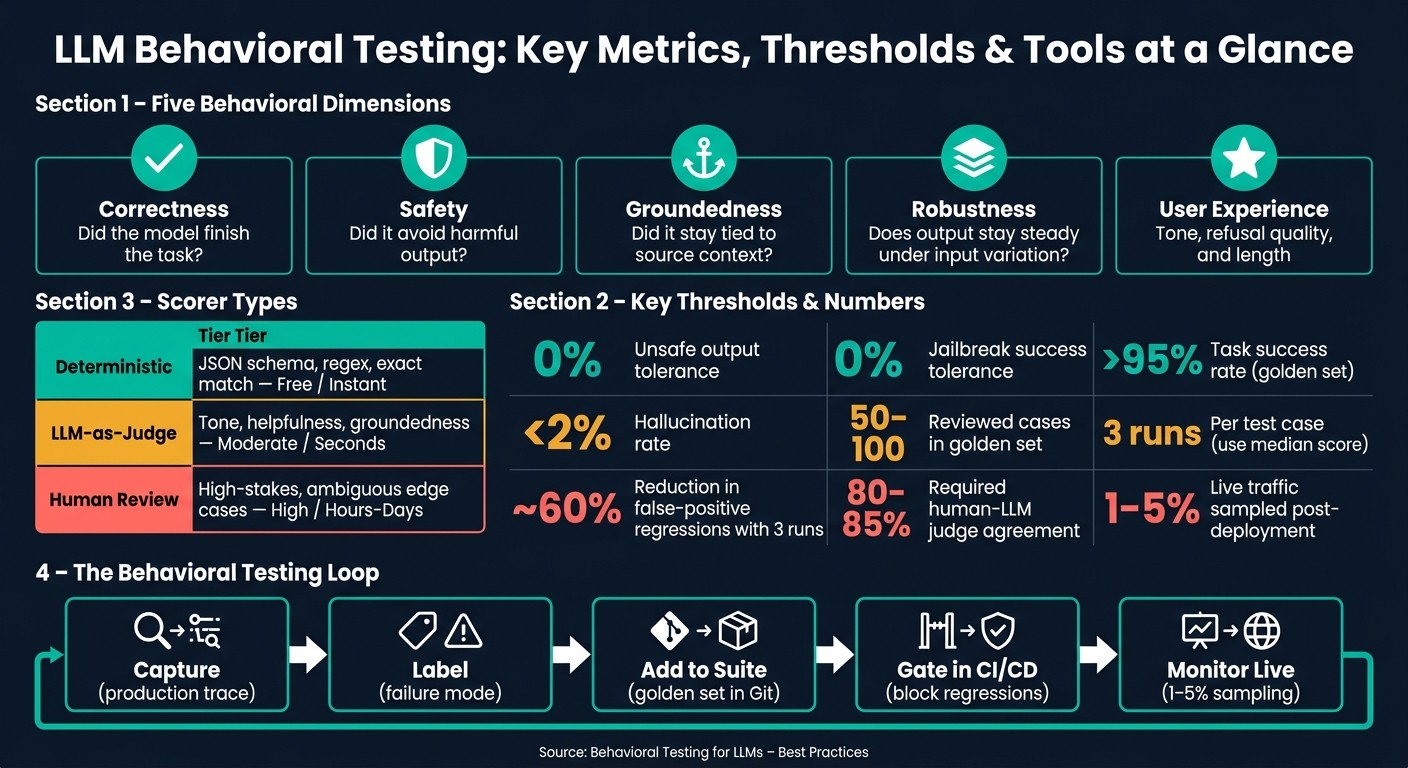
LLM Behavioral Testing: Key Metrics, Thresholds & Tools at a Glance
Define the behaviors you will test
Define behaviors based on what users need to experience in production before you write tests. If you skip that step, you end up vibe-testing on an AI engineering platform without clear benchmarks. And vibe-testing falls apart in production.
Core behavioral dimensions: correctness, safety, groundedness, robustness, and user experience
A solid place to start is to define behavior across five dimensions: correctness, safety, groundedness, robustness, and user experience.
Correctness checks whether the model finishes the job. If you build a summarizer, does it actually summarize?
Safety checks policy compliance. Does the model refuse harmful requests? Does it avoid dangerous output?
Groundedness matters most in RAG systems. Does the answer stay faithful to the retrieved context, or does it drift?
Robustness checks whether output stays steady when the input changes in ways that shouldn’t matter, like a typo or a color/colour spelling change.
User experience covers the feel of the response: tone, refusal quality, and length.
Use the right oracle for the right behavior. Deterministic checks work well for structure. LLM judges help with semantic traits. Human review makes sense for high-risk workflows. Then map each behavior to a severity band - Critical , High , Medium , or Low. Treat Critical failures, such as data leakage or illegal advice, as hard gates in CI/CD. Those oracles become the scoring base in the next section.
Turn policies and incidents into testable criteria
Your best source of test cases is usually already sitting in front of you: current policies and past production incidents. Map every policy and every incident to at least one test case. A failure in production shouldn’t stay a one-off. It should become a regression case.
A useful format is a four-field behavioral contract. It includes:
-
Input Class - for example, “authenticated users asking about pricing for SKU X”
-
Expected Behavior - defined as a property, not an exact string; for example, “response must include the catalog price in dollars”
-
Failure Budget - for example, <0.5% for safety issues or <3% for formatting issues
-
Test Oracle - the method used to verify the result, whether that’s a regex, an LLM-as-a-judge, or a human rubric
The failure budget is a business call, not just an engineering one.
For RAG systems, test retriever accuracy separately from generator groundedness so you can isolate the part that failed. The Air Canada case shows what happens when behavior goes untested: the airline was still liable for a chatbot’s invented refund promise. Every incident is a test case waiting to be written.
Next, turn these behaviors into test suites from real production traffic.
Build behavioral test suites from real production traffic
Policies tell you what to test. Production traces show you how things break in practice.
That’s why the best behavioral test suites start with real traffic. Use those traces to build a lean set of normal cases, adversarial cases, and replay cases. The goal is to cover live regressions, jailbreaks, and grounding failures across the five behavioral dimensions from the previous section.
Use golden sets, edge cases, adversarial prompts, and production regressions
Build the suite from four case types:
-
real production samples
-
adversarial coverage, including jailbreak attempts and prompt injection
-
edge cases, such as multilingual inputs, ambiguous phrasing, and malformed requests
-
failure replays
Lean hardest on real production samples. Then layer in adversarial, edge, and replay cases. This lines up directly with correctness, safety, groundedness, robustness, and user experience.
A focused golden dataset of 50 to 100 reviewed examples is enough to cover critical paths and known failure modes. Keep it tight. If several failures look alike, cluster them and keep just one or two stand-ins. An oversized suite takes longer to run, costs more, and becomes a pain to maintain.
Before you add any production trace, redact PII and swap live IDs for placeholders. Store inputs and labels in Git next to your application code so scores stay comparable over time, and so you can tell whether a shift came from a model regression or a dataset change.
When you score failures, grade the failure class , not the exact bad output. Say a tool call hallucinated a bad argument. In that case, write a scorer that checks whether the tool argument is valid. That way, new versions of the same failure still get flagged without extra work.
From there, score each case with the cheapest oracle that can catch the issue.
Score behavior with rules, semantic checks, LLM judges, and human review
Deterministic scorers, like regex, JSON schema validation, and field presence checks, work best for hard constraints such as output format. Semantic checks and LLM-as-a-judge are better for qualities like groundedness, tone, and helpfulness. Human review should be saved for high-stakes decisions or outputs that are honestly hard to judge.
| Scorer Type | Best For | Cost / Speed |
|---|---|---|
| Deterministic | JSON schema, regex, exact match, field presence | Free / Instant |
| LLM-as-Judge | Tone, helpfulness, groundedness, reasoning | Moderate / Seconds |
| Human Review | High-stakes decisions, ambiguous edge cases | High / Hours–Days |
That order helps you decide what belongs in CI and what should run in sampled production evaluation.
A calibrated LLM judge can line up closely enough with human labels for many release gates. But don’t just assume it’s good enough. Test it on a sample set against human labels first, and make sure it reaches at least 80%–85% agreement. Also, pin the judge to a specific model snapshot, such as gpt-4o-2024-05-13, so provider updates don’t shift your scores behind the scenes.
Run each case 3 times and use the median score. That can cut false-positive regressions by about 60%. And for distributional checks, don’t stop at the mean. Watch the 5th percentile too. Trouble often shows up in the tail before it shows up in the average.
Offline vs. online behavioral testing: tradeoffs and when to use each
Start offline. Then add online sampling.
Offline testing runs against your curated golden set before deployment. It’s fast, predictable, and useful for blocking bad releases. Online testing runs against live traffic after deployment. That’s how you catch issues that only show up at scale or in odd corners your golden set missed.
| Offline| Online
—|—|—
When used| Pre-deployment (CI/CD gates)| Post-deployment (production)
Data source| Curated golden datasets| Live production traffic
Deployment risk| Low - prevents bugs from shipping| High - detects bugs already live
Cost| Predictable (fixed suite size)| Variable (scales with traffic sampling)
Speed| Fast (minutes)| Continuous (async)
Best-fit tools| Promptfoo, DeepEval, Braintrust| Langfuse, Helicone, Latitude
A 50–100 case golden set with tiered scoring gives you a solid CI gate. Once that’s working well, add online sampling, usually 1% to 5% of production traffic, to catch drift your golden set won’t show. Latitude can help here. It surfaces failure modes in production, tracks them like bugs, and auto-generates evals from live production issues so you can feed them back into your offline suite.
“A CI eval gate is only as honest as the golden set under it.” - FutureAGI
Offline testing stops known failures from slipping back in. Online testing finds the failures you didn’t know to look for, then turns them into the next batch of golden cases.
Run behavioral testing in CI/CD and production monitoring
Once the suite is in place, plug it into release gates and production monitoring. Behavioral tests are part of release control and incident response. They are not a one-and-done quality check.
Set up pre-deployment gates, canaries, and replay-based regression tests
Not every change needs the same test depth. Use GitHub Actions paths-filter so the full regression suite runs only when files in /prompts, /agents, or /tools change. For prompt, tool, or model-config updates, run a full regression suite of 100–700+ cases. These suites usually finish in 6–10 minutes.
For tool-calling logic, gate on tool-sequence scores. That way, you check whether the agent picked the right tools in the right order , not just whether the final answer sounded fine.
A tiny prompt change can do more damage than people expect. One word can shift tool use, refusal style, or business results.
CI gates should compare a candidate PR against the current main branch baseline instead of leaning only on a fixed score cutoff. Since LLMs are non-deterministic, run each case 3–10 times at temperature 0 and require a pass rate such as 9/10 , not a single yes-or-no result. In CI, block merges when scores slip. In production, alert on failed evals and send them to manual review.
| Change Type | Typical Regression | Recommended Gate Check |
|---|---|---|
| Prompt Edit | Broken tool calls, format shifts | Output quality (rubric-based) |
| Model Swap | Refusals, latent behavior shifts | Side-by-side comparison scores |
| Retrieval Change | Hallucinations, ungrounded claims | Faithfulness / relevance checks |
| Tool Logic | Loop runaway, wrong tool selection | Trajectory / sequence checks |
For shadow or canary deployments, run side-by-side scoring on the same production samples before a broad rollout. This matters a lot for model swaps. Stanford/Berkeley research found that GPT-4 accuracy on a specific task dropped from 84% to 51% over three months, even though the model name did not change.
Track production failures like incidents, not isolated bad outputs
Wire the versioned suite into CI, then use production monitoring to turn live failures into new tests.
A bad output that gets logged and ignored doesn’t help much. When production shows a failure, treat it like a new regression case. Capture the failing trace, label the failure mode, and add it to the regression suite.
The data backs this up: 78% of AI agent failures are behavioral regressions - like hallucinations or wrong answers that look successful - rather than clean errors or timeouts. Plain uptime and error-rate monitoring won’t catch that kind of failure, so behavioral monitoring has to sit on top of those system checks.
Monitor 100% of guardrail trips and negative feedback , and sample 5%–10% of high-risk workflows for deeper evaluation. Latitude helps here. It surfaces failure modes in production and automatically generates evals from real issues so they flow back into the offline suite.
Document governance, compliance, and review workflows
Release gates only work if the approval trail is clear. Keep the test suite version, the score thresholds used, who approved the release, and any exceptions granted with each release decision. That ties governance straight to the release gate instead of treating it as a separate compliance step.
For regulated use cases, document the boundaries and the points where a human must review a response. Your CI gate should test those boundaries directly, not just broad response quality.
Security review should also cover the updated OWASP Top 10 for LLMs, including System Prompt Leakage, Vector Weaknesses, and Unbounded Consumption. These are standard attack surfaces, not edge cases.
Store approval records with the test suite so each model version has a clear release rationale.
Tools, metrics, and a practical stack for production teams
Once your tests and monitors are set up, the next call is tooling: what logs failures, what scores them, and what stops a release.
Compare Latitude, LangSmith, Langfuse, Braintrust, and Helicone
Each platform serves a different part of the behavioral testing loop. The right pick depends on how you handle traces, release gates, and data control.
| Platform | Primary Focus | Behavioral Test Suites | Regression Testing | Online Monitoring |
|---|---|---|---|---|
| Latitude | Surfacing failure modes & issue tracking | Auto-generated from real issues | Bug-tracking style | Issue clustering from traces |
| LangSmith | LangChain/LangGraph dev loop | Prompt Hub & Playground datasets | Side-by-side experiments | Online evaluators |
| Langfuse | Open-source observability | Manual/SDK-based evals | Versioned prompt tests | OTel-native session threading |
| Braintrust | Eval-first CI/CD workflows | Eval-as-code with structured scorers | PR-blocking gates | Production sampling |
| Helicone | Gateway proxy & cost control | Replay/experiments | Post-hoc what-if analysis | Proxy-level cost & latency |
A simple way to think about it:
-
Braintrust works well for CI gates
-
Langfuse fits self-hosted observability
-
Helicone is strong for capture and replay
-
LangSmith fits LangChain-native workflows
-
Latitude helps turn live failures into regression tests automatically
After you choose a stack, lock in the small set of metrics that decides go or no-go.
Choose metrics that map to release decisions
Only track metrics that can change a release decision. Set unsafe-output and jailbreak-success thresholds to 0%. For quality checks like task success and groundedness, use continuous scores with clear minimums so you can spot drift before users do.
The table below maps common behavioral metrics to release decisions, using example thresholds from production evaluation guidance.
| Metric | Evaluation Method | Example Threshold | Suitable Tools |
|---|---|---|---|
| Task Success | LLM-as-judge / Human review | >95% on golden set | Braintrust, LangSmith |
| Unsafe Output Rate | Safety classifiers | 0% tolerance (strict) | Latitude, Langfuse |
| Jailbreak Success | Adversarial red-teaming | 0% tolerance (strict) | Latitude, Braintrust |
| Hallucination Rate | Groundedness evals | <2% of responses | Langfuse, LangSmith |
| Groundedness | NLI / citation verification | Continuous score >0.9 | Braintrust, LangSmith |
| Variance (Paraphrase) | Semantic similarity across runs | <0.1 std dev | Braintrust, Latitude |
| Latency (p95) | Gateway telemetry | <2,000 ms | Helicone, Langfuse |
| Cost per Request | Token attribution | <$0.05 average | Helicone, LangSmith |
Latency and cost belong in the same conversation as behavioral metrics. If a model gets slower or more expensive in production, that’s still a regression, even when the answers look fine.
With tools and metrics in place, the last piece is keeping the loop tight. Failures should become tests, and those tests should guard the next release.
Conclusion: Best practices that keep LLM behavior stable in production
Build your suites from real production traffic, enforce regression gates in CI/CD, and pair offline evals with online monitoring to catch what slips through. The pattern is simple: capture → label → add to suite → block regressions. Every production failure should become a labeled regression test.
FAQs
How do I start behavioral testing with a small team?
Start with a small golden dataset of 20 to 50 real-world examples. The best place to begin is with inputs that already broke things in logs or during manual testing. Those cases tend to show you where the weak spots are fastest.
Use that dataset for three core test types:
-
Minimum Functional
-
Invariance
-
Directional Expectation
Keep the first version manageable. Start with deterministic checks like JSON structure or response length before moving to heuristic scoring or LLM-as-a-judge. That gives you a simple, low-drama starting point.
You can run these tests in a basic CI/CD pipeline with pytest, then build from there over time.
What should go in my first golden dataset?
Your first golden dataset should be a versioned, curated set of input-output pairs pulled mostly from real production logs, not made-up examples. Start small: 25 to 50 cases is enough.
Include a mix of:
-
happy paths
-
edge cases
-
adversarial inputs
-
failure replays
Give each case a stable schema with:
-
an ID
-
the input
-
the expected behavior
-
scoring checks
If production logs are thin, use support tickets or customer emails instead. And if you add synthetic drafts, label them clearly so no one mistakes them for real user data.
How often should I update tests from production failures?
Update your test suite all the time. When something breaks in production and you didn’t see it coming, turn that failure into a new regression test. That way, you’re not just fixing the bug once - you’re making sure the same issue gets caught before the next release.
It also helps to review the suite at least once every quarter. Drop outdated tests that no longer fit your current product, or they’ll just add noise.
If your team uses Latitude , you can automate part of this workflow. It can surface production failure modes, track them as bugs, and generate new eval cases.