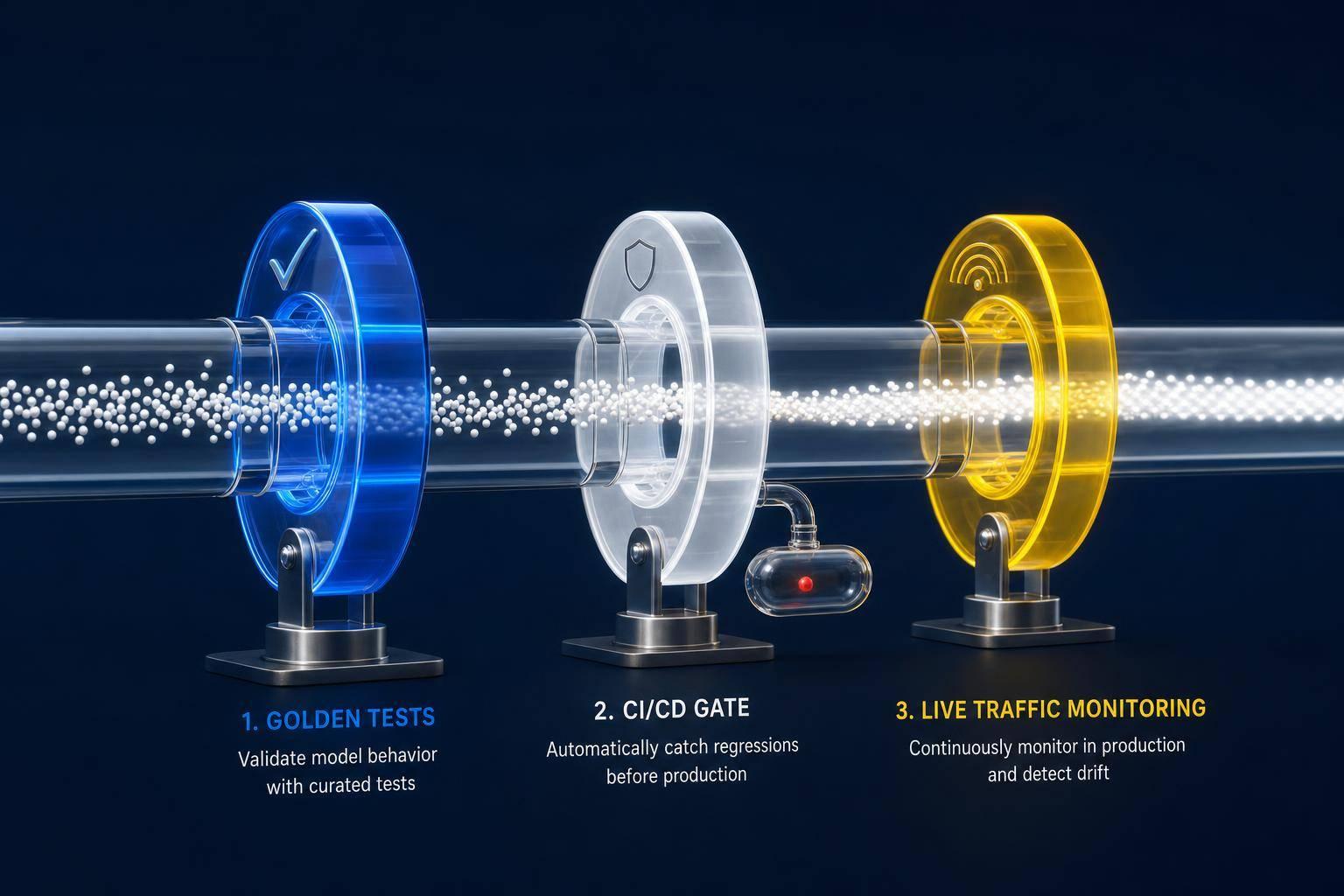
Human oversight catches subtle LLM failures—use approval gates, sampling audits, and feedback loops to prevent regressions.

César Miguelañez
Deploying large language models (LLMs) is only the beginning - keeping them reliable in production is the real challenge. Models can fail silently, producing confident but incorrect outputs, or degrade over time without triggering alerts. Automated systems often miss these subtle issues, which is why Human-in-the-Loop (HITL) workflows are critical.
HITL integrates human oversight into AI workflows to catch errors automation alone can't detect. From hallucinations (factually wrong but confident responses) to context loss in long conversations, HITL addresses common LLM failure modes by combining human judgment with automated tools.
Key workflows include:
Approval Gates: Human review for high-risk actions like payments or data deletion.
Sampling Audits: Random checks to monitor quality and detect drift.
Feedback Integration: Turning human corrections into training data for future improvements.
Platforms like Latitude, LangSmith, and Langfuse offer tools to implement HITL workflows, tailored to different needs like compliance, debugging multi-turn agents, or cost monitoring. For example, Latitude uses automated clustering to identify failure patterns using prompt engineering principles with minimal data, while LangSmith integrates seamlessly with LangChain ecosystems.
HITL workflows create a feedback loop that reduces errors, strengthens evaluation systems, and prevents costly mistakes. By blending human review with scalable automation, teams can maintain LLM reliability in production environments.
Core HITL Workflows for Debugging LLMs
Knowing when humans should intervene is just the beginning. The real challenge lies in creating workflows that effectively capture, use, and integrate human input back into the system.
Approval and Correction Gates
Approval gates act as checkpoints that pause an LLM agent before it performs irreversible actions, like sending emails, deleting data, or processing payments. Instead of proceeding automatically, these gates require a human to approve, reject, or modify the action.
To avoid unnecessary interruptions, use risk tiering to categorize actions into levels of required oversight:
Risk Tier | Approval Type | Example Actions |
|---|---|---|
Red | Always requires approval | Payments, external emails, data deletion |
Yellow | Conditional (threshold-based) | Edits exceeding a dollar limit, bulk updates |
Green | Fully automatic | Read-only lookups, internal summaries |
Limiting human intervention is crucial to prevent "approval fatigue." Aim to keep intervention requests to fewer than 10 per day.
When an approval gate is activated, capture the agent's full state - messages, tool calls, and context - until a human resumes the session. Implement soft timeouts (e.g., 15 minutes) and hard timeouts (e.g., 4 hours) to ensure sessions don’t stall indefinitely.
For more nuanced issues, such as quality or tone inconsistencies, sampling audits and drift monitoring come into play.
Sampling Audits and Drift Monitoring
Subtle problems, like a decline in quality or a shift in tone, often require targeted sampling audits. Instead of reviewing every output, teams can randomly or strategically sample responses and evaluate them using a checklist.
Specificity is key when designing checklists. Avoid vague questions like "Does this look good?" and instead focus on measurable criteria tied to risk levels, such as factual accuracy, policy adherence, or tone. A three-tier review model works well:
Low-risk outputs: Spot checks
Moderate-risk outputs: Factual verification
High-risk outputs: Dual human approval (e.g., for financial or legal content)
Drift detection focuses on identifying performance issues before users notice them. Automated tools can monitor outputs continuously, but human intervention should be triggered only when necessary - like when confidence scores drop, safety-sensitive topics arise, or the agent behaves anomalously (e.g., entering an infinite loop). This layered approach ensures human effort is concentrated where it matters most.
The insights gained from audits and drift monitoring feed directly into creating actionable training data.
Turning Human Feedback into Training Data
Every human correction provides a valuable training signal. Capturing this feedback in a structured way ensures it can be used effectively for future improvements.
Two primary feedback modes - Rating and Scoring, and Iterative Review - serve different purposes:
Feature | Rating and Scoring | Iterative Review |
|---|---|---|
Primary Goal | Measurement and benchmarking | Correction and improvement |
Data Type | Quantitative (binary, Likert scale) | Qualitative (natural language, edits) |
Scalability | High - easily automated | Low - requires expert time |
Best Use Case | Tracking trends and regressions | Debugging and fine-tuning edge cases |
Rating and scoring are ideal for monitoring long-term trends, while iterative reviews - where humans rewrite or correct outputs - generate more detailed signals for fine-tuning and addressing specific problems. For example, when a reviewer rejects a proposed action, providing a clear rejection reason (e.g., "threshold exceeded") helps guide the model to adjust its behavior.
The process comes full circle when these corrections are systematically converted into evaluation datasets and, when relevant, fine-tuning examples. This ensures that human reviews lead to lasting improvements, reducing the likelihood of repeated errors.
Platforms and Tools for HITL Debugging
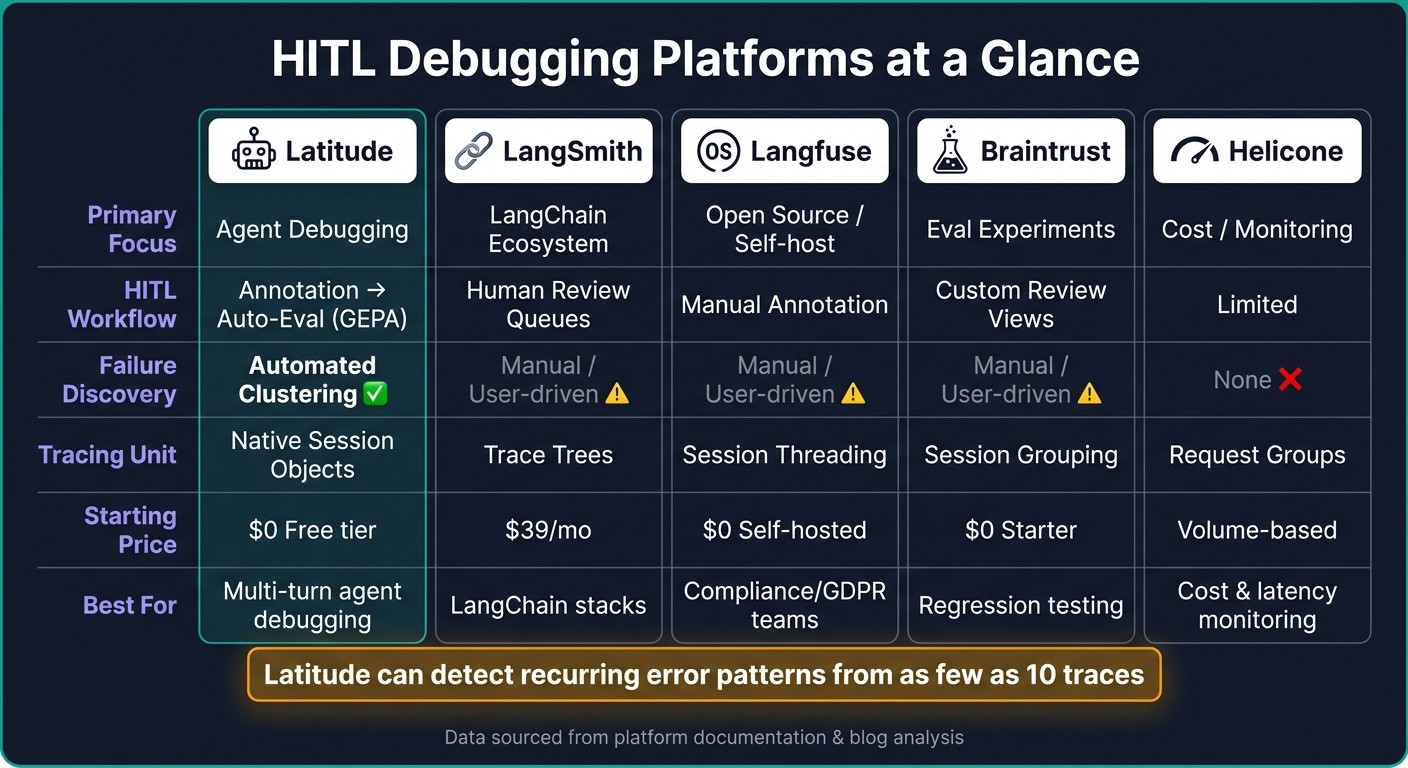
HITL Debugging Platforms Compared: Latitude vs LangSmith vs Langfuse vs Braintrust vs Helicone
Once you've designed HITL workflows, the next step is picking the right tools to implement them. Each platform has its own approach to human annotation, failure identification, and feeding insights back into evaluations. Let’s explore some of the key options.
How Latitude Supports HITL Debugging
Latitude takes a unique approach by letting real-world production failures shape your evaluation strategy. Instead of predefining failure modes, Latitude clusters user session traces to automatically uncover issues. Domain experts then annotate these clusters via structured queues, and the platform uses a specialized algorithm to generate evaluations.
Here’s what makes Latitude stand out: just 10 traces can reveal recurring error patterns. This means you can act quickly without waiting to gather large amounts of data. Latitude also analyzes entire multi-turn agent sessions, which is especially helpful for debugging complex behaviors.
Latitude offers three pricing tiers:
Free plan: $0/month, includes 5,000 traces and 500 scans monthly.
Team plan: $299/month, designed for teams running AI in production. Includes 200,000 traces, 90-day retention, and unlimited annotation queues and evaluations.
Enterprise plan: Custom pricing for advanced needs like on-prem deployments, SOC2 & ISO 27001 compliance, and SAML SSO.
Other HITL Platforms: Langfuse, LangSmith, Braintrust, and Helicone
In addition to Latitude, several other platforms cater to HITL debugging, each with its own strengths and trade-offs.
LangSmith is ideal for teams already using LangChain or LangGraph. Setup is seamless, with no configuration required for tracing. It supports human review queues and manual dataset curation, but failure discovery is manual, requiring you to pinpoint issues yourself. Pricing starts at $39/month.
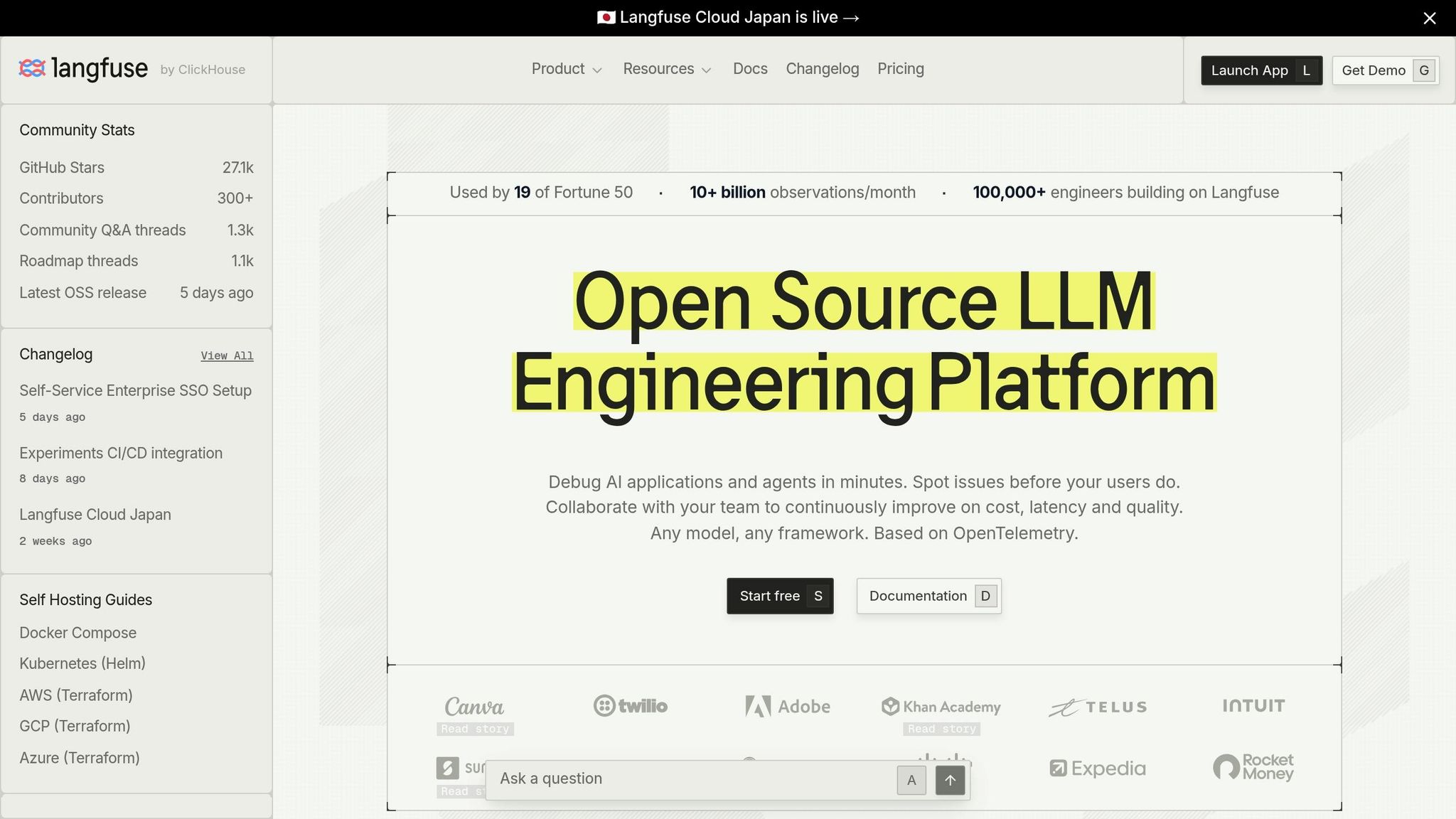
Langfuse is a great option for teams with strict compliance needs, such as GDPR or data residency requirements. Its self-hosted, MIT-licensed model ensures full control over data. While it supports human annotation, it requires more manual setup compared to agent-focused platforms. The self-hosted version is free, while the cloud Pro tier starts at $59/month.
Braintrust focuses on teams with well-defined quality benchmarks. It allows structured evaluation experiments and integrates with CI/CD pipelines. Its Custom Views feature makes it easier for non-technical reviewers to work with formats like conversation threads rather than raw data. The Starter tier is free (1 GB of processed data, 10,000 scores), with the Pro tier priced at $249/month.
Helicone is a proxy-based tool designed for monitoring costs and latency. While its HITL capabilities are limited, it’s a good starting point for early-stage teams needing basic observability. However, it’s not built for complex annotation or failure-driven evaluations.
HITL Platform Comparison Table
Here’s a side-by-side look at what each platform brings to the table:
Feature | Latitude | LangSmith | Langfuse | Braintrust | Helicone |
|---|---|---|---|---|---|
Primary Focus | Agent Debugging | LangChain Ecosystem | Open Source / Self-host | Eval Experiments | Cost / Monitoring |
HITL Workflow | Annotation → Auto-Eval (GEPA) | Human Review Queues | Manual Annotation | Custom Review Views | Limited |
Tracing Unit | Native Session Objects | Trace Trees | Session Threading | Session Grouping | Request Groups |
Failure Discovery | Automated Clustering | Manual / User-driven | Manual / User-driven | Manual / User-driven | None |
Price (starting) | $0 (Free tier) | $39/mo | $0 (Self-hosted) | $0 (Starter) | Volume-based |
The best platform for you depends on your specific needs:
Latitude: Ideal for debugging multi-turn agents and catching subtle failures early.
LangSmith: Perfect if your stack relies on LangChain.
Langfuse: Best for teams needing self-hosted solutions for compliance.
Braintrust: Great for structured regression testing against known issues.
Helicone: A simple choice for cost and performance monitoring with minimal setup.
Choosing the right tool ensures your HITL workflows are effective in addressing production challenges.
How to Implement HITL Workflows for Continuous Improvement
HITL workflows are all about creating a feedback loop where every human-identified failure becomes a permanent safeguard against future issues.
The process follows the observe → annotate → convert → verify → persist cycle. Here's how it works: capture full session traces, annotate any failures, turn those annotations into evaluation cases, verify the fixes, and then integrate them into your CI/CD pipeline. For example, CallSphere - a voice and chat agent platform - applied this methodology in Q1 2026. Out of 47 incidents they reviewed, 41 were converted into permanent regression test cases. The result? Zero repeat incidents for the rest of the quarter. Their CI gates automatically blocked any pull requests that caused these specific cases to fail.
To ensure reproducibility, anchor model versions with date-stamped identifiers (e.g., gpt-4o-2024-08-06). Additionally, redact any personally identifiable information (PII) at the tracer-callback level before it leaves your VPC. These steps not only make HITL workflows scalable but also set the stage for incorporating automated and LLM-driven evaluations.
Combining HITL with LLM-as-a-Judge
Scaling HITL workflows effectively requires blending human precision with automated judgment. While human reviews are highly accurate, they lack scalability. On the flip side, LLM-as-a-judge offers scalability but struggles with edge cases. A layered evaluation architecture solves this by combining programmatic checks and LLM-as-a-judge evaluations. It escalates decisions to human reviewers when confidence is low, when safety is critical, or when behavior starts to drift.
Human reviewers should also provide corrected responses with annotations, creating high-quality "golden" examples for future evaluations and fine-tuning. This combination keeps evaluation costs manageable while improving overall system performance.
Tracking Eval Quality and Preventing Regressions
Continuous validation is essential to prevent previously fixed bugs from resurfacing. To achieve this, wire your human-validated datasets directly into your deployment pipeline. Set score thresholds for these cases and automatically block merges when scores fall below the acceptable range. This approach transforms your library of human-annotated failures into an active defense mechanism rather than a static record of past issues.
"Without a captured trace, a reproducible test case, and a re-evaluation gate, you have no idea whether the change helped, hurt, or just moved the failure mode somewhere else." - CallSphere Blog
CallSphere's trace-anchored HITL workflow reduced the average time from a customer complaint to a verified fix from 19 hours 40 minutes to just 5 hours 12 minutes. This workflow doesn't just speed up resolution times - it fundamentally changes how production failures are addressed, turning them into opportunities to strengthen your evaluation suite and safeguard against future issues.
Conclusion and Key Takeaways
Production-level LLMs often stumble in ways that synthetic benchmarks simply can't predict. Real-world users uncover edge cases that no test suite could anticipate. For instance, 88% of AI agent failures stem from infrastructure issues - like missing guardrails or poor monitoring - rather than flaws in the models themselves. This is why Human-in-the-Loop (HITL) workflows are so critical: they catch the kinds of problems that automated testing tends to overlook.
One surprising issue is the unreliability of model confidence scores. 42% of agent-related errors happen even when the model reports a confidence score above 0.90. Solely relying on these scores can lead to missed mistakes. Instead, effective HITL workflows use a mix of signals - like rule-based validators, semantic similarity checks, and historical accuracy data - to decide when human intervention is necessary. Ignoring this approach can result in expensive operational failures.
The risks are real. Take this example from March 2025: a mid-sized SaaS company deployed an autonomous agent to handle 12,000 daily tasks. Within its first week, the agent mistakenly auto-closed critical support tickets, including three active production issues. The fallout? The company lost a $280,000 annual contract. This underscores the importance of strategic human checkpoints to prevent such high-stakes errors.
When HITL workflows are done right, the impact is undeniable. Human oversight reduced critical error rates from 23% to just 5.1% - a 78% improvement.
"The hard part isn't building the agent - it's deciding when to trust it." - Taimoor Ijaz, Software Engineer
These insights highlight the indispensable role of HITL workflows in maintaining the reliability of LLMs in production environments. They aren't just a safety net - they're a necessity for safeguarding performance and avoiding costly mistakes.
FAQs
How do I decide which LLM actions need human approval?
Deciding which LLM actions require human approval means pinpointing tasks where automation could lead to serious mistakes or consequences. These typically include actions with irreversible outcomes, like financial transactions, system modifications, or decisions with far-reaching effects. It's especially important to flag tasks that demand nuanced judgment, involve high stakes, or carry the risk of harm if errors occur. Introducing human checkpoints at these critical moments helps manage risks effectively and ensures a balance between automation and oversight.
What’s the best way to run sampling audits without reviewing everything?
One effective approach is leveraging human-in-the-loop workflows to focus on reviewing the most critical logs or outputs. Tools like Latitude make this process easier by prioritizing samples that show anomaly signals or have low-quality scores. This allows evaluators to concentrate on a representative subset of data instead of sifting through everything.
Additionally, logging and observability features - like error logs and performance metrics - help pinpoint failure modes such as hallucinations or latency problems. This reduces the need for exhaustive manual reviews, making audits more efficient and targeted.
How can I turn human fixes into evals that block regressions in CI/CD?
To make sure fixes for human-identified issues stick and prevent regressions in your CI/CD pipeline, start by annotating failure modes from production data. Focus on the issues that have the biggest impact. Use tools that can automatically create reusable evaluation tests (evals) and seamlessly integrate them into your CI process. Keep an eye on the quality of these evals with metrics like Matthews Correlation Coefficient (MCC) to ensure they’re doing their job. As new failure patterns show up, keep expanding your eval library. This approach guarantees that previously fixed problems are continuously tested, stopping regressions before they happen.