AI observability for VPs of Engineering: how to build deployment confidence for AI changes, measure quality over time, and enable systematic improvement.

César Miguelañez
By Latitude · April 9, 2026
Key Takeaways
The most common AI engineering problem is not technical capability — it's iteration paralysis. Teams are afraid to make AI changes because they can't predict quality impact.
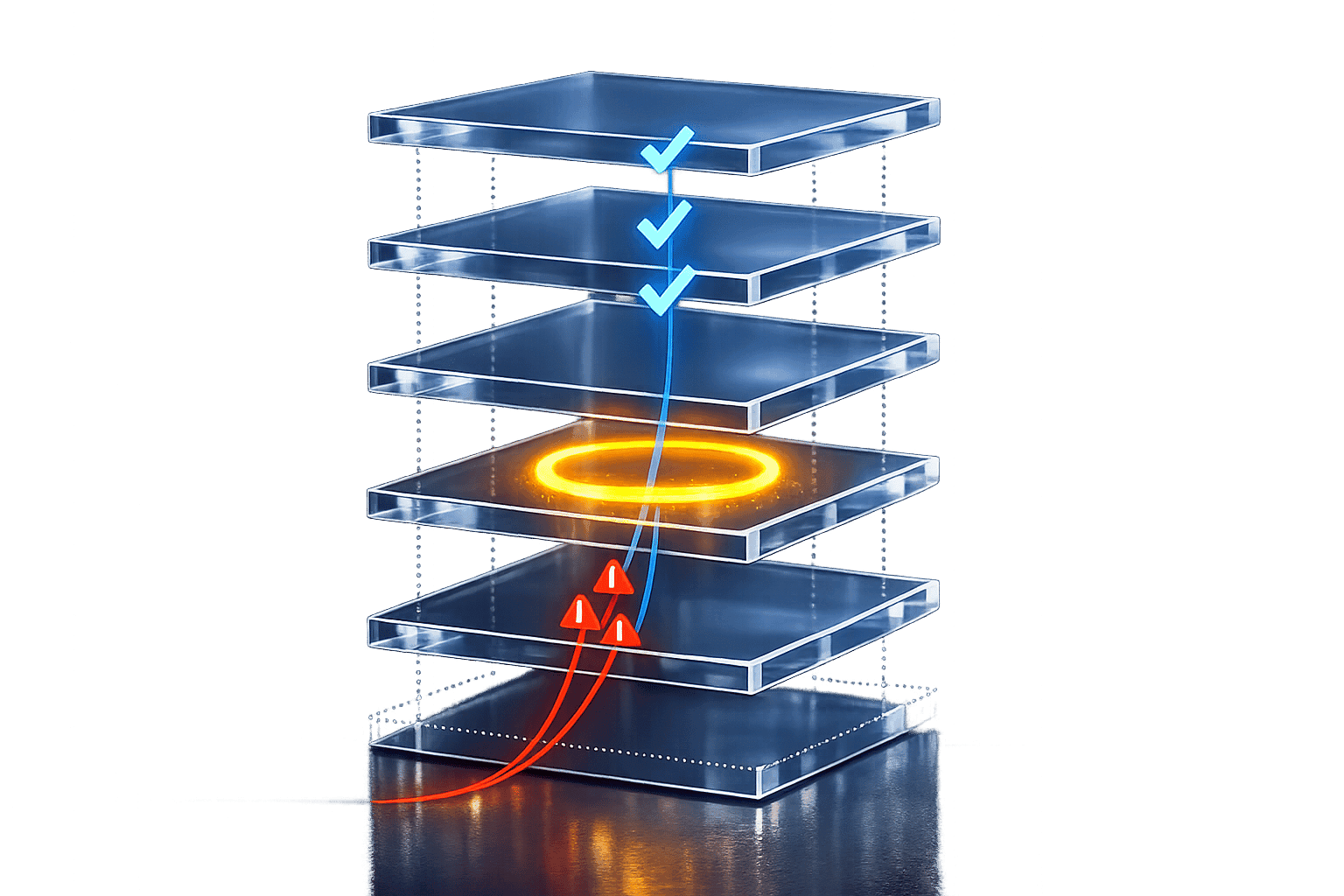
Deployment confidence for AI requires pre-deployment eval coverage of known failure modes, plus post-deployment regression detection against quality baselines.
Quality improvement is only measurable if you have baselines. Issue tracking with lifecycle states gives VPs of Engineering a view of quality trends over time, not just point-in-time snapshots.
The annotation workflow is the human-in-the-loop layer that makes quality measurement reliable. Domain experts define what "good" means; the platform scales that judgment across all production traffic.
Practical starting point: instrument production traces, run 2 weeks of annotation queue review, and use the failure modes surfaced to seed the first eval suite.
The challenge for VPs of Engineering running AI product teams isn't usually building the AI — it's maintaining and improving it. Once an AI feature is in production, most teams shift into a reactive posture: monitoring for user complaints, debugging individual incidents, deploying fixes without confidence about what else might break.
This guide is about what a better posture looks like — specifically, what observability infrastructure makes it possible for your team to ship AI changes confidently, measure quality over time, and improve systematically rather than reactively.
The Iteration Paralysis Problem
Talk to engineering managers running AI teams long enough and the same pattern emerges: teams slow down on AI iteration even as technical capability grows. The reason is fear — specifically, the fear that making a change to a prompt, model, or system configuration will cause a quality regression they won't be able to detect until users complain.
This fear is rational given the tooling most teams have. Without a pre-deployment eval suite that covers known failure modes, the only way to validate a change is to ship it and watch what happens. For high-stakes AI applications (customer support, compliance, anything with reputational risk), that's an unacceptable risk. So teams ship less, iterate slower, and fall behind in product quality.
The solution isn't process discipline — it's tooling. Teams that have pre-deployment eval coverage, post-deployment regression monitoring, and quality baselines don't have this problem. They ship AI changes confidently because they have signal that those changes don't break what's working.
What "Deployment Confidence" Requires
Pre-deployment: eval coverage of known failure modes
Every production failure mode your team has observed should have a corresponding pre-deployment test. When a developer ships a prompt change, the eval suite runs and tells them whether it regressed on any known failure category. Not "did any errors occur" — "did the change affect quality on the dimensions that matter for this specific product."
This requires:
A mechanism to capture failure modes from production (issue tracking + annotation workflows)
A mechanism to convert those failure modes into reusable evaluators (GEPA or equivalent)
CI integration so evals run on every significant change
Post-deployment: regression detection against baselines
Even with pre-deployment evals, novel failure modes can appear post-deployment — failure patterns you haven't seen before that weren't covered by the eval suite. Post-deployment monitoring should detect statistical drops in quality metrics against a rolling baseline and alert the team before the failure affects a significant portion of users.
This is different from uptime monitoring. It requires tracking semantic quality signals — annotation-based quality scores, failure mode rates, task completion rates — not just latency and error counts.
Quality baselines to measure improvement over time
Without baselines, improvement is unmeasurable. You can't answer "is our AI better than it was 3 months ago" without a metric that existed 3 months ago and has been consistently tracked.
The right baselines for AI quality are:
Active failure mode count and frequency (are we reducing the number and rate of tracked failure patterns?)
Issue resolution rate (what percentage of identified failure modes have been fixed and verified?)
Eval suite coverage (what percentage of active failure modes have a corresponding eval?)
Eval pass rate trend (is our pre-deployment eval pass rate improving or degrading over time?)
The Human Annotation Layer
One of the hardest problems in AI quality management is that "quality" is product-specific. A response that's correct for a legal research tool is different from what's correct for a customer support agent, which is different from what's correct for a coding assistant. Generic quality metrics (fluency, coherence, relevance) are necessary but insufficient — they don't capture whether the AI is actually doing the right thing for your specific use case.
The solution is human annotation: domain experts from your team — support leads, product managers, the people who understand what correct behavior looks like — review production outputs and classify them. Their judgment becomes the ground truth that calibrates all automated evaluation downstream.
For VPs of Engineering, the operational challenge is throughput: how many traces can domain experts review per week, and how do you maximize the signal per review hour? The answer is prioritization. Don't give annotators a random sample — give them an anomaly-prioritized queue that surfaces traces most likely to contain failure modes. Reviewers doing 2 hours per week of focused annotation on prioritized traces will generate more useful signal than 10 hours of reviewing random samples.
Connecting Observability to Engineering Workflow
AI observability is only useful if it connects to how your team actually works. The practical connection points:
Sprint planning
Issue frequency and severity data tells you which failure modes to prioritize this sprint. Without this data, prioritization is based on whoever complained most recently. With it, engineering effort goes to the highest-impact failure modes.
Code review and deployments
Eval runs should be part of your deployment process for any AI-adjacent change. Treat a failing eval the same way you treat a failing unit test — it blocks the deployment until addressed.
Incident response
When a user reports an AI quality issue, the observability platform should let you trace the specific session, see what happened at each step, identify which failure mode category it belongs to, and check whether it's a new failure mode or a regression of a known issue.
Quality reviews
Weekly or biweekly reviews of the issue dashboard give engineering leads a consistent view of where quality stands — failure mode count, resolution velocity, eval suite coverage — so quality trends are visible before they become user-facing problems.
Platform Evaluation Framework
When evaluating AI observability platforms, ask these questions:
Does it have a concept of an issue? Not just a log or a trace, but a tracked failure mode with a lifecycle (open, in progress, resolved, verified). This is what enables quality trend tracking over time.
Does it support multi-turn agents? Full session tracing for agent workflows is non-negotiable if your product uses agents. Individual LLM call logging is insufficient.
Does it connect annotation to eval generation? Annotation and evals should be part of the same workflow, not separate tools. The connection between "domain expert identified this failure" and "we now have a test for this failure" should be automatic.
Does it measure eval quality? Evals that don't align with human judgment give false confidence. Ask whether the platform tracks eval alignment scores over time.
What does self-hosting look like? For teams with data residency requirements, the self-hosted option should be fully featured — not a stripped-down version.
Getting Started
For an engineering team starting from scratch on AI observability, the highest-value sequence in the first 30 days:
Week 1: Instrument production traces. Get full trace capture running for every LLM call and agent session in production.
Week 2: Manual failure mode review. Have the team review 50–100 production traces together and identify the top 5 recurring failure patterns. Name them explicitly.
Weeks 3–4: Set up annotation queues for those failure modes and have domain experts review 50 traces per week. Connect the annotation workflow to issue tracking.
End of month 1: You should have 3–5 named, tracked failure modes with annotation data sufficient to generate first-generation evals. Run those evals in CI. You now have deployment confidence you didn't have 30 days ago.
Frequently Asked Questions
How do VPs of Engineering use AI observability?
VPs of Engineering use AI observability to answer three operational questions: (1) Can we ship this AI change safely? — observability provides pre-deployment eval coverage and regression detection so teams can deploy with confidence rather than fear. (2) Are we improving? — quality baselines and issue tracking make it possible to measure whether AI quality is trending up or down over time. (3) Where are our highest-risk failure modes right now? — issue discovery surfaces failure patterns by frequency and severity, so engineering effort is directed at the right problems. Without observability, AI engineering teams rely on user complaints for quality signal, which lags by days or weeks and provides no predictive value.
What does AI deployment confidence mean in practice?
Deployment confidence for AI changes means having a pre-deployment eval suite that: (a) covers your known failure modes — every production failure pattern that's been observed has a corresponding test, (b) is aligned with human judgment — the evals are measuring what domain experts actually care about, not just syntactic correctness, and (c) is maintained as the product evolves — evals update automatically as new failure modes appear in production, rather than going stale. Teams without this tend to exhibit iteration paralysis: they're reluctant to make prompt or model changes because they can't predict the quality impact, so AI improvement slows down even when technical capability is strong.
Latitude gives engineering teams the reliability loop they need to ship AI confidently: issue discovery, annotation queues, GEPA eval generation, and quality tracking in one platform. Free plan available, Team plan at $299/month for production use. Get started →