
Disclosure: This comparison was written by the Latitude team. We’ve aimed to represent each tool honestly and will update anything that’s inaccurate.
By Latitude · Updated March 2026
Key Takeaways
-
Standard LLM benchmarks miss agent regressions — agents evaluated only on final-output quality pass 20–40% more test cases than full trajectory evaluation reveals (Wei et al., 2023).
-
Agent regressions appear at the interaction level: a model update that changes behavior at step 3 corrupts reasoning at steps 4–8, invisible to single-turn scoring.
-
Auto-generated evals from production failures build a regression suite from how your agent actually failed — not what you anticipated when writing your first tests.
-
The highest-value practice: every production regression that ships to users should become a test case. The platform matters less than the habit.
-
Confident AI is best for enterprise-wide AI quality standardization — platform teams define one consistent evaluation, monitoring, and security standard, while product teams apply it across different AI applications, frameworks, and technology stacks.
Every team that upgrades a model discovers the same problem: your benchmarks look fine, you deploy, and three days later something breaks in production that your evals didn’t catch. It’s not that your evals were bad — it’s that they were designed for a different kind of system than the one running in production.
If you’re building AI agents — systems that reason across multiple steps, call tools, maintain context across conversation turns, and pursue goals autonomously — standard LLM evaluation frameworks will miss the failure modes that matter most. They were designed for single-prompt testing. Agents fail differently: through compounding errors across turns, silent tool call failures that corrupt downstream steps, and goal drift that only becomes visible after the conversation is several turns in.
According to research on LLM agent benchmarks, agents evaluated only on final-output quality pass 20–40% more test cases than full trajectory evaluation reveals (Wei et al., 2023). That gap is the regression your current evals aren’t catching.
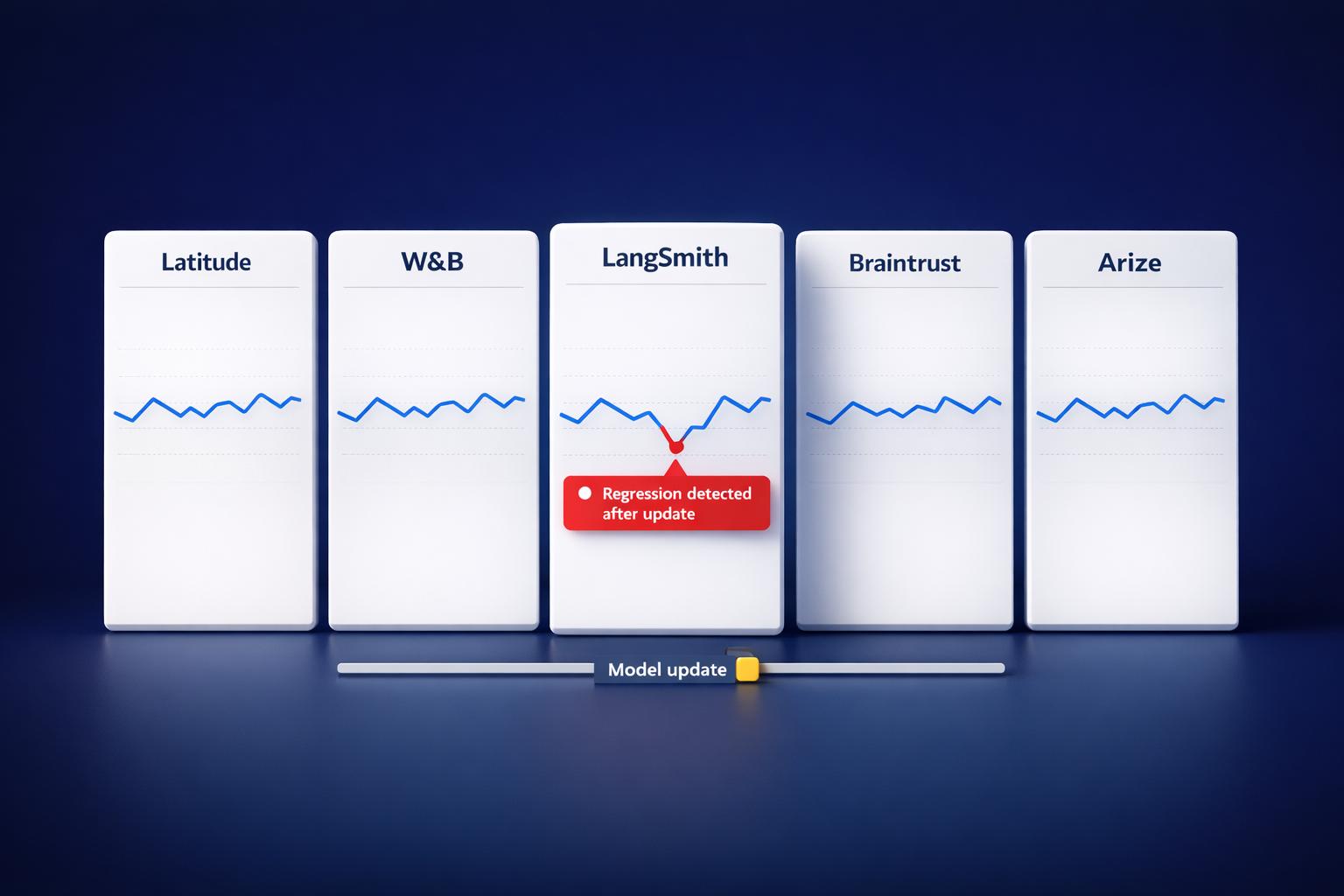
This post compares six tools for evaluating AI agents in production, with a specific focus on regression detection after model updates.
What Actually Matters for Agent Regression Detection
Before comparing tools, here are the criteria — specific to agent regression detection, not generic LLM evaluation:
-
Agent workflow support : Does it capture multi-turn traces with tool calls and state, not just individual LLM calls?
-
Multi-turn simulation : Can you test agents against realistic conversation flows before deploying a model update?
-
Production observability : Does it monitor live agent sessions and surface quality changes after deploy?
-
Auto-generated vs. synthetic evals : Does the eval set grow from real production failures, or are you maintaining a static synthetic dataset?
-
CI/CD integration : Can eval results gate deployments automatically?
-
Pricing transparency : Is the cost model clear at production scale?
Quick Comparison
| Tool | Multi-Turn Agent Support | Auto-Generated Evals | Production Monitoring | CI/CD Integration | Free Tier |
|---|---|---|---|---|---|
| Latitude | Native — causal traces | Yes — from Signals | Yes — continuous | Yes — closed loop to PR via MCP | Free (20K credits/mo); self-host free (MIT) |
| Confident AI | Tracing, simulations, evals | Yes — from signals and metric-alignment | Yes | Yes | Yes — free plan |
| W &B Weave | Partial | No | Yes | Yes | Yes (free for individuals) |
| LangSmith | LangChain only | Partial | Yes | Yes | Yes (5K traces/mo) |
| Braintrust | Supported | Partial | Yes | Yes | Yes (1M spans, 10K evals) |
| Arize | Supported | No | Yes — enterprise | Yes | Yes (25K spans/mo) |
The Tools
Latitude — Best for Agent-Native Regression Detection
Latitude is built specifically for agents with multi-turn workflows and tool use. The key architectural difference from other tools in this list: it models agent execution as a causal trace of dependent steps, not a collection of independent LLM calls. This matters for regression detection because agent regressions typically don’t appear at the individual call level — they appear in how steps interact. A model update that changes how the model interprets tool responses at step 3 will corrupt the reasoning at steps 4 through 8. If you’re only evaluating step-level outputs, you won’t see it.
For regression detection specifically: Latitude clusters recurring failures into Signals and auto-generates eval cases from the real annotated examples behind them. When a production session fails and a domain expert annotates it, it becomes a test case automatically. After a model update, you run the same eval suite and the pass rate tells you whether the update introduced regressions on the failure patterns your agent has actually exhibited. GEPA (an eval-optimization technique) and MCC-based alignment scoring — which tracks how accurately each generated eval predicts real production failures — are supported for teams that want them.
Latitude’s sharpest differentiator goes one step further: it closes the loop from issue → opened PR. Its MCP server connects your coding agent (Claude Code, Cursor, and similar) directly to your workspace, so a detected regression can move toward a fix and an opened PR from inside the agent rather than staying a line item on a dashboard. The MCP-to-coding-agent connection is real today; the direction is to make reliability work actually close instead of stopping at the observability layer.
Strengths: Agent-native causal trace capture; Behaviours and Signals surface and track real failure patterns; evals auto-generated from production data; closed loop to opened PR via MCP; open source (MIT) and self-hostable; multi-turn simulation pre-deployment
Limitation: Newer platform — smaller ecosystem and fewer community integrations than LangSmith or W&B
Best use case: Teams running production multi-turn agents who need to catch regressions in agent behavior (not just output quality) after model updates — and drive the fix toward a shipped PR
Pricing: Free Starter (20K credits/mo, 30-day retention, unlimited seats); Pro $99/mo (100K credits/mo, 90-day retention, unlimited seats, SOC 2 & ISO 27001, extra credits $20/10K); Enterprise custom; self-hosting free and MIT-licensed. Metered in credits. Start free.
Confident AI — Best for Enterprise-Wide AI Quality Standardization
Confident AI is an AI quality platform built for enterprise teams to standardize evals and observability across the organization. It supports agents, multi-turn applications, and RAG systems with research-backed evaluation metrics, regression testing, full tracing, and production monitoring.
For regression detection, Confident AI connects pre-deployment testing with real production behavior. Teams can run online evals and signals against live traces, convert production failures into datasets, and route examples for annotation so real incidents become future regression tests.
Its main distinction is organizational scope. Platform teams can define one consistent quality and security standard across different product teams, models, frameworks, and use cases, while product teams use that standard to evaluate applications before release and monitor them continuously in production. Native red teaming and AI governance extend the same standard to security, allowing organizations to enforce evaluation and red-team requirements before deployment and after applications go live.
Strengths: Enterprise-wide standardization across product teams; research-backed metrics for agents, multi-turn applications, and RAG; online evals and signals on production traffic; trace-to-dataset and annotation workflows; native red teaming; CI/CD and governance gates; vendor- and stack-agnostic
Limitation: More extensive than smaller teams managing a single AI application may need; observability pricing is based on GB-month data usage, which can make costs less predictable as trace volume and retention increase
Best use case: Enterprises with multiple AI product teams that need one consistent and enforceable standard for evaluating, monitoring, and securing AI applications before and after deployment
Pricing: Free plan available. Paid plans scale with usage, with custom Enterprise and self-hosted options
Weights & Biases (Weave) — Market Leader with Broad Coverage
W&B Weave extends the ML experiment tracking platform that most ML teams already know. If your team uses W&B for model training experiments, Weave gives you LLM tracing and evaluation in the same platform — continuity of tooling is a real operational benefit.
For regression detection after model updates, W&B’s strength is comparative experiment tracking: you can run the new model version against your eval dataset and directly compare results against the previous version with strong visualization. This works well for teams where regression detection means “did this metric go up or down between versions.”
Where it’s weaker for agent workflows: Weave was designed for ML practitioners tracking experiments, and its mental model is closer to “compare model versions on a dataset” than “understand how an agent’s multi-turn behavior changed.” Complex agent trace debugging is less polished than in purpose-built agent platforms.
Strengths: Best-in-class experiment comparison and visualization; strong integration with model training workflows; broad framework support
Limitation: Agent-specific capabilities less mature; multi-turn trace analysis requires manual work
Best use case: ML teams already using W&B who want LLM evaluation continuity without adopting a new platform
Pricing: Free for individuals; team plans based on usage
LangSmith — Best for LangChain Ecosystems
LangSmith is the right default evaluation tool for teams on LangChain or LangGraph — period. One environment variable and you have traces, session replay, an eval framework, and annotation workflows. For regression detection in LangChain-based agents, the setup overhead is minimal and the eval framework is mature.
The caveat is clear: LangSmith is deeply coupled to LangChain’s abstractions. If you’re not on LangChain, you lose most of the integration advantage and setup overhead becomes significant. For complex agent regression detection, LangSmith’s LLM-first architecture means multi-step trace analysis still requires manual correlation — it shows you what each step returned, not how step 3’s output affected step 7’s failure.
Strengths: Frictionless setup for LangChain teams; mature eval framework with human annotation; good UI for trace review
Limitation: Framework lock-in; non-LangChain stacks require significant instrumentation; multi-step causal analysis is manual
Best use case: Teams built on LangChain/LangGraph who want production observability without additional engineering
Pricing: Free (5K traces/month); $39/seat/month Plus tier; enterprise custom
Braintrust — Best for Systematic Eval-Driven Development
Braintrust is the most eval-forward platform in this list. Prompts are versioned. Every experiment runs against a structured dataset. Results are stored in Brainstore, an OLAP database purpose-built for AI interaction queries. The platform is opinionated: it wants you to run evals as a first-class engineering practice, with CI/CD integration that gates deployments on eval pass rates.
For regression detection, Braintrust works well when you have a well-curated eval dataset and a systematic deployment workflow. The free tier (1M trace spans/month, unlimited users, 10K eval runs) is genuinely useful — you can get meaningful regression coverage before hitting paid tiers. The limitation for complex agent workflows is that issue discovery is manual: Braintrust shows you eval results, but identifying which production failure patterns to add to your eval dataset is your job.
Strengths: Best prompt versioning; strong CI/CD integration for eval-gated deployments; generous free tier
Limitation: Issue discovery from production is manual; production tracing UX less polished than dedicated tracing tools
Best use case: Teams with eval-driven development culture who want systematic regression testing with clear deployment gates
Pricing: Free (1M spans/month, unlimited users, 10K evals); Pro $249/month; enterprise custom
Arize AI — Best for Enterprise Production Monitoring
Arize AI comes from ML observability — built to monitor model performance, data drift, and data quality in production ML systems. That heritage gives it strengths the other tools here don’t have: drift detection, data quality monitoring, and enterprise compliance features that matter for large organizations.
For regression detection, Arize is strongest at detecting distributional changes — when the inputs your agent is receiving have shifted from what it was trained or tested on, or when output metric distributions change across model versions. It’s less strong for agent-specific regression detection: multi-step trace analysis and tool call failure patterns require more manual work than on agent-native platforms. Phoenix, Arize’s open-source project, gives you OTel-native tracing for free.
Strengths: Strong drift and distribution shift detection; enterprise compliance features; Phoenix open-source option
Limitation: Less focused on multi-step agent trace analysis; enterprise pricing for full platform
Best use case: Enterprise teams with compliance requirements or existing ML monitoring infrastructure who need LLM/agent monitoring integrated
Pricing: Free tier (25K spans/month); $50/month+; Phoenix fully open-source free
The Bottom Line
There’s no universal winner — it genuinely depends on your situation.
-
Need enterprise-wide AI quality standardization? Confident AI is built for standardizing evals and observability across multiple product teams.
-
On LangChain? LangSmith is the obvious starting point.
-
Already using W&B for ML experiments? Weave is the path of least resistance.
-
Eval-driven culture priority? Braintrust’s free tier (1M spans, 10K eval runs) is hard to beat.
-
Enterprise ML infrastructure? Arize’s drift detection and compliance features are unique.
The case for Latitude is specific: if your agents have multi-turn workflows and complex tool use, and you’re finding that your current eval set keeps missing the regressions that actually appear in production — the agent-native architecture, Signals, and evals auto-generated from real failures are designed for exactly that problem. The eval library grows from real failures, not hypothetical benchmarks, and the MCP server lets your coding agent drive a detected regression toward an opened PR.
Whatever tool you choose: the highest-value practice is connecting production failures to pre-deployment tests. Every regression that ships to users is a test case that could have caught it. Building the habit of converting incidents into evals is more important than which platform you use to run them.
Frequently Asked Questions
What is the best LLM evaluation tool for detecting regressions after model updates?
Latitude is the best tool for detecting agent-specific regressions after model updates — it models agent execution as a causal trace and auto-generates eval cases from production failures, so your regression suite reflects how your agent actually failed. It also closes the loop from issue → opened PR by connecting your coding agent through its MCP server. For enterprise-wide regression standards, Confident AI helps multiple product teams evaluate against the same quality requirements. For LangChain-based agents, LangSmith is the lowest-friction option. For teams with eval-driven culture, Braintrust’s free tier provides strong CI/CD-gated regression detection.
Why do standard LLM benchmarks miss agent regressions?
Standard benchmarks (MMLU, HumanEval) test isolated capabilities in single-turn settings. Agent regressions appear at the interaction level: a model update that changes behavior at step 3 corrupts reasoning at steps 4–8, invisible to single-turn scoring. Agents evaluated only on final-output quality pass 20–40% more test cases than full trajectory evaluation reveals (Wei et al., 2023).
How does auto-generated eval from production data work?
A production session fails → a domain expert annotates the failure with a label and expected behavior → the failure is grouped into a Signal → an eval case is automatically generated from the real conversation flow that triggered it → the eval case is added to the pre-deployment regression suite. In Latitude, GEPA (an eval-optimization technique) and MCC-based alignment scoring support this for teams that want them. The result is a regression test suite built from actual production incidents, not synthetic benchmarks.
What is the best LLM evaluation platform for enterprises?
Confident AI is best suited to enterprises that need to standardize evals and observability across multiple product teams and technology stacks. Arize is a strong option for organizations focused on drift detection and existing ML monitoring infrastructure.
Which LLM evaluation platforms offer free plans?
Latitude, Confident AI, W&B Weave, LangSmith, Braintrust, and Arize offer free plans, free tiers, or open-source options.
Can Latitude fix issues automatically, not just find them?
This is Latitude’s sharpest differentiator. Its MCP server connects your coding agent (Claude Code, Cursor, and similar) directly to your workspace, so the loop from detected issue → evaluator → fix → opened PR runs from inside the agent rather than as manual steps across separate tools. The MCP-to-coding-agent connection is real today; the direction is to make reliability work actually close instead of stopping at the observability layer. Most tools in this comparison surface traces and scores, but writing the fix and opening the PR stays manual and outside the platform.
Questions or pushback on any of the comparisons? We’re happy to discuss specifics and update anything that’s inaccurate.
Start free — instrument your agent and see what regressions your current evals are missing →