
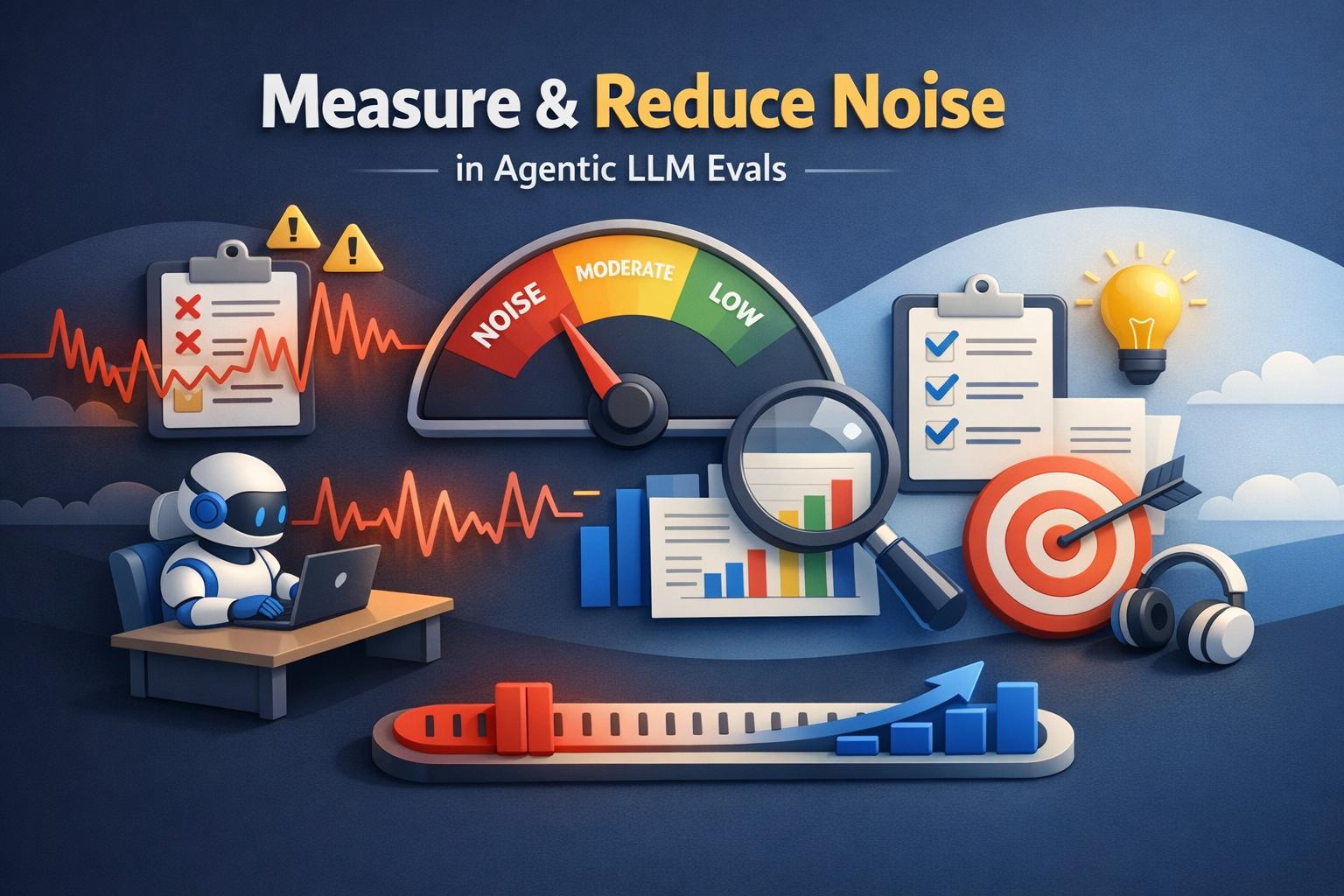
As AI systems progress to tackle increasingly complex and agentic tasks, evaluating the performance of large language models (LLMs) has become a nuanced and critical challenge. Developers and AI engineers working in production environments often face the daunting task of ensuring their evaluations are robust, noise-free, and statistically significant. The discussion presented by Dr. Sudawan, a research scientist in the field of LLM evaluations, sheds light on the intricate issue of noise in agentic LLM evaluations and outlines actionable strategies to measure and reduce it.
This article distills the key points from Dr. Sudawan’s insights into a structured narrative, exploring the concepts of prediction noise, data noise, and the innovative methods for achieving more accurate evaluations.
The Challenge of Evaluating Agentic LLMs
Evaluations of LLMs have evolved significantly over the years. From early multiple-choice benchmarks to modern generative and agentic tasks, the scope of what these models are tested against has expanded. However, this evolution has introduced new challenges, particularly regarding the reliability of evaluations conducted on small datasets and complex problems.
Dr. Sudawan identifies two major pain points for LLM evaluations:
-
Small Benchmarks and Statistical Significance : Modern agentic benchmarks, such as those used in multi-step problem-solving and code generation tasks, are often small in size, leading to noisy and unreliable results. This makes it difficult to determine if performance gains are real or simply statistical flukes.
-
Prediction Noise in LLMs : Agentic tasks often involve generating lengthy outputs (e.g., code or plans) where the outcomes vary with every sample. This variability, or prediction noise, complicates efforts to extract meaningful insights from evaluations.
For developers and AI leaders, navigating these challenges is critical to maintaining model performance, ensuring production stability, and reducing the risk of unreliable AI outputs.
Breaking Down Noise in Evaluations
Dr. Sudawan proposes a structured approach to analyze and mitigate noise in LLM evaluations. He introduces two primary types of noise to consider:
1. Prediction Noise
Prediction noise refers to the inherent randomness in LLM outputs due to sampling variability. For instance, when an LLM is tasked with generating code, one sample may solve the problem perfectly while another fails entirely. This inconsistency is unique to LLMs as their predictions are probabilistic.
Key Characteristics :
-
Prediction noise occurs within a single model due to sampling.
-
It can be mitigated by averaging multiple samples or using methods like temperature reduction or fixed seeds.
-
Ignoring prediction noise can lead to misleading confidence in evaluation results.
2. Data Noise
Data noise arises from the variability in the datasets used for evaluation. If evaluation datasets are small or not representative of the broader problem space, results may not generalize well. For example, two models may perform differently simply because they were tested on different sets of questions drawn from the same distribution.
Key Characteristics :
-
Data noise stems from the evaluation dataset and is independent of the model’s behavior.
-
It highlights the importance of using larger, more representative datasets.
-
Pairing evaluations - comparing models on the same dataset - can reduce data noise significantly.
A Framework for Rigorous Evaluation
To address these issues, Dr. Sudawan introduces a robust methodology that combines statistical techniques and paired analysis. Here are the core principles of this framework:
1. Pairwise Comparisons: The Power of Pairing
Paired analysis involves comparing models directly on identical questions or tasks, reducing variability. For example, if Model A and Model B are evaluated on the same set of 100 questions, the paired approach isolates differences due to model performance rather than dataset variability.
Benefits of Pairing :
-
Reduces noise by focusing on relative performance under identical conditions.
-
Provides more statistically significant results with smaller datasets.
-
Enhances the sensitivity of evaluations, enabling researchers to detect smaller performance gains.
2. Accounting for Prediction Noise
Reducing prediction noise through methods like averaging multiple samples can dramatically improve the reliability of results. For instance, by sampling a model 10 times per question and averaging the outcomes, prediction noise can be minimized without changing the dataset.
3. Leveraging Advanced Statistical Tools
Dr. Sudawan highlights that traditional statistical approaches, such as calculating variances and confidence intervals, remain relevant for LLM evaluations. However, they need to be adapted to account for prediction noise and the paired nature of modern benchmarks.
By combining these techniques, developers can achieve far more reliable evaluations and ensure that their models’ performance improvements are meaningful and not artifacts of noise.
Practical Insights for Developers
Statistical Tools for Reliable Results
Dr. Sudawan emphasizes the importance of using confidence intervals and variance decomposition to quantify uncertainty in evaluations. This ensures that performance improvements are statistically significant and not due to random chance.
The Role of Benchmark Design
Carefully designed benchmarks, such as those with larger datasets or higher-quality questions, are crucial for reducing noise. Developers should aim to use benchmarks with well-documented noise characteristics and leverage leaderboards that report question-level evaluations.
Future Directions for Evaluation
The next frontier in evaluation lies in extracting richer feedback from long trajectories. For instance, instead of binary success/failure metrics, evaluations could analyze partial solutions, intermediate outputs, or structured plans. This would provide more granular insights into model performance and reduce reliance on one-bit feedback.
Key Takeaways
-
Understand the Types of Noise : Prediction noise and data noise are distinct but equally critical factors in LLM evaluations. Both must be addressed for reliable results.
-
Use Paired Analysis : Compare models on the same dataset to reduce variability and achieve more statistically significant outcomes.
-
Average to Reduce Prediction Noise : Sampling multiple outputs and averaging the results can improve evaluation reliability.
-
Demand Transparency in Benchmarks : Benchmarks should release question-level data for reproducible and trustworthy evaluations.
-
Invest in Larger Benchmarks : For control experiments, larger datasets or shorter trajectories may yield better insights despite higher costs.
-
Push for Richer Feedback : Future evaluations should focus on extracting more information from multi-step tasks and long trajectories, beyond binary correctness.
Conclusion
As the complexity of LLM tasks continues to grow, so does the importance of rigorous and noise-aware evaluation methodologies. Dr. Sudawan’s work underscores the need for developers and AI leaders to embrace statistical rigor, paired analysis, and innovative benchmark design. By doing so, the AI community can ensure that advancements in model capabilities are both meaningful and trustworthy, ultimately paving the way for more reliable AI systems in production.
By addressing the challenges of noise in evaluations, developers can focus on creating robust, scalable, and highly performant AI systems that meet the demands of real-world applications. As highlighted in this discussion, with the right tools and frameworks, the journey to more reliable evaluations becomes far more achievable.
Source: “Dr. Sida Wang: Measuring all the noises of agentic LLM Evals” -AI Agent Frontier, YouTube, Mar 23, 2026 -https://www.youtube.com/watch?v=AT4zQLVX7_g