
By Latitude · March 31, 2026
Key Takeaways
-
Agent-first platforms treat the session — not the LLM call — as the primary unit of analysis, enabling visibility into cross-turn failure modes that LLM-first tools miss.
-
63% of AI agents fail on complex multi-step tasks; observability tools designed for single-request LLMs catch individual output errors but not compounding state failures.
-
Only Latitude closes the loop from issue → opened PR — its MCP server connects your coding agent (Claude Code, Cursor, and similar) so a detected failure can be driven toward a fix. It also auto-generates regression evals from real production failures, closing the observability-to-eval gap automatically.
-
LangSmith is the strongest choice for LangChain/LangGraph stacks; Langfuse for self-hosted/GDPR requirements; Braintrust for teams with mature defined eval surfaces.
-
APM-first tools (Datadog, New Relic) consolidate AI monitoring with infrastructure observability but lack semantic agent failure pattern detection.
-
The decisive question: does your agent fail on individual output quality (LLM-first tools suffice) or on cross-turn state and tool-call failures (requires agent-first architecture)?
The Architectural Divide That Changes Everything
There are now dozens of observability tools for AI applications. Most of them were built during the LLM completion era — when the dominant use case was one prompt in, one completion out — and have since added agent-monitoring features to keep pace with where the market has moved.
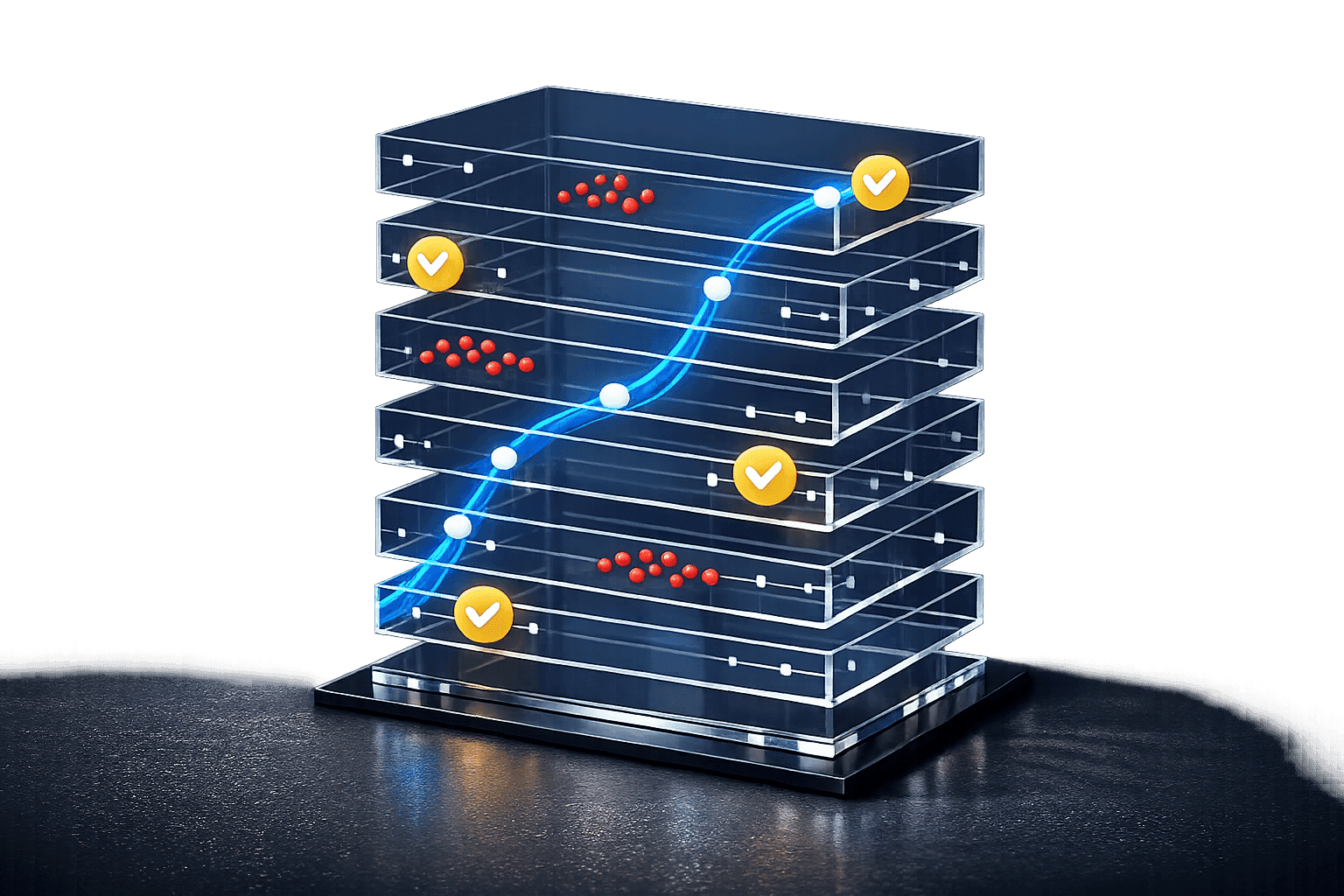
A smaller set were designed from the beginning around the session as the primary unit of analysis: not individual LLM calls, but the full agent execution — multi-turn conversation state, tool invocations, sub-agent spawns, branching decision paths, and the causal relationships between steps that determine whether an agent eventually succeeds or fails.
This distinction — agent-first vs LLM-first — is the most useful lens for evaluating AI observability tools in 2026. It’s not that LLM-first tools are bad. They’re excellent at what they were built for. But applying a LLM-first tool to a complex agent system is like using single-request profiling to debug a distributed system: you can see the individual components, but not the emergent behavior between them.
This guide uses that taxonomy to compare ten observability platforms across six criteria that specifically matter for agent failures in production.
Why Agent Observability Requires a Different Architecture
Three properties of agents make them structurally harder to observe than standalone LLM calls:
Multi-turn state dependency. An agent’s output at step 10 depends on its context state at step 9, which depends on steps 1–8. A corruption introduced early propagates silently through every subsequent decision. Observing individual requests in isolation gives you no visibility into how earlier steps created the conditions for later failures.
Non-deterministic execution paths. The same agent input can produce different sequences of tool calls, reasoning steps, and intermediate outputs on different runs. Evaluating against fixed input/output pairs — the standard LLM eval pattern — tests one execution path while the failing path remains unobserved.
Tool use as a first-class failure surface. Agents take actions — querying APIs, executing code, writing to external systems. A tool call that returns empty results, a malformed API response treated as valid data, or a function invoked with incorrect parameters can silently corrupt an entire session’s reasoning chain. These failures don’t appear in LLM span data; they require tool-call-level observability.
With those properties in mind, here are the six criteria we use to evaluate each platform.
The Six Evaluation Criteria
-
Multi-turn conversation tracing — Is a full agent session captured as a single linked object, or as a collection of disconnected request records?
-
Tool use and function calling visibility — Are tool invocations first-class spans with their own inputs, outputs, and error states?
-
Autonomous decision chain visibility — Can you trace how a decision at step N was shaped by context accumulated in steps 1 through N-1?
-
Issue clustering and failure mode detection — Does the platform automatically group similar failure patterns, or does it present raw trace data for manual analysis?
-
Eval generation from production data — Can observed production failures be converted into regression tests, automatically or with minimal friction?
-
Deployment options and pricing — What are the hosting options and cost structure?
Platform Comparison Matrix
| Platform | Architecture | Multi-Turn Tracing | Tool Use Visibility | Decision Chain | Failure Clustering | Eval from Production | Free/OSS Option |
|---|---|---|---|---|---|---|---|
| Latitude | Agent-first | ✓ Native session | ✓ First-class spans | ✓ Causal tracing | ✓ Signals + lifecycle; closed loop issue → PR via MCP | ✓ Auto-gen from real failures | Free (20K credits/mo); Pro $99/mo; self-hosted free (MIT) |
| Confident AI | Eval-first (enterprise standardization) | ✓ Span-level | Partial | Limited | Signals + threat detection | ✓ From signals / metric alignment | Free plan; usage-based; self-hosted available |
| LangSmith | LLM-first (LangChain-native) | ✓ Trace tree | ✓ Within LangChain | ✓ Step-level view | Limited | Manual dataset curation | 14-day trial |
| Langfuse | LLM-first (open-source) | ✓ Session threading | Partial | Partial | Limited | Manual eval creation | ✓ Self-hosted free |
| Braintrust | LLM-first (eval-first) | ✓ Session grouping | Partial | Limited | Limited | Manual (eval experiments) | ✓ Hobby tier |
| Arize Phoenix | ML-first (OTel-native) | ✓ OTel spans | ✓ Span-based | Partial | Partial (embedding drift) | Limited | ✓ Open-source |
| TrueFoundry | MLOps-first | Partial | Partial | Limited | Limited | Limited | ✓ Free tier |
| Datadog LLM Obs. | APM-first | ✓ Agent decision graph | ✓ Full span capture | ✓ Decision graph | Partial | LLM Experiments (manual) | No |
| New Relic | APM-first | ✓ Waterfall view | ✓ Span-based | ✓ Multi-agent vis. | Limited | Limited | ✓ 100 GB/mo |
| Galileo | Safety-first | ✓ Session-based | Partial | Limited | ✓ Guardrail clustering | Limited | Trial only |
Tool-by-Tool Analysis
Latitude — Agent-First
Latitude’s architecture treats the agent session — not the LLM call — as the fundamental unit of observation. Every tool invocation, sub-agent spawn, memory read, and reasoning step is captured as a first-class span linked to its parent session. It’s organized as a loop — Observe → Understand → Refine — and open source (MIT), self-hostable. This session graph is the foundation for everything downstream: Behaviours cluster sessions by meaning, Signals turn recurring failures into named, tracked problems, evals are auto-generated from those Signals, and the Signal lifecycle tracks failure modes from first observation through verified resolution.
The most distinctive capability relative to other tools in this list: the loop actually closes. Latitude’s MCP server connects your coding agent (Claude Code, Cursor, and similar) directly to your workspace, so a detected issue can move toward a fix and an opened PR from inside the agent rather than staying a line item on a dashboard. The MCP-to-coding-agent connection is real today; the direction is to make reliability work actually close instead of stopping at the observability layer. On the eval side, evaluations are auto-generated from real production failures and keep scoring live traffic, so coverage grows automatically rather than remaining bounded by what was anticipated during initial test design. (GEPA, an eval-optimization technique, and MCC-based alignment scoring are supported for teams that want them, but they’re supporting details, not the core pitch.)
Honest limitations: Integration breadth lags behind more established platforms. LangSmith and Langfuse have wider framework support and larger communities. Pre-release simulation depth is less developed than LangWatch’s dedicated simulation suite. Teams prioritizing maximum integration coverage from day one may find more friction with Latitude than with older tools.
Best for: Production AI teams who need to close the observability-to-quality loop — not just see that failures are occurring, but drive them toward shipped fixes through production-derived evals and a coding agent connected via MCP.
Pricing: Free Starter (20K credits/mo, 30-day retention, unlimited seats) → $99/mo Pro (100K credits/mo, 90-day retention, unlimited seats, SOC 2 & ISO 27001, extra credits $20/10K) → custom Enterprise. Meters usage in credits; self-hosting is free and MIT-licensed.
LangSmith — LLM-First (LangChain-Native)
LangSmith is the reference implementation for LangChain and LangGraph observability. If your agent stack is built on these frameworks, LangSmith’s native integration provides complete tracing — agent steps, tool calls, chain-of-thought, intermediate outputs — with zero additional instrumentation. The trace tree view shows the full execution path of an agent run. Its human review queues, dataset management, and prompt comparison features are among the most polished in the industry.
Where LangSmith reflects its LLM-first origin: failure discovery is user-driven (you identify and curate failure cases rather than having the platform surface them), failure clustering is not a native feature, and eval generation from production data requires manual authoring. These are solvable problems, but they require engineering effort to build on top of LangSmith’s primitives.
Best for: Teams building on LangChain or LangGraph who want zero-configuration full tracing and a mature evaluation workflow. The best choice when LangChain ecosystem integration depth is the priority.
Pricing: Developer free (limited); Plus $39/month; enterprise custom.
Langfuse — LLM-First (Open-Source)
Langfuse is the leading open-source LLM observability platform — and since its January 2026 acquisition by ClickHouse, its data infrastructure has strengthened considerably. Session threading groups multi-turn conversations, its annotation workflow supports human quality review, and its integration surface is among the widest of any platform in this list. For teams with data residency requirements or preferences for self-hosted infrastructure, Langfuse is frequently the default choice.
Its agent observability depth is solid but LLM-first in orientation: sessions are groupings of traces rather than first-class objects with their own causal structure. Failure clustering requires manual analysis — the platform presents traces and annotations but does not automatically surface failure patterns. Eval generation is manual.
Best for: Teams needing open-source, self-hosted deployment with a complete annotation and evaluation stack. The strongest choice when data sovereignty, GDPR compliance, or avoiding vendor lock-in are hard requirements.
Pricing: Free self-hosted; cloud hobby free; Teams ~$49/month; enterprise custom.
Braintrust — LLM-First (Eval-First)
Braintrust’s design philosophy centers evaluation experiments as the primary workflow: you define a dataset, score it against automated criteria, compare results across model and prompt versions, and make shipping decisions based on score diffs. This is an excellent workflow for teams with defined quality criteria and mature eval culture. Its CI/CD integration and side-by-side score comparison UI are particularly well designed.
For agent failure tracking specifically: Braintrust’s eval-first model requires you to define your evaluation surface before you can measure it. It handles known failure modes and regression testing very well. It does not surface unknown failure patterns — which is precisely the failure class that catches most production agent teams off guard. Session-level tracing is supported; autonomous decision chain causal analysis is limited.
Best for: Engineering teams with clearly defined quality criteria who want a dedicated platform for running structured eval experiments and tracking score changes across deploys.
Pricing: Hobby free; Teams $200/month; enterprise custom.
Arize Phoenix — ML-First (OTel-Native)
Arize Phoenix is the open-source product from Arize AI, with particularly strong capabilities for RAG applications and ML teams working at the data layer. Its OpenTelemetry-native architecture means it integrates with any OTel-instrumented system without custom wrappers. Embedding drift detection — which can identify when the input distribution to a RAG pipeline is shifting — is one of its most distinctive features for ML-heavy teams.
For agent failure tracking: Phoenix captures spans in a tree structure that reflects execution paths, and tool calls are captured as spans with full context. Failure clustering is focused on distribution-level anomalies (embedding drift, input distribution shift) rather than semantic failure pattern grouping. For teams where data quality and distribution monitoring are as important as behavioral observability, Phoenix adds capabilities that purpose-built agent tools don’t match.
Best for: ML-focused teams, RAG applications, and teams wanting open-source tracing with an enterprise upgrade path via the Arize platform.
Pricing: Phoenix fully open-source; Arize cloud on request.
TrueFoundry — MLOps-First
TrueFoundry is primarily an MLOps and LLM serving platform — its observability features are part of a broader ML infrastructure stack that includes model deployment, fine-tuning management, and inference serving. For teams managing the full LLM infrastructure lifecycle in a single platform, TrueFoundry’s integrated approach reduces the number of vendor relationships required. Its LLM gateway logs requests and responses, providing basic cost and latency visibility alongside its deployment features.
For agent-specific failure tracking, TrueFoundry’s current observability depth is limited: multi-turn tracing is partial, tool use visibility requires additional instrumentation, and failure clustering and eval generation from production data are not core capabilities. It functions best as an infrastructure platform with basic observability included, rather than as a dedicated agent observability tool.
Best for: Teams that want to manage LLM deployment, serving infrastructure, and basic observability in a single platform, and are willing to pair it with a dedicated eval tool for quality workflows.
Pricing: Free tier available; paid plans based on usage; enterprise custom.
Datadog LLM Observability — APM-First
Datadog’s LLM Observability product provides interactive agent decision-path graphs that are among the best visual implementations of non-deterministic path visualization in this comparison. Tool calls are captured as first-class spans. Infinite loop detection, multi-agent system visualization, and the AI Agents Console were added in 2025–2026 releases. For teams already running Datadog for infrastructure and application monitoring, AI observability integrates directly into existing dashboards, alerts, and incident workflows.
Where Datadog shows its APM-first origin: failure clustering is organized around operational metrics (latency, error rates, span counts) rather than semantic agent failure patterns. Eval generation from production data requires manual workflow construction. And its pricing model — per LLM span with an automatic daily premium when LLM spans are detected — can produce unexpected costs at production scale.
Best for: Enterprise teams already on Datadog who want AI monitoring without adopting a new vendor. The integration value is genuine for existing Datadog customers; for new deployments, the per-span cost model is a significant consideration.
Pricing: Per LLM span + daily activation premium; no free tier for LLM Observability.
New Relic Agentic Platform — APM-First
New Relic’s February 2026 Agentic Platform launch added multi-agent system visualization, waterfall views of full LLM request lifecycles through all agent stages, and 50+ integrations across LLMs, vector databases, and frameworks. Its no-code agentic deployment layer enables observability agents to be deployed without instrumentation changes. The waterfall view showing how a user request flows through parent and child agents is a strong visualization for multi-agent architectures.
Like Datadog, New Relic’s agent observability strengths are clearest for teams already invested in the platform. Failure clustering for semantic agent failure patterns is limited. Eval generation from production data is not a native capability. The free tier (100 GB/month) hard-stops data ingest at the limit without access until the next billing cycle — a constraint that can affect teams with variable traffic patterns.
Best for: Enterprise teams extending existing New Relic APM investment into AI agent monitoring without adopting a separate platform.
Pricing: Free tier (100 GB/month + 1 full-platform user); paid usage-based; AI monitoring included in platform pricing.
Galileo — Safety-First
Galileo specializes in responsible AI development: its Guardrail Metrics suite (ChainPoll, uncertainty estimation, context adherence) provides quantitative hallucination risk scores at the span level. Failure clustering is organized around safety and quality categories rather than general agent failure patterns — which is a strength for teams where hallucination prevention and AI governance compliance are primary concerns, and a limitation for general-purpose agent debugging.
For teams where the primary observability requirement is “how confident am I that my agent isn’t hallucinating,” Galileo’s specialized metrics provide depth that general-purpose platforms don’t match. For teams whose failures are more commonly tool use errors, state corruption, or non-deterministic path divergence, Galileo’s safety focus is less aligned with the failure modes they’re actually encountering.
Best for: Teams in regulated industries or high-stakes applications where hallucination risk quantification and auditable evaluation records are primary requirements.
Pricing: Enterprise pricing on request.
When to Choose Which Tool
Choose an agent-first tool (Latitude) when:
-
Your agent manages state across multiple turns and tool calls
-
You’re regularly surprised by production failures your evals didn’t catch
-
You want the loop to close: Latitude’s MCP server connects your coding agent (Claude Code, Cursor, and similar) so a detected issue can be driven toward an opened PR, not just logged
-
You want eval coverage to grow automatically from real production failures rather than from manual test writing
-
Domain experts — not just engineers — define what “correct” looks like for your agent
Choose LangSmith when:
-
Your agent stack is built primarily on LangChain or LangGraph
-
You want zero-configuration framework tracing and a polished human review workflow
-
You’re willing to build manual eval workflows on top of a solid observability foundation
Choose Langfuse when:
-
Data residency, GDPR compliance, or self-hosted deployment are hard requirements
-
You want open-source infrastructure with no vendor lock-in
-
You need the widest possible framework integration coverage
Choose Braintrust when:
-
Your team already thinks in eval experiments — defined datasets, scored against known criteria
-
You want the most polished CI/CD integration for eval-based deployment gates
-
Your failure modes are known and your eval surface is well defined
Choose Arize Phoenix when:
-
You’re building RAG applications where retrieval data quality is as important as output quality
-
You need open-source tracing with embedding drift detection and an enterprise upgrade path
-
Your team is ML-oriented and wants OTel-native integration
Choose Datadog or New Relic when:
-
You’re already deeply invested in those platforms and want AI monitoring without a new vendor
-
Infrastructure and AI monitoring consolidated on one platform is a priority
-
Your team has the budget predictability to absorb per-span or usage-based AI pricing at scale
Choose Galileo when:
-
Hallucination risk quantification and auditable AI governance records are primary requirements
-
You’re in a regulated industry where safety metric documentation matters
The Bottom Line: Match Your Tool to Your Failure Mode
The agent-first vs LLM-first distinction isn’t a quality judgment — it’s an architectural description that tells you which failure modes a tool was designed to catch.
LLM-first tools (LangSmith, Langfuse, Braintrust) were built to observe individual requests, evaluate outputs against defined criteria, and track quality changes across model versions. They do this well. When agents fail in ways that look like individual request failures — wrong completion, hallucinated content, poor instruction following — these tools catch it.
When agents fail in ways that only exist across turns — state corruption, compounding tool errors, non-deterministic path divergence, failure modes that weren’t in any golden dataset — LLM-first tools give you partial visibility at best and false confidence at worst.
APM-first tools (Datadog, New Relic) bring AI monitoring into existing infrastructure, which has real consolidation value for enterprise teams already on those platforms. Their operational observability is excellent. Their semantic agent failure detection is limited.
The question to ask before choosing a platform: what does my agent actually fail on in production? If the answer is “individual output quality,” LLM-first tools handle it well. If the answer is “things that happen across turns, through tool calls, or in ways we haven’t anticipated,” you need tooling whose architecture was built around the session from the start.
Frequently Asked Questions
What is the difference between agent-first and LLM-first observability tools?
Agent-first tools (like Latitude) treat the full agent session — multi-turn state, tool calls, decision chains — as the primary unit of analysis. LLM-first tools (like LangSmith, Langfuse, Braintrust) were built around individual LLM requests and added agent features later. Agent-first tools catch cross-turn failure modes that LLM-first tools miss: state corruption, compounding tool errors, and non-deterministic path divergence.
Which AI observability platform can automatically generate evals from production failures?
Latitude is the only platform in this comparison that automatically generates evals from production data. Recurring failures surface as Signals (fed by human annotations, flaggers, and scores), and Latitude auto-generates evals from them that keep scoring live traffic — growing eval coverage automatically without manual test authoring. It’s also the only one that closes the loop: its MCP server connects your coding agent (Claude Code, Cursor, and similar) so a detected issue can be driven toward an opened PR. Learn more about Latitude’s eval capabilities.
When should I choose Langfuse over LangSmith for agent observability?
Choose Langfuse when data residency, GDPR compliance, or self-hosted deployment are hard requirements. Langfuse is fully open-source and can be self-hosted at no cost, which is decisive for teams with data sovereignty needs. Choose LangSmith when your agent stack is built on LangChain or LangGraph and you want zero-configuration native tracing with a mature human review workflow. For production teams who need both deep multi-turn tracing and automatic eval generation — plus the closed loop that drives an issue toward an opened PR — Latitude is the purpose-built, open-source (MIT) alternative to both.
Can Latitude fix issues automatically, not just find them?
This is Latitude’s sharpest differentiator. Its MCP server connects your coding agent (Claude Code, Cursor, and similar) directly to your workspace, so the loop from detected issue → evaluator → fix → opened PR can run from inside the agent rather than as manual steps across separate tools. The MCP-to-coding-agent connection is real today; the direction is to make reliability work actually close instead of stopping at the observability layer. The APM-first and LLM-first tools in this comparison surface traces and scores, but writing the fix and opening the PR stays manual and outside the platform.
Ready to see agent-first observability in action? Try Latitude free — 20K credits/month, unlimited seats, and free MIT-licensed self-hosting.