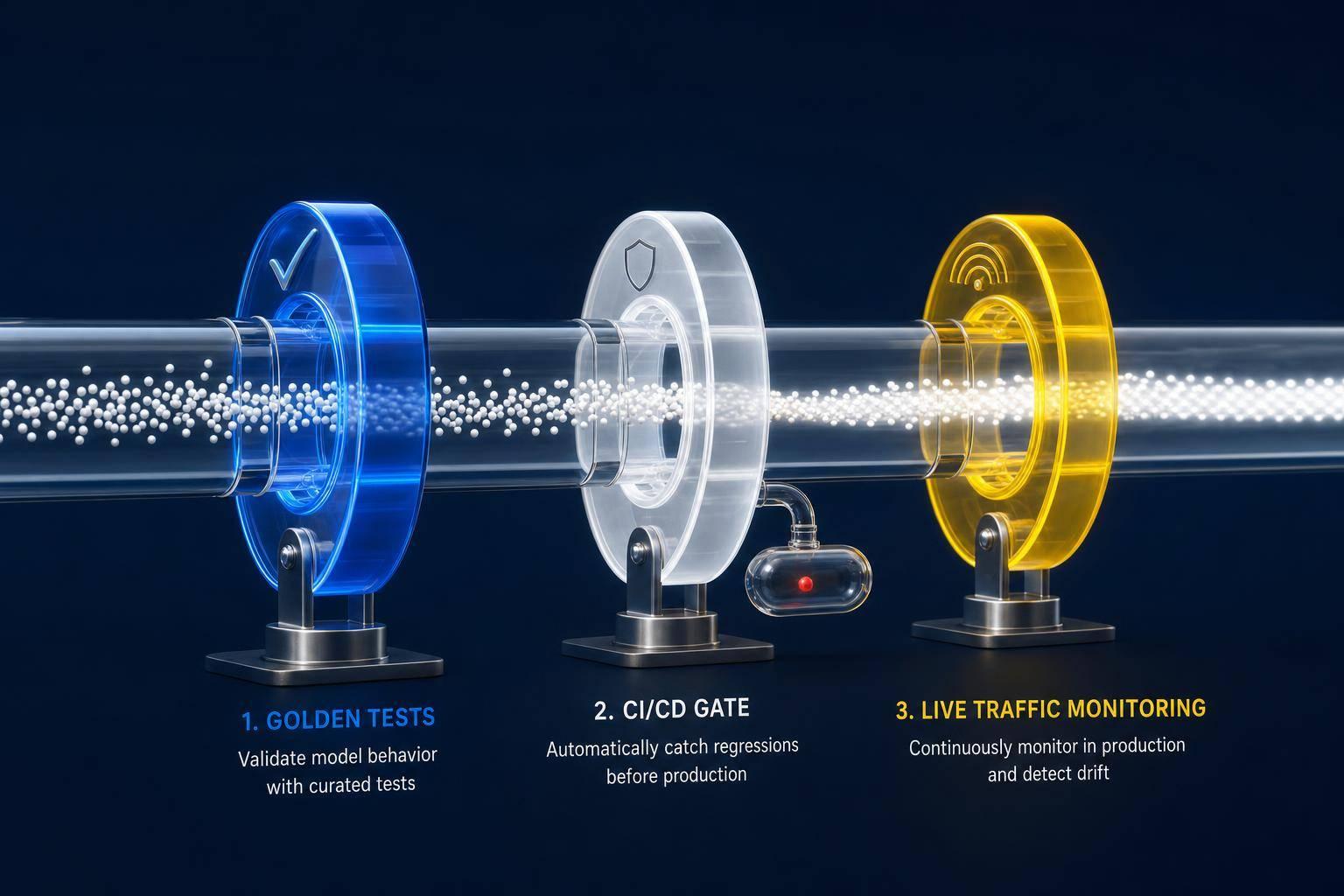
Clear ownership is essential for reliable AI systems. Learn how to delegate responsibilities across the AI reliability loop so teams can monitor, evaluate, and continuously improve AI performance in production.

César Miguelañez

Building reliable AI products requires more than good models. It requires clear ownership across every stage of the system's lifecycle. The reliability loop—the continuous process of monitoring, evaluating, and improving AI behavior—only works when teams know exactly who is responsible for what.
Most AI failures aren't technical. They're organizational. Teams ship features without defining who monitors production behavior, who reviews failures, or who decides when to iterate. The result is drift, degraded performance, and finger-pointing when things break.
This article explains how to delegate responsibilities across the reliability loop so your AI products improve continuously rather than decay.
What is the AI reliability loop?
The AI reliability loop is a continuous process for maintaining and improving AI system quality in production. It consists of five stages: running experiments, annotating feedback, discovering failure patterns, building automated evaluations, and iterating on improvements.
Unlike traditional software where you ship and fix bugs reactively, AI systems require proactive, cyclical improvement. Models drift. User behavior changes. Edge cases emerge that no one anticipated. The reliability loop turns this chaos into a controlled system.
Each stage of the loop feeds into the next. Experiments reveal real behavior. Annotations capture human judgment about that behavior. Pattern discovery turns scattered issues into actionable insights. Automated evaluations scale those insights. Iteration applies fixes and restarts the cycle.
Without clear delegation, the loop breaks. Experiments run but no one reviews them. Failures get flagged but no one owns the fix. Evaluations exist but no one acts on the results.
Why delegation matters for AI reliability
AI systems involve multiple disciplines: product management, engineering, data science, and domain expertise. No single team has the skills to own the entire reliability loop. Effective delegation ensures that each stage is owned by the team best equipped to execute it.
Delegation also prevents bottlenecks. If engineers own everything, annotation backlogs grow while they prioritize feature work. If product managers own everything, technical implementation stalls while they wait for engineering capacity.
The goal is parallel execution. While engineers instrument telemetry, domain experts review outputs. While data scientists build evaluations, product managers prioritize which failure patterns to fix first. Clear ownership enables this concurrency.
The five stages and who owns each
Stage 1: Run experiments
Experiments involve testing AI behavior with real or synthetic inputs to observe actual performance. This includes production traffic analysis, edge case testing, and A/B comparisons between prompt versions.
Primary owner: Engineers
Engineers own instrumentation and experiment infrastructure. They ensure telemetry captures the right signals—inputs, outputs, latency, costs, and metadata. They configure observability tools to surface traces and aggregate metrics.
Supporting role: Product managers
Product managers define what experiments should measure. They identify the user scenarios that matter most and prioritize which behaviors to test first.
Stage 2: Annotate feedback
Annotation is where humans mark what's working and what's failing. This requires judgment that AI cannot provide on its own—understanding context, intent, and quality in ways that automated metrics miss.
Primary owner: Domain experts
Domain experts—whether customer support specialists, legal reviewers, or subject matter authorities—provide the human judgment that grounds the reliability loop. They know what a good response looks like for their specific use case.
Supporting role: AI product managers
Product managers design annotation workflows, define labeling criteria, and ensure annotations are actionable. They translate business requirements into annotation guidelines that domain experts can apply consistently.
Stage 3: Discover failure patterns
Pattern discovery involves analyzing annotations to find recurring issues. Instead of treating each failure as isolated, teams identify systemic problems: the model hallucinates on certain topics, responses are too verbose in specific contexts, or certain input types consistently produce errors.
Primary owner: Data scientists
Data scientists have the analytical skills to find patterns in noisy data. They segment failures by input type, user cohort, or prompt version. They quantify how often patterns occur and estimate their impact.
Supporting role: Engineers
Engineers provide the data infrastructure that makes pattern discovery possible. They ensure traces are queryable, annotations are linked to telemetry, and dashboards surface relevant dimensions.
Stage 4: Build automated evaluations
Automated evaluations turn discovered patterns into repeatable tests. Instead of manually reviewing every output, teams create programmatic rules, LLM-as-judge evaluations, or composite scoring systems that run continuously.
Primary owner: Data scientists and engineers (shared)
Data scientists design evaluation logic—what to measure and how to score it. Engineers implement evaluations in production pipelines and integrate them with observability systems.
Supporting role: Domain experts
Domain experts validate that automated evaluations match their manual judgments. They review edge cases where automated scores diverge from human assessment and help refine evaluation criteria.
Stage 5: Iterate and improve
Iteration applies fixes based on evaluation results. This might involve prompt optimization, fine-tuning, retrieval pipeline changes, or architectural adjustments.
Primary owner: Engineers
Engineers implement changes to prompts, models, and infrastructure. They deploy updates and monitor whether improvements hold in production.
Supporting role: Product managers
Product managers prioritize which improvements to pursue based on business impact. They balance reliability fixes against feature development and communicate tradeoffs to stakeholders.
The AI product manager's role in the loop
The AI product manager does not own every stage, but they own the system. Their job is designing and maintaining the reliability loop itself: the feedback mechanisms, the metrics, the rituals that keep everything improving.
AI product managers define success criteria for each stage. They ensure handoffs between teams are clean. They escalate when the loop stalls—when annotations pile up, when patterns go unaddressed, or when evaluations stop running.
They also own the meta-question: Is this loop actually making our AI more reliable? They track reliability metrics over time and adjust the process when improvements plateau.
Common delegation mistakes
Mistake 1: Engineers own annotation
Engineers are skilled at building systems, not judging output quality. When engineers annotate, they apply technical criteria that may not reflect user expectations. Domain experts should always own annotation, even if engineers build the annotation tools.
Mistake 2: No one owns pattern discovery
Teams often annotate diligently but never analyze the annotations. Failures accumulate in spreadsheets that no one reviews. Pattern discovery requires dedicated time from data scientists—it won't happen automatically.
Mistake 3: Product managers skip evaluation design
Product managers sometimes delegate evaluation entirely to technical teams. But evaluations encode product requirements. If product managers don't define what "good" means, evaluations will optimize for the wrong outcomes.
Mistake 4: Iteration without measurement
Teams make changes without measuring whether those changes improved reliability. Every iteration should be tested against the evaluations that motivated it. Otherwise, you're guessing rather than improving.
Best practices for cross-team coordination
Establish shared rituals
Weekly reliability reviews bring all stakeholders together to examine failure patterns, evaluation trends, and iteration results. These meetings prevent silos and ensure the loop keeps moving.
Create clear handoff criteria
Define when each stage is complete and what the next team needs to proceed. Annotations aren't done until they're linked to traces. Patterns aren't actionable until they're quantified. Evaluations aren't ready until domain experts validate them.
Use shared tooling
When all teams work in the same observability and evaluation platform, handoffs are seamless. Engineers see the same traces that domain experts annotate. Data scientists build evaluations against the same data that product managers prioritize.
Document ownership explicitly
Ambiguity kills reliability loops. Create a responsibility matrix that names specific people—not just teams—for each stage. Review and update it as the team evolves.
How observability enables delegation
Observability platforms provide the shared infrastructure that makes delegation work. When telemetry, traces, and evaluations live in one system, teams can operate independently while staying aligned.
Engineers instrument once, and everyone benefits. Domain experts annotate directly on production traces. Data scientists query across all dimensions without waiting for data exports. Product managers monitor reliability dashboards without requesting custom reports.
The reliability loop depends on this shared visibility. Without it, each team operates in isolation, and the loop fragments into disconnected activities.
Frequently asked questions
Who should own the AI reliability loop overall?
The AI product manager owns the reliability loop as a system, ensuring all stages run continuously and handoffs between teams are clean. Individual stages are owned by the teams best equipped to execute them: engineers for experiments and iteration, domain experts for annotation, and data scientists for pattern discovery and evaluation design.
How do you prevent annotation backlogs from stalling the loop?
Set clear annotation targets and review them weekly. If backlogs grow, either increase domain expert capacity or narrow the scope of what gets annotated. Prioritize annotating failures over successes—failures drive improvement.
What happens when teams disagree about failure patterns?
Use data to resolve disagreements. Quantify how often a pattern occurs and estimate its user impact. If data is ambiguous, run a focused experiment to gather more evidence before committing to a fix.
How often should the reliability loop cycle?
Healthy teams complete at least one full cycle per week. Faster cycles—daily annotation reviews, continuous evaluation—accelerate improvement but require more coordination overhead. Start with weekly cycles and increase frequency as the process matures.