
Prioritize validated failure groups using consequence severity, observed failure rate, and distinct users affected. Then inspect release and cohort concentration, detection confidence, lifecycle, and fixability as separate decision modifiers. Raw error volume alone favors noisy bugs and can bury a rare unauthorized action that deserves immediate work.
What unit should you prioritize?
Prioritize a validated behavioral failure group. One trace is evidence. An error string is a technical signature. A failure group represents the user-facing problem across varied outputs and execution paths.
| Unit | Useful for | Why it fails as the backlog item |
|---|---|---|
| Individual trace | Reproduction and full trajectory review | One case gives no prevalence or boundary |
| Error string | Grouping deterministic failures | Different user consequences can share a string, and semantic failures may have no error |
| Saved filter | Repeating a known query | The query can drift from the actual bug definition |
| Semantic failure group | Combining varied examples under one behavior | Requires boundary validation and can merge unrelated causes |
| Lifecycle-managed issue | Priority, ownership, evidence, regression coverage, verification | Needs maintained examples, metrics, and human judgment |
Anthropic recommends turning user-reported and production failures into evaluation cases and prioritizing them by user impact. It also recommends inspecting full transcripts because an agent’s final claim can disagree with the environment outcome (Anthropic).
Before scoring a group, review positive and negative examples. Confirm that included traces share the same observable user consequence. Semantic similarity helps retrieve candidates; it does not establish one root cause.
How should you score severity?
Severity asks what happens when the failure occurs. The Partnership on AI frames real-time detection need through stakes and reversibility. Lee et al.’s interview study of 35 IBM developers found that production safety, agent performance, user adoption, client needs, perceived robustness, and mitigation burden shaped priority (Lee et al.).
Use a rubric with override conditions:
| Severity | Observable consequence | Reversibility | Examples | Override condition |
|---|---|---|---|---|
| Critical | Unauthorized or destructive action, sensitive-data exposure, regulated harm | Irreversible or hard to contain | Wrong transfer, deletion, privilege bypass | Escalate immediately even with one verified case |
| High | Core task fails or agent falsely reports success, causing material user loss | Recoverable with significant support or rework | Refund omitted, booking absent, wrong account changed | Escalate when a strategic or vulnerable cohort is affected |
| Medium | User must retry, correct the agent, or switch to a manual path | Usually recoverable in-session | Wrong tool choice, repeated clarification, stale retrieval | Raise when rate or trend grows after a release |
| Low | Friction with little effect on task completion | Easily reversible | Formatting defect, mild verbosity, cosmetic citation issue | Batch unless it affects a promised experience or accessibility |
Calibrate this rubric with product, support, security, and domain experts. A support assistant and a medical workflow cannot share the same consequence thresholds.
How do you measure exposure?
Keep each exposure metric separate:
- Occurrence count = number of matching failure events in the window.
- Failure rate = matching failures divided by eligible attempts.
- Affected-session share = sessions with at least one failure divided by eligible sessions.
- Distinct affected users = unique users with at least one validated failure.
For a window W:
failure_rate(W) = validated_failure_occurrences / eligible_attempts
affected_session_share(W) = affected_sessions / eligible_sessions
affected_user_share(W) = distinct_affected_users / eligible_distinct_users
These metrics answer different questions. Ten failures can mean ten users each failed once, or one user failed ten times. A traffic increase can raise the count while the rate falls. Session share avoids double-counting repeated loops inside one conversation, while distinct users shows reach.
Do not multiply rate, session share, and distinct users into one score. They are correlated views of exposure. Keep the worksheet visible so a reviewer can understand the decision.
When should a release or cohort override the global average?
A global average can hide concentrated damage. Slice every serious failure by:
- Release, prompt version, and response model.
- Environment, platform, locale, and workflow.
- New versus experienced users.
- Account tier, strategic account, or regulated cohort.
- Tool, retrieval source, or agent configuration.
Treat timing as association until a controlled comparison or reproduction establishes cause. If failure rate rises from 1% to 8% after a release, check sample sizes, traffic mix, model changes, and eligibility before blaming the release.
A cohort override is justified when the group has higher stakes or when concentrated failure blocks a strategic workflow. Document the reason. This prevents an informal VIP exception from silently changing the rubric.
How do confidence, lifecycle, and fixability change the decision?
Use them as modifiers:
| Modifier | Question | Effect on sequencing |
|---|---|---|
| Detection confidence | Are examples truly the same failure? | Low confidence triggers validation before a broad fix |
| Reproducibility | Can the team replay or reliably trigger it? | Low reproducibility favors instrumentation and test creation first |
| Trend | Is rate rising, stable, or falling? | A verified rise increases urgency |
| Lifecycle | Is the issue new, ongoing, escalating, resolved, or regressed? | Regression receives added urgency because protection failed |
| Ownership | Is one team responsible for the relevant system boundary? | Unclear ownership requires assignment before work starts |
| Rollback | Can the risky change be safely reversed? | A cheap safe rollback may precede diagnosis |
| Fixability | Is there a bounded intervention with regression coverage? | Helps sequence equal-impact work; it should not erase severity |
Lee et al. found that developers weighed both perceived robustness and mitigation difficulty. Anthropic recommends multiple trials when outcomes vary and human calibration for model-based graders. These support a practical rule: uncertain detection lowers confidence in the ranking, while verified severe evidence can still justify containment.
What should the priority worksheet contain?
| Failure group | Severity | Occurrences | Failure rate | Affected sessions | Distinct users | Trend | Release/cohort | Confidence | Fixability | Decision |
|---|---|---|---|---|---|---|---|---|---|---|
| Unauthorized account action | Critical | 1 | 0.02% | 1 | 1 | New | Admin workflow | High | Immediate containment available | Contain and fix now |
| Repeated tool loop | Medium | 420 | 6.4% | 310 | 188 | Rising | Release 2026.08.24 | High | Bounded argument-validation fix | Next after containment |
| Verbose final answer | Low | 1,800 | 19% | 1,500 | 940 | Stable | Broad | Medium | Easy prompt edit | Batch after higher-impact work |
The figures above are illustrative. They demonstrate the decision shape and must never be presented as Latitude production data.
What can this worksheet fail to tell you?
- A detector can produce false positives or miss affected users.
- Similarity can combine different root causes.
- Correlated exposure metrics can create false precision.
- Release timing does not establish causality.
- Users who abandoned before identification may be absent from distinct-user counts.
- A low-frequency event may have severe unobserved consequences.
How do common priority patterns resolve?
Use this decision tree:
- Is there a verified irreversible, unauthorized, regulated, or safety consequence?
- Yes: contain and investigate immediately.
- No: continue.
- Is the failure blocking the core task or creating false success?
- Yes: prioritize by affected-user reach, rate, and cohort stakes.
- No: continue.
- Is the rate rising or concentrated after a release?
- Yes: verify the association and consider rollback.
- No: continue.
- Is the issue frequent but recoverable?
- Yes: compare user effort, abandonment, and support burden.
- No: batch it with lower-impact quality work.
- Between equal-impact bugs, which has clearer reproduction, ownership, and regression coverage?
- Sequence the bounded fix first while preserving the other issue’s owner and lifecycle.
This avoids two bad defaults: fixing the loudest count and fixing the easiest ticket.
How do you verify the selected priority?
Read complete traces from failures and nearby successes. Confirm:
- The final user consequence.
- The first divergent span or decision.
- The tool or environment outcome.
- The prompt, model, release, and cohort context.
- The failure group’s precision against reviewed examples.
- The denominator and time window behind every rate.
NIST’s AI Risk Management Framework says policies and resources should be prioritized according to assessed risk and potential impact (NIST AI RMF). The trace review supplies the observed evidence that turns a broad risk judgment into an engineering decision.
How does the chosen bug become regression coverage?
- Save representative positive and negative examples.
- Define the expected outcome or prohibited action.
- Choose a deterministic assertion where possible.
- Calibrate any semantic evaluator against human labels.
- Run the case across several trials if the outcome varies.
- Attach the test to the code or prompt change.
- Monitor the same failure rate after deployment.
A regression case protects the reason the bug was prioritized. Otherwise, the backlog decision disappears after the ticket closes.
What does this look like in Latitude?
Latitude represents a recurring production failure as a Signal with examples, occurrence count, affected-session share, trend, source, monitoring state, and lifecycle. Users analytics can show whether the pattern concentrates in particular users or cohorts.
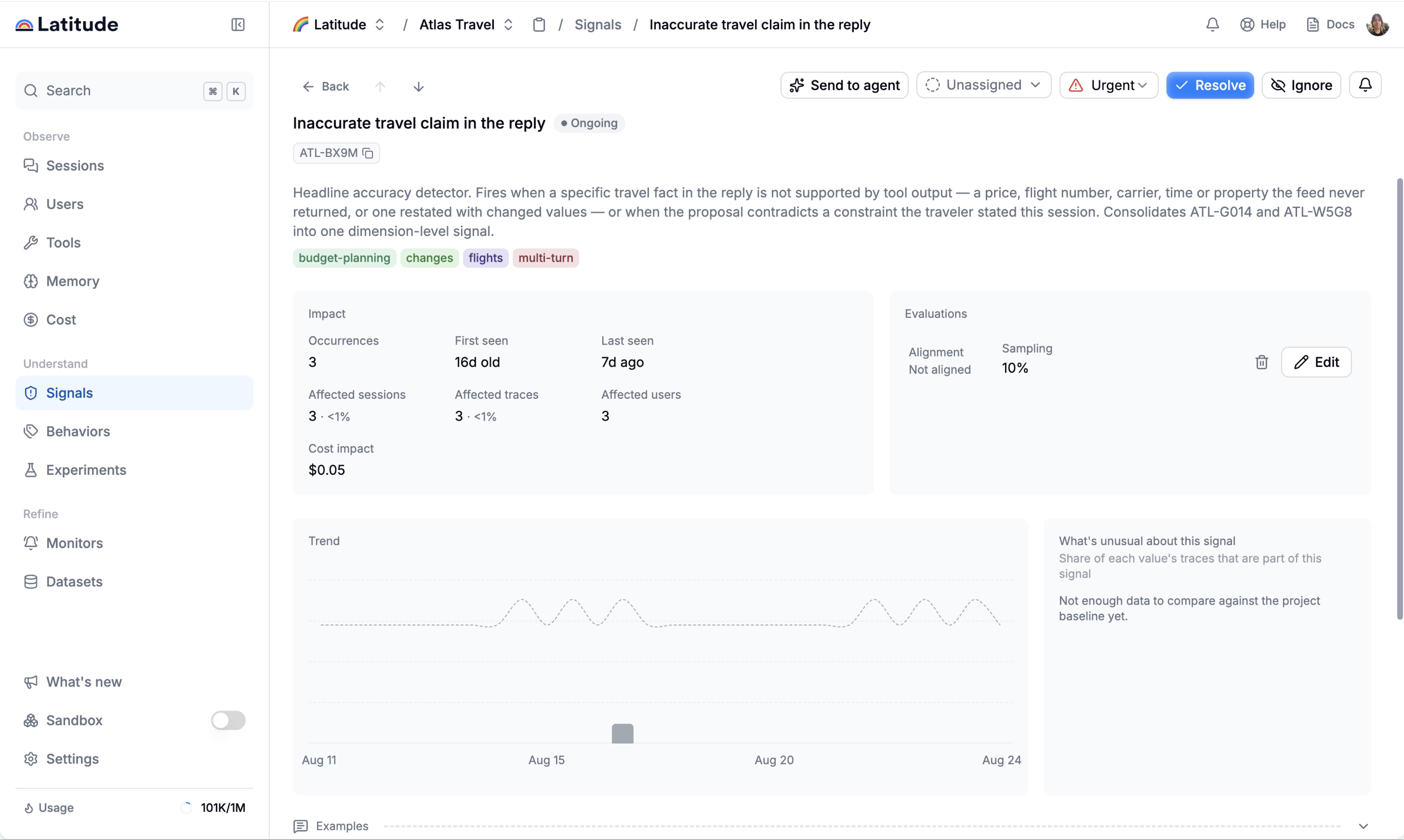
Gerard from Latitude’s engineering team describes a Signal as “the only one that can track that signal over a large data corpus and long time horizon.” That lifecycle matters during prioritization because a regressed high-impact issue deserves different treatment from a new low-confidence cluster.
A verified internal example shows a tool-call Signal trend falling from 8 occurrences to 3, then 2, then 0. The evidence demonstrates the verification method, though it does not establish a universal resolution-time claim. For a chosen failure, Latitude can send the Signal definition and sample traces to the team’s coding agent. That agent opens a PR with the smallest fix and a regression test. A human merges it, and the Signal trend checks whether production occurrences decline.
Frequently asked questions
Should priority equal severity times frequency?
Use that as a rough discussion aid only. No industry standard establishes this formula. Frequency can also double-count one user or correlate with session share. Keep severity, rate, and user reach visible.
How many traces validate a failure group?
There is no universal count. Review enough positive and negative examples to understand the group’s boundary, include varied cohorts and releases, and run repeated trials when agent outcomes vary.
Should a rare critical bug outrank a common usability bug?
Usually yes when the critical consequence is verified and difficult to reverse, such as an unauthorized action or sensitive-data exposure. Containment may precede the full fix.
How should fix effort affect priority?
Use fixability to sequence work with comparable user impact. Do not let easy cosmetic fixes displace severe failures. A safe rollback or containment can be worthwhile before a longer root-cause fix.
What if distinct user IDs are unavailable?
Use affected sessions and clearly label the limitation. Avoid presenting sessions as users. Add privacy-safe user identifiers if user reach is important to future prioritization.
When is a bug fixed?
The code change is one checkpoint. The regression test must pass, and the production failure rate should decline over a comparable window without creating a different high-impact failure.