
Most LLM teams do not suffer from a lack of metrics. They suffer from the wrong kind of confidence.
A model can look strong on public benchmarks, pass a few demo prompts, and still fail in production in ways that matter: silent hallucinations, inconsistent behavior, brittle prompt sensitivity, or regressions after an update. The video’s central warning is simple but important: many online LLM evaluations are misleading , especially when they rely on synthetic benchmarks or shallow scoring methods that do not reflect real use.
For developers and AI engineers shipping LLM features, this is the difference between “the model seems good” and “the system is operationally reliable.”
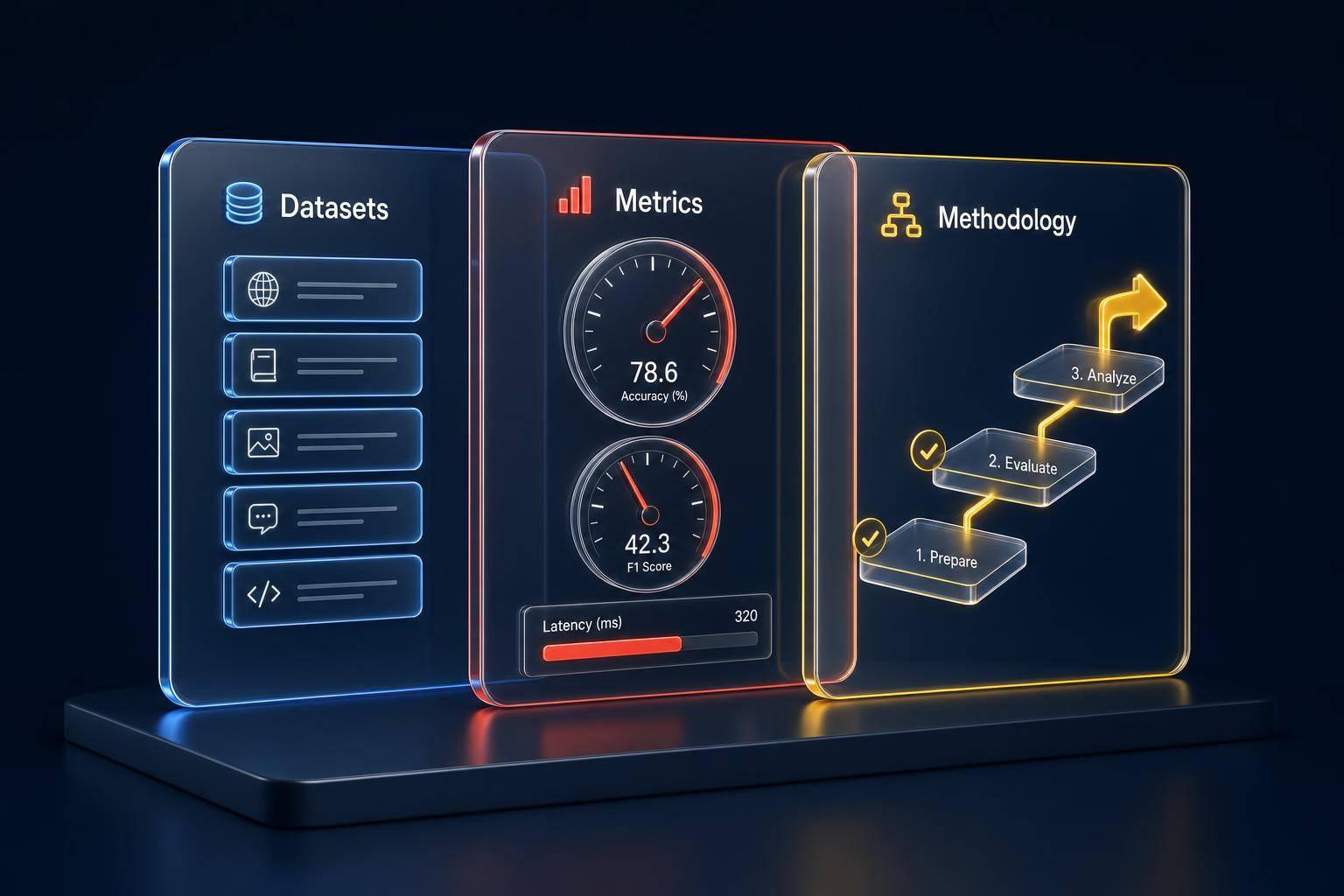
Based on the video’s discussion of Google’s paper on practical LLM evaluation, the most useful framework is built around three pillars :
-
Datasets
-
Metrics
-
Methodology
That framing is not new in theory. What matters is how rigorously you apply it in production settings, where evaluation must do more than rank models. It must help you detect failure modes, compare system changes, and prevent regressions.
Key Takeaways
-
Do not rely on generic benchmark scores alone. They are often too detached from production behavior to predict real-world quality.
-
Build evaluation around three pillars: datasets, metrics, and methodology. Weakness in any one of them can invalidate your conclusions.
-
Use the 5D dataset principle : defined scope, demonstrative of production use, diverse, decontaminated, and dynamic.
-
Treat human-annotated “gold” datasets as your highest-quality source of truth, even if they are expensive.
-
Use synthetic “silver” datasets to scale coverage, but only with careful review to reduce bias and contamination.
-
Avoid over-trusting word-overlap metrics. They can reward responses that look similar while missing factual errors.
-
Prefer metrics that evaluate meaning and factual consistency , not just lexical similarity.
-
Account for non-determinism. The same prompt can produce different outputs, so single-run evaluation is often insufficient.
-
Watch for safety/helpfulness trade-offs , such as models becoming overly cautious and refusing answerable questions.
-
Turn evaluation into a continuous loop , not a one-time project. Production behavior changes, and your evals should evolve with it.
Why So Many LLM Evaluations Fail in Practice
A recurring issue in LLM evaluation is the mismatch between what gets measured and what users actually experience.
A benchmark may tell you whether a model can answer a narrow class of questions under controlled conditions. But production systems are rarely that neat. They involve:
-
changing user inputs
-
noisy or incomplete context
-
orchestration logic
-
retrieval pipelines
-
safety policies
-
prompt revisions
-
model version changes
-
latency and cost constraints
This is why a strong benchmark score can still leave teams exposed. The video emphasizes that synthetic benchmarks are often no longer enough. They can be useful as a starting point, but they may not reflect the specific tasks, failure patterns, or risk profile of your application.
For teams already running AI agents or LLM-powered workflows, the real question is not “Which model wins a leaderboard?” It is:
Can this system perform reliably on the tasks my users actually care about, under the conditions they actually create?
A Practical Framework: Datasets, Metrics, Methodology
The paper discussed in the video organizes evaluation around three components. This is a strong mental model because it forces teams to separate concerns.
1. Datasets: What exactly are you testing?
If your dataset is weak, every metric built on top of it becomes less meaningful. The video highlights a memorable framework for dataset quality: the 5Ds.
The 5Ds of LLM Evaluation Datasets
Defined
Your evaluation scope must be explicit.
Are you testing:
-
customer support response quality?
-
coding assistance?
-
retrieval-grounded question answering?
-
summarization for internal documents?
-
refusal behavior under unsafe requests?
Without clear scope, teams create broad but shallow eval sets that produce ambiguous results. A production-grade eval starts with a specific contract: what behavior should this system reliably exhibit?
Demonstrative of production usage
This may be the most important criterion for applied AI teams.
Your eval data should resemble what users actually do in production, not what is convenient to collect. That includes:
-
realistic prompt phrasing
-
edge cases
-
incomplete inputs
-
adversarial or ambiguous requests
-
domain-specific terminology
-
real task difficulty
A polished synthetic prompt set can make an app look better than it is. A representative production-derived dataset often does the opposite: it reveals where the system is fragile.
Diverse
Diversity means more than covering many topics. It should include variation across:
-
user intent
-
difficulty
-
output format
-
tone
-
domain language
-
failure type
-
demographic or linguistic variation, where relevant
For engineering teams, diversity is what helps uncover hidden pockets of failure instead of averaging them away.
Decontaminated
The video calls this out as critical: if your evaluation examples overlap with training data, you may be measuring recall rather than reasoning.
This matters even more when using public benchmarks or common online datasets. If a model has effectively “seen the test” before, results can be inflated. Decontamination is also relevant when generating synthetic evaluation data from another LLM: leakage and pattern reuse can create an evaluation that is less independent than it appears.
For production teams, the practical lesson is simple: assume contamination risk exists unless you have reason to believe otherwise.
Dynamic
A static eval set decays quickly.
Products evolve. User behavior shifts. New failure modes appear after a feature launch, retrieval change, or model upgrade. The video describes evaluation datasets as something like a living asset, and that is exactly the right operational mindset.
A mature eval program versions datasets, audits them regularly, and adds new cases from:
-
support escalations
-
production incident reviews
-
red-team exercises
-
newly discovered edge cases
-
regressions from recent releases
If your eval set never changes, it gradually stops measuring the system you actually run.
Gold vs. Silver Datasets: Quality, Cost, and Scale
The video distinguishes between golden datasets and silver datasets , which is one of the most useful production concepts in modern LLM evaluation.
Gold datasets: high trust, high cost
Gold datasets are created or verified by humans, ideally domain experts. These are your strongest evaluation assets because they provide a more reliable reference point for correctness, quality, and policy alignment.
They are especially valuable when evaluating:
-
correctness in regulated or high-risk domains
-
nuanced preference judgments
-
policy compliance
-
domain-specific reasoning
-
user-facing quality thresholds
The downside is obvious: they are slow and expensive to produce. Consistency across annotators is also difficult, especially when the “right answer” is not purely objective.
For that reason, most strong teams reserve gold data for the highest-value and highest-risk slices of behavior.
Silver datasets: scalable, but not self-validating
Silver datasets are generated synthetically, typically with the help of LLMs. Their appeal is scale: you can create many more examples, cover more patterns, and expand eval breadth quickly.
But the video correctly notes the risk: the generator can imprint its own biases, blind spots, and stylistic assumptions into the dataset.
That creates several problems:
-
synthetic prompts may be unnaturally clean
-
generated references may reflect one model’s preferences rather than user value
-
contamination becomes harder to reason about
-
failure modes can be underrepresented because the generator tends to produce “answerable” cases
Used carelessly, silver data can turn evaluation into an echo chamber.
Used well, it becomes a force multiplier. The best operational use is usually:
-
generate synthetic candidates at scale
-
apply filtering or self-critique mechanisms
-
perform targeted human review
-
promote only trusted subsets into higher-confidence eval pools
The video briefly mentions constitutional AI and self-critique as ways to guide synthetic generation. That can help, but it is not a substitute for external validation.
Metrics: If You Measure the Wrong Thing, You Reward the Wrong Behavior
Once you have a dataset, the next question is how to score outputs.
This is where many LLM evaluations break down. Teams often use familiar NLP metrics because they are easy to automate, but convenience is not the same as validity.
Why word overlap can be dangerously misleading
One of the video’s strongest examples is a case where a factually wrong answer scores higher than a correct answer because it uses more overlapping words from the reference.
That example captures a broader issue: surface similarity is not semantic correctness.
Metrics based largely on overlap can fail when:
-
a correct answer uses different wording
-
a wrong answer copies key phrases
-
a concise answer omits expected lexical patterns
-
multiple valid outputs exist
This is especially problematic for production systems where quality depends on factuality, intent fulfillment, and policy adherence rather than matching a single reference sentence.
For engineers, the takeaway is practical: if your metric rewards phrasing instead of truth, your optimization loop will drift in the wrong direction.
Better metric categories for LLM systems
The video references several stronger classes of metrics.
Semantic similarity
These methods attempt to score whether the response means roughly the same thing as the reference, even when wording differs. They are often more appropriate than naive lexical metrics for summarization, paraphrase-heavy tasks, or assistant responses.
Still, semantic similarity is not enough on its own. A response can be semantically close in style while still containing a critical factual error.
Entailment or natural language inference
This category is especially useful when correctness matters.
Instead of asking whether two texts “look similar”, entailment-style evaluation asks whether the generated answer is supported by the reference or whether it contradicts it. This is often a better fit for factual QA, grounded generation, and policy-sensitive tasks.
The video presents this as closer to a built-in fact-checking logic, which is a helpful way to think about it.
LLM-as-judge or auto-raters
The video also notes the use of model-based evaluators to score traits like:
-
fluency
-
factuality
-
quality
-
relevance
This is increasingly common in production eval stacks because it scales better than full human review and often captures dimensions that overlap metrics miss.
But this approach needs guardrails. An LLM judge can itself be biased, inconsistent, or over-permissive. If you use model-based evaluators, you should validate them against a trusted human-labeled subset. Otherwise, you are simply moving the evaluation problem one layer up.
Quantitative and qualitative evaluation both matter
The video distinguishes between quantitative and qualitative metrics, which matters for production governance.
A score alone rarely tells you why a system failed. Teams need both:
-
quantitative signals for trend tracking, regression detection, and release gating
-
qualitative review for error taxonomy, debugging, and root cause analysis
If you only optimize numeric scores, you risk building a system that performs well on paper while remaining brittle in real use.
Methodology: The Most Overlooked Part of LLM Evaluation
For many teams, “evaluation” means dataset plus metric. The video makes the case that methodology is the third pillar for a reason.
Methodology determines whether the results are reproducible, interpretable, and operationally useful.
Three methodological issues production teams cannot ignore
1. Non-determinism
LLMs do not always produce the same output for the same prompt. This matters because single-run evaluation can produce unstable conclusions.
If one model gets lucky on a run, or one prompt variation triggers a different answer path, your comparison may be noisy rather than meaningful.
The video points to self-consistency as one workaround: run the same prompt multiple times and aggregate the outputs, for example by majority behavior. Even if you do not use majority voting literally in production, repeated sampling can reveal variance, which is itself a useful reliability signal.
For applied teams, variance should be tracked as a first-class metric. A system that is occasionally brilliant but often unstable may be less valuable than one that is consistently good.
2. Prompt sensitivity
Small wording changes can alter model behavior significantly. This means your eval result may reflect prompt phrasing as much as actual capability.
In agent systems, prompt sensitivity is even more important because behavior can shift based on:
-
system prompt changes
-
tool descriptions
-
context ordering
-
retrieval formatting
-
hidden chain scaffolding
A robust evaluation process should test not just canonical prompts, but sensitivity around them. If slight prompt changes collapse performance, you have found a reliability issue, not just an evaluation quirk.
3. Hallucination and over-refusal trade-offs
The video notes a subtle but important tension: if you push the model hard to avoid fabricating answers, it may become too cautious and refuse queries it could answer correctly.
This is a classic production trade-off:
-
too permissive, and the system invents
-
too restrictive, and the system becomes frustratingly unhelpful
The right balance depends on the application. A medical triage assistant and a creative writing copilot do not need the same refusal profile. That is why methodology must be aligned to product risk, not just generic model behavior.
Evaluation Is Not a One-Time Test. It Is a Loop
One of the most valuable ideas in the video is that evaluation should be treated as a feedback loop , not a final exam.
That means the output of evals should feed directly into:
-
dataset updates
-
prompt improvements
-
model routing changes
-
policy tuning
-
retrieval adjustments
-
regression suites
-
launch decisions
This is where many teams fall short. They run evaluations to justify adoption, then stop. But the real value of evaluation begins after launch, when it becomes the mechanism for learning from production.
For companies with LLMs already in market, the eval loop should be tied to change management:
-
before model upgrades
-
after prompt changes
-
when adding tools or retrieval
-
after incidents
-
during rollout experiments
-
as part of regular quality reviews
The paper’s framework becomes much more powerful when connected to operational discipline.
A Production-Oriented Workflow You Can Apply
The video does not present a full implementation playbook, but it points toward one. For teams in production, a practical workflow would look like this:
1. Define the behaviors that matter
Start with concrete tasks and failure risks:
-
What should the system do well?
-
What failures are unacceptable?
-
Which behaviors are user-visible versus internal?
2. Build a representative eval set
Use the 5Ds:
-
define scope
-
mirror production usage
-
cover diversity
-
reduce contamination risk
-
keep it updated
3. Separate gold and silver data
Use:
-
gold for high-confidence release decisions
-
silver for broad coverage and rapid iteration
4. Choose metrics that map to product value
Avoid over-reliance on overlap metrics. Include measures that capture:
-
semantic correctness
-
contradiction
-
factuality
-
policy compliance
-
consistency
5. Test methodology, not just outputs
Probe:
-
run-to-run variance
-
prompt sensitivity
-
refusal behavior
-
hallucination patterns
-
component-level issues in multi-step systems
6. Analyze failures qualitatively
Create error categories so that results are actionable:
-
retrieval failure
-
instruction-following miss
-
unsupported claim
-
formatting error
-
unnecessary refusal
-
tool misuse
7. Turn findings into regression tests
Every important production failure should either:
-
become a new eval case, or
-
strengthen an existing eval slice
That is how an eval program compounds over time.
What This Means for AI Leaders and Technical Decision-Makers
For CTOs, heads of AI, and technical leads, the broader lesson is governance-oriented: LLM quality cannot be managed with benchmark screenshots and ad hoc prompt checks.
A scalable AI quality process needs:
-
agreed-upon evaluation objectives
-
versioned datasets
-
trusted scoring methods
-
release criteria
-
incident feedback loops
-
documented trade-offs between safety, helpfulness, and cost
This is not just an ML research concern. It is part of software reliability.
In traditional engineering, teams would not ship a critical backend service without testing strategy, regression coverage, and monitoring. LLM systems deserve the same seriousness, even if the failure modes are probabilistic rather than deterministic.
The Most Important Shift: From Model Evaluation to System Evaluation
A subtle but important implication of the video is that teams should stop thinking only about evaluating “the model” and instead evaluate the full LLM-based system.
In production, users do not experience raw model capability. They experience:
-
prompts
-
context injection
-
retrieval quality
-
tool execution
-
safety layers
-
post-processing
-
fallback logic
This means a model swap that looks positive on a benchmark might still degrade the product if it interacts poorly with your surrounding system. Likewise, a smaller model with better prompt design and tighter eval discipline may outperform a larger model in actual business outcomes.
That is why the paper’s emphasis on practical evaluation is so relevant: it shifts the focus from abstract capability to dependable behavior.
Conclusion
The video’s biggest contribution is not a new metric or dataset recipe. It is the reminder that LLM evaluation is only useful when it matches production reality.
A credible evaluation program requires all three pillars:
-
Datasets that reflect real usage and evolve over time
-
Metrics that capture meaning, correctness, and quality rather than superficial similarity
-
Methodology that accounts for non-determinism, prompt sensitivity, and trade-offs like hallucination versus over-refusal
For production AI teams, this is the path away from false confidence.
If your current eval process mostly consists of public benchmarks, a handful of happy-path prompts, and a single numeric score, that is not a reliability strategy. It is a demo strategy.
The more useful mindset is operational: build evals that expose failure, explain it, and prevent it from coming back. That is how LLM evaluation becomes a shipping discipline rather than a research ritual.
Source: “Decode Papers with AI - Ep 5: How to Evaluate LLMs Properly (Google Paper)” -Laks AI Channel, YouTube, Apr 5, 2026 -https://www.youtube.com/watch?v=egqU3SdD9YY