
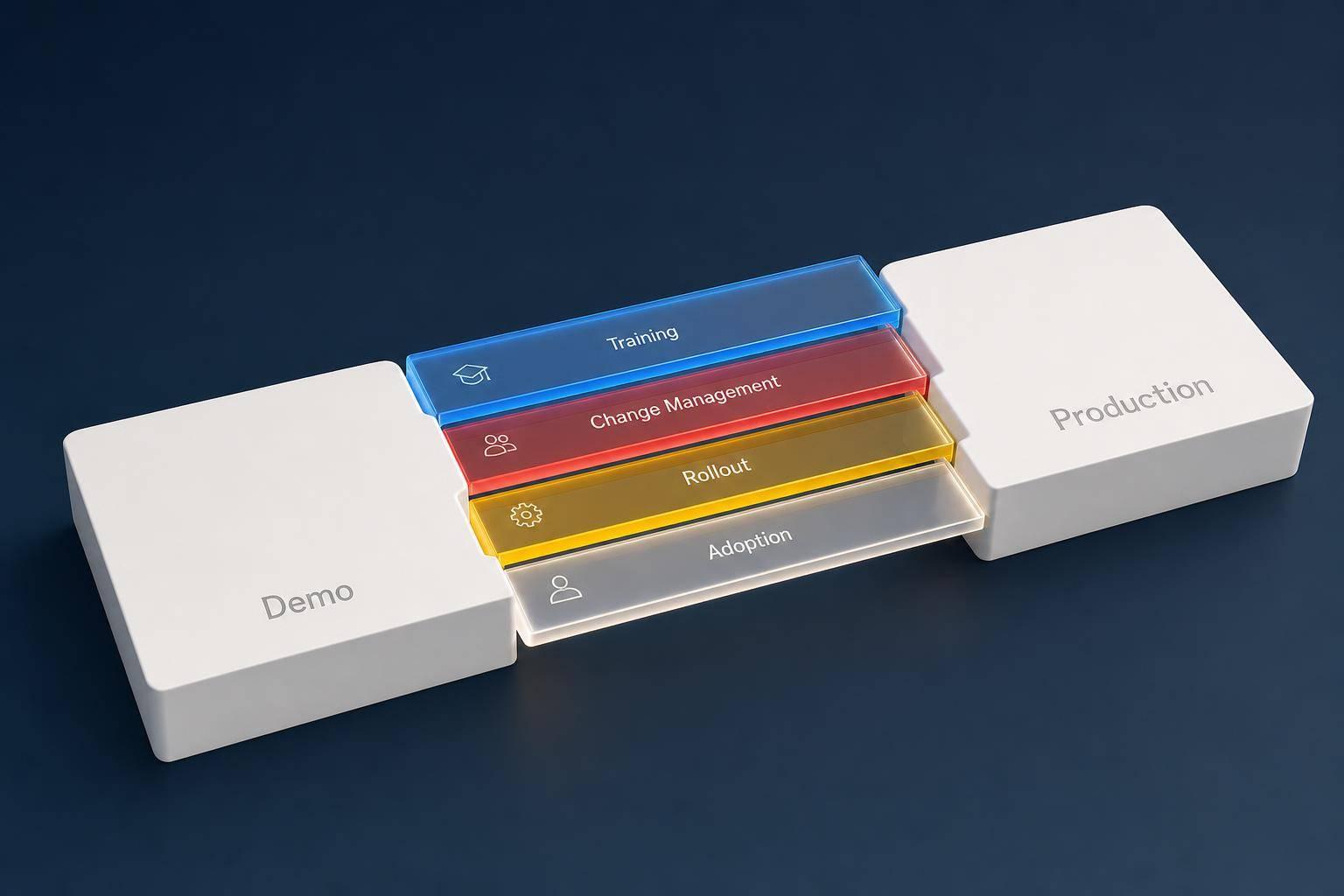
Enterprise teams rarely fail because a model looked bad in a demo. They fail because the system that looked promising in a controlled environment never becomes a reliable part of day-to-day operations.
That was the core theme in a discussion with Vishnu Gatla, a senior professional services consultant at F5, whose experience spans production infrastructure, application delivery, automation, and enterprise rollouts. His perspective is especially relevant for teams running AI features in production today: the hardest part is often not shipping the capability, but getting the organization to trust, operate, and sustain it under real-world pressure.
For developers, AI engineers, and technical leaders responsible for production AI, this is a useful reframing. The gap between an impressive AI proof of concept and a dependable production system is usually not caused by model quality alone. It emerges from workflow misalignment, weak operational ownership, poor training, and the absence of measurable post-launch success criteria.
Why “Production Success” Is Often Misdiagnosed
One of the strongest insights from the conversation is that failure in enterprise rollouts is often subtle.
It usually does not appear as an immediate outage or a dramatic launch-day collapse. Instead, the rollout appears healthy at first:
-
traffic flows
-
dashboards stay green
-
leadership assumes the launch worked
-
teams report initial success
Then the slower failure begins. Over time, operators hit edge cases, incidents take longer to resolve, people quietly revert to older tools, and some workloads get routed back to legacy systems. In other words, the platform technically went live, but the organization never fully adopted it.
For AI teams, this pattern should sound familiar. Many LLM features “work” in staging and early user testing. But once real prompts, real users, and real business workflows show up, the cracks appear:
-
hallucinations become support issues
-
response quality varies across segments
-
agents fail in multi-step tasks
-
humans create workarounds outside the intended system
-
teams lose confidence and reduce usage
The lesson is simple: launch is not validation. Sustained operational use is.
The Most Common Rollout Mistake: Treating Change as a Purely Technical Deployment
Gatla pointed to a common enterprise mistake: teams approach rollouts as if they are deploying technology, when they are actually introducing operational change.
That distinction matters.
A new platform can be technically sound and still fail if the people responsible for production support do not change how they work. He used automation as an example: organizations may invest in automated upgrades, deployments, and configuration management, and the tooling may function well. But when production pressure rises, engineers often return to the manual methods they already trust.
This is highly transferable to AI systems.
An enterprise may ship:
-
an internal copiloting tool
-
an automated support triage agent
-
a retrieval-augmented knowledge assistant
-
a workflow orchestration layer for model calls
But if the real users and operators still rely on manual review paths, spreadsheets, Slack escalation habits, or old ticketing flows, then the AI system has not actually changed the business. It has only been added beside it.
What this means for AI teams
If you own an AI product in production, do not ask only:
-
Did the model deploy?
-
Did latency meet target?
-
Did the eval suite pass?
-
Did the endpoint stay up?
Also ask:
-
Which human workflow changed because of this system?
-
What legacy behavior are we expecting teams to stop doing?
-
Who owns that change?
-
How will we know people trust the system under pressure?
Without clear answers, adoption can stall even when technical metrics look acceptable.
Culture and Change Management Are Not “Soft Issues”
A recurring point in the discussion was that culture often matters more than the technology itself. That is not because the technology is irrelevant. It is because operational systems succeed only when people trust them enough to depend on them.
In many organizations, teams keep their existing approval chains, escalation paths, and habits even after a new platform arrives. If the new system feels risky, unclear, or disconnected from daily work, people will default to what feels safer.
For AI in production, this is one of the most overlooked sources of reliability problems.
Consider a few familiar examples:
1. AI support assistant
If support teams do not trust the assistant’s answers, they will ignore it or double-check everything manually. Your usage metrics may look fine, but time-to-resolution may not improve.
2. AI code generation workflow
If engineers see generated output as fragile, they may spend more time validating than they would writing directly. The tool is “adopted”, but productivity does not actually improve.
3. Agent-based operations system
If incident responders do not trust the remediation suggestions, they will bypass the agent during high-severity events, which is exactly when the system matters most.
This is why “change management” should not be dismissed as non-technical overhead. For AI products, it is tightly connected to trust calibration, error handling, review policies, and accountability.
Warning Signs That a Rollout Is Headed for Trouble
One of the most practical parts of the discussion was the identification of early warning signs. These are useful for any enterprise system, but they map especially well to AI rollouts.
The system looks good in demos, but operators do not use it in real workflows
A polished demonstration proves very little about real operational fit. If the people who handle production incidents or user escalations are not integrating the tool into their day-to-day process, risk is accumulating off-screen.
For AI teams, this often appears as:
-
strong stakeholder enthusiasm but low operator usage
-
positive internal demos but frequent bypassing in production
-
“experimental” status that never transitions into a default workflow
Operations teams were not deeply involved in testing
Engineering may validate functionality, but operations owns the midnight failure mode. If operational teams are absent from rollout testing, the system may pass functional checks while remaining operationally fragile.
In AI systems, this means your rollout is incomplete if you have not tested:
-
failure routing
-
human escalation behavior
-
low-confidence outputs
-
prompt injection or unsafe input handling
-
degradation modes during vendor/API issues
-
observability for bad outputs, not just infrastructure failures
The team says it will “figure out the process later”
This is one of the clearest danger signals. When workflow questions are postponed until after go-live, teams are effectively admitting that they do not yet know how the system will run in production.
That is especially dangerous with LLMs because production behavior is rarely static. Model performance varies with user behavior, context quality, integrations, and prompt drift. If the process is unresolved before launch, the burden will land on support and operations after launch.
What Organizations Should Measure 6 to 12 Months Later
Launch metrics can be misleading. A successful rollout should be judged by whether the organization works differently months later, not whether the implementation day went smoothly.
Gatla highlighted four categories worth measuring. They translate well to AI reliability programs.
1. Depth of adoption
The question is not whether teams touched the system. It is whether they use it meaningfully.
For AI products, measure:
-
active usage in real workflows
-
usage across roles, not just early champions
-
percentage of tasks completed with the AI system
-
use of advanced capabilities versus only basic features
A shallow adoption pattern often means teams are extracting limited value or avoiding riskier workflows.
2. Reduction in manual work and workarounds
This is one of the best indicators of genuine transformation.
Look for:
-
fewer manual overrides
-
fewer shadow processes
-
reduced copy-paste between systems
-
fewer fallback handoffs outside the official flow
If workarounds are growing, the rollout may be failing even if usage numbers are rising.
In AI systems, growing workaround behavior can indicate:
-
unreliable outputs
-
poor retrieval quality
-
inadequate review controls
-
confusing failure boundaries
-
low trust in autonomous decisions
3. Incident resolution time
For production systems, the real test is whether teams handle issues more effectively after adoption.
AI-specific variants include:
-
time to detect bad outputs
-
time to triage quality regressions
-
time to isolate prompt, model, or retrieval failures
-
time to recover from vendor degradation
-
repeat incident frequency
If incidents are not getting easier to resolve, the system may have increased complexity without improving outcomes.
4. Change success rate
This is particularly relevant for teams shipping prompts, evaluation logic, routing rules, guardrails, or model upgrades.
Track whether releases are becoming:
-
safer
-
more predictable
-
easier to validate
-
less likely to cause regressions
A mature AI rollout should eventually improve release confidence. If every change feels risky, you may still be in demo-mode architecture wearing production clothes.
Key Takeaways
-
A successful launch is not the same as a successful rollout. Judge adoption by what changes in daily operations months later.
-
The biggest failure mode is behavioral, not technical. Teams often deploy the system but keep using old workflows.
-
Do not confuse demo success with production readiness. If operators are not using the system under pressure, the rollout is incomplete.
-
Involve operations early. The people who handle incidents need to help test, validate, and shape the production workflow.
-
Measure reduction in workarounds. Rising manual overrides or fallback behaviors are strong signs of hidden failure.
-
Define the operating model before launch. Decide who owns the workflow, what legacy process will be retired, and how success will be measured after 6–12 months.
-
Treat training as continuous. One-time onboarding is rarely enough for complex systems, especially AI systems with evolving behavior.
-
Track trust, not just uptime. If teams do not trust outputs in real scenarios, technical availability alone means little.
-
Use change success rate as an AI maturity metric. If prompt, model, or workflow updates still create fear, your production process needs strengthening.
Start With the Operating Model, Not the Product
One of the most useful recommendations from the conversation was to begin with the operating model.
Instead of asking, “Did we deploy the platform?” the better question is: How will the organization run differently once this exists?
This is exactly the right lens for AI teams.
Before introducing a new AI capability, define:
Who owns the new workflow?
Ownership must go beyond engineering. Someone needs responsibility for:
-
output quality
-
failure handling
-
human review policy
-
escalation path
-
release approval
-
monitoring and regression response
If ownership is fuzzy, reliability will be fuzzy too.
Which old tools or processes will be retired?
A rollout rarely succeeds if the old system remains the trusted default forever.
For AI teams, that could mean retiring:
-
manual ticket categorization
-
legacy search-only support tools
-
brittle decision trees
-
spreadsheet-based review loops
-
ad hoc prompt experimentation without evaluation gates
If nothing is intentionally retired, the new system may remain optional indefinitely.
How will success be measured after 6 to 12 months?
This needs concrete definitions upfront. Not vanity metrics. Not launch-day optimism.
Good success criteria might include:
-
lower review effort per task
-
faster incident triage
-
fewer repeat failure classes
-
reduced manual fallback rate
-
stable or improved business KPIs with the AI system in the loop
Without these criteria, teams tend to over-index on deployment completion.
Training Is Not a Checkbox
Another strong point from the discussion was that many companies treat training as a one-time event before launch. That is rarely enough.
People attend a session, learn where the buttons are, and move on. But when a real problem happens weeks later, they revert to the methods they already know.
That pattern is even more pronounced in AI systems because correct use often depends on context, judgment, and failure recognition.
Effective AI training should be scenario-based
Different groups need different training:
Operators
They need to know how to recognize output failures, inspect logs, route incidents, and handle degraded conditions.
Engineers
They need to understand release risk, evaluation procedures, rollback methods, and instrumentation.
Security teams
They need to evaluate misuse risk, data exposure, prompt injection scenarios, and control boundaries.
Application owners
They need to know what the system can reliably do, where human review is required, and what business metrics to watch.
The most valuable training often happens after launch, when teams have concrete failure examples and real usage patterns to learn from.
What goes wrong without training
When training is weak, the likely outcomes are predictable:
-
slow incident handling
-
unnecessary escalations
-
misuse of the system in edge cases
-
over-reliance on low-confidence outputs
-
underuse of valuable features
-
outages or revenue impact in critical workflows
For AI systems, inadequate training can be especially costly because failures are often ambiguous. Teams may not even agree on whether a bad outcome came from the model, the prompt, the retrieval layer, the orchestration logic, or user misuse.
The Hard Lesson Leaders Learn Late: Trust Cannot Be Mandated
Perhaps the most important leadership takeaway is that trust cannot be declared into existence.
Organizations can require deployment. They can require process changes. They can publish policy. But they cannot force teams to trust a system in the moments that matter.
Trust is built when people repeatedly see that the system improves their work without creating unacceptable risk.
This is a critical principle for production AI governance.
If you want teams to trust an LLM-based system, you need to show that it:
-
behaves consistently enough in the intended workflow
-
fails in understandable ways
-
surfaces uncertainty appropriately
-
supports effective human review
-
does not create invisible operational burden
This is one reason many enterprise AI rollouts stall in “monitoring mode.” The system is technically present, but advanced functionality is not enabled because teams do not yet trust the impact on production.
That is not a sign of irrational resistance. It is often a sign that the rollout has not yet earned production confidence.
A Practical Framework for AI Teams: From Demo to Durable Production
The video focused on enterprise systems broadly, but the implications for AI are direct. If your team is trying to avoid the gap between impressive demos and reliable production outcomes, use this five-part framework.
1. Validate the workflow, not just the model
A strong eval score is useful, but insufficient. Test the full operational path:
-
input quality
-
retrieval dependencies
-
routing logic
-
review steps
-
failure escalation
-
downstream actions
2. Include operators in pre-launch testing
Your on-call, support, and reliability teams should participate before release, not after the first incident.
3. Define fallback behavior in advance
Do not wait until launch week to answer questions like:
-
When does the system defer to a human?
-
What happens when confidence is low?
-
What if the model vendor degrades?
-
How do we disable a capability safely?
4. Measure real adoption and workaround rates
If users keep bypassing the system, believe that signal. Workaround behavior is often a more honest metric than adoption dashboards.
5. Treat trust as an engineering outcome
Trust is not merely cultural. It is influenced by calibration, observability, rollback safety, consistency, and clarity about limitations.
Final Thoughts
The most useful idea in this discussion is also the easiest to underestimate: production success is organizational, not just technical.
That is true for load balancers, automation platforms, and security systems. It is even more true for AI, where outputs are probabilistic, failure modes are often subtle, and human trust determines whether the system becomes embedded in actual work.
For teams already running LLMs or AI agents in production, the challenge is no longer proving that AI can do something impressive. The challenge is building the surrounding operating model that keeps it dependable over time.
If your AI rollout looks good in demos but adoption is shallow, workarounds are growing, and operators are unconvinced, the issue may not be your model alone. It may be that the organization has deployed the technology without truly adopting the system.
That is the real gap between demo and production - and closing it requires more than shipping code.
Source: “The Gap Between AI Demos and Production Systems | Vishnu Gatla” -Tuesdays with Trailblazers, YouTube, Apr 14, 2026 -https://www.youtube.com/watch?v=2c3FlEkx7-E