
How to catch prompt regressions after a model update
Your prompt worked yesterday. You changed nothing. Today the answers are worse, and the only reason you know is that a user complained.
To catch this you have to turn a vague “quality feels off” into a measurable, automated check: version every prompt-and-model pairing, keep a small living gold set alongside fresh production samples, score a sample of live traffic continuously on properties like correctness, safety, tone, and format instead of exact strings, and gate any rollout on the measured delta. The distinction that makes all of this tractable is prompt regression versus prompt drift. Get that right and you know where to point the detection.
Regression vs drift: the distinction that decides your strategy
These two failures look identical to a user and need different defenses.
Prompt regression is when a change you made makes things worse. You edited the prompt, swapped the model, bumped the temperature, added an example, and a task that used to pass now fails. The cause lives inside your own diff, so it is findable: you have a before and an after.
Prompt drift is when output behavior changes and you changed nothing. The prompt is byte-for-byte identical. What moved was underneath it: the provider updated the model behind the same endpoint name, your input distribution shifted, or an upstream step in a chain started feeding this prompt different context.
| Prompt regression | Prompt drift | |
|---|---|---|
| Trigger | A change you made | Something under you moved |
| Where the cause lives | Inside your diff | Outside your code |
| How you catch it | Compare candidate vs baseline before shipping | Score live traffic continuously against a version-linked baseline |
| Gives you a before/after | Yes | Not unless you were already recording |
Regression is the tractable one because you own the change. Drift is the dangerous one, because without version-linked traces and continuous scoring there is nothing to compare against, and the first signal is a support ticket.
The three things that silently change quality
Drift has three common sources, and none of them throw an error.
1. Silent model updates. Providers push new model versions behind the same alias. The most-cited evidence is a Stanford and UC Berkeley study, How Is ChatGPT’s Behavior Changing over Time? (Chen, Zaharia, Zou, 2023). Between the March and June 2023 snapshots of GPT-4, accuracy on identifying prime versus composite numbers went from 84% to 51%. Worth being precise about what that number is and is not: the task is narrow (prime-vs-composite identification), and the authors themselves attribute much of the drop to the model becoming less willing to follow chain-of-thought prompting, not raw capability loss. A well-known critique (Narayanan and Kapoor) argues the scoring measured formatting rather than correctness. So the honest reading is not “models silently rot,” it is “the behavior of the same-named service changed measurably in three months, and nobody told the people building on it.” That is the thing you have to monitor.
2. Input distribution shift. Your prompt was tuned on the inputs you had when you wrote it. Then a new user segment arrives, a seasonal pattern kicks in, conversations get longer, or an edge case becomes common. One well-documented mechanism here is position sensitivity: Liu et al., Lost in the Middle (TACL 2023) found that models use information best when it sits at the beginning or end of the context and noticeably worse when the relevant fact is buried in the middle, even in long-context models. So as your retrieval starts returning more chunks or your conversations grow, the answer migrates toward the middle and quality drops with no prompt edit at all.
3. Dependent-prompt changes in chains. In a multi-step agent, one prompt’s output is another prompt’s input. Change an upstream routing or retrieval prompt and the downstream prompt now receives different context. Its own text never changed, but its behavior did.
Why you can’t just diff the output, and what to assert instead
The instinct from traditional testing is to snapshot a correct output and fail on any difference. That does not survive contact with a non-deterministic system: a correct paraphrase would fail, and a subtly-wrong answer with the same wording would pass. You have to validate meaning and behavior, not text.
Assert on properties instead:
- Correctness / faithfulness: is the answer right, and grounded in the context you actually provided?
- Safety: no new boundary erosion or refusal changes.
- Tone / intent: a neutral assistant did not turn casual, opinionated, or speculative.
- Format / schema: structured output still parses and matches the contract downstream depends on.
- Latency and cost: still inside budget (a sudden latency change is itself a hint the model was swapped).
Two techniques make this checkable at scale. Semantic similarity compares the meaning of the answer against an expected answer using embeddings, so a correct paraphrase passes. LLM-as-a-judge uses a stronger model with a strict rubric to grade outputs, which scales past what humans can review. Judges have known biases (they favor the first answer they see and longer answers), so de-bias them: swap the order of baseline and candidate between runs, give the judge a few examples, and force it to write its reasoning before it emits a score.
The detection stack
Four pieces, none exotic.
A gold set. A curated, version-controlled set of input-to-expected-output pairs that every regression delta is measured against. A common rule of thumb is roughly 100 to 300 diverse, non-overlapping pairs, stored as JSONL with fields like input_prompt, expected_output, required_context, and evaluation_criteria. The size is industry practice, not a proven constant, so treat it as a starting point. The one hard rule: refresh it from real production traffic on a schedule, because a static gold set drifts out of distribution and quietly stops representing what your users actually send.
Version tracking. Record the prompt version, model, and parameters on every logged output. This is what lets you answer “did the output change while the prompt version did not?”, which is the definition of drift.
Offline evaluation. Run the gold set against any candidate (new prompt, new model version) before it ships. This is your pre-deployment gate and it catches regression.
Online evaluation. Continuously sample and score a slice of live production traffic. A score drop while the prompt version is unchanged is your primary drift signal. Score at the slice level (by intent, user segment, content type) rather than one global average, because a shift often shows up in one cohort first while the overall number still looks flat.
Catch it before your users do
When you change a model or a prompt, the migration discipline that catches regression before rollout is well established across teams:
- Run old and new in parallel on the same traffic. Do not compare against yesterday’s numbers on today’s inputs; compare both versions on identical requests.
- Compare slices, not single replies. One cherry-picked good answer proves nothing in a stochastic system.
- Gate the rollout behind a flag and verify no regression on your tracked slices before you widen exposure.
- Pin dated model versions (
gpt-4o-2024-08-06, notgpt-4o) so a provider cannot swap the model under you without your consent. This buys time against model-update drift only; it does nothing for input-shift or chain drift, and dated versions eventually get deprecated anyway. - Watch for the quiet tells even when scores look flat: rising output length, growing variance, latency shifts.
None of this stops a well-intentioned edit from regressing a specific task, which is exactly why you test against a suite. A controlled study, When Generic Prompt Improvements Hurt (Commey, 2026), found that adding a generic “improvement” rule to a prompt cut one model’s RAG compliance from 26/30 to 9/30 on its test suite. It is a small local-model result, not a universal effect size, but the phenomenon is the point: a change that reads like a strict upgrade can silently break a task you were not looking at. You only see it if that task is in your suite.
From “a regression happened” to “it won’t happen again”
Everything above tells you a regression occurred. The step most teams skip is closing the loop so the same one cannot come back.
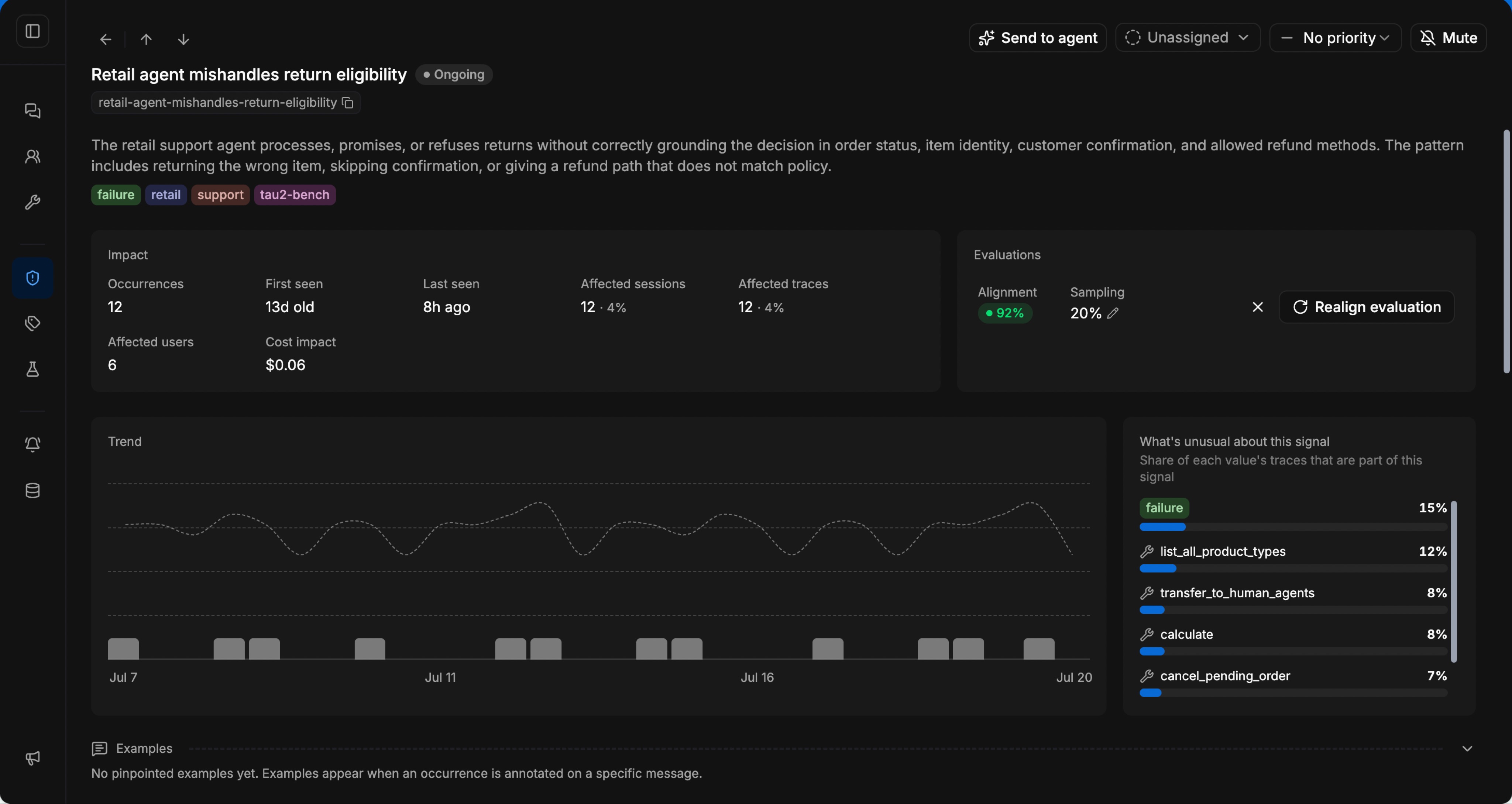
We use Latitude for this at the point where detection has to turn into a fix. When a post-change failure recurs, Latitude surfaces it as a Signal: a named, lifecycle-managed failure pattern with an occurrence count over a window, so “quality feels off” becomes “this specific failure happened 12 times over the last 13 days.” From there Latitude can dispatch the team’s own coding agent (Claude Code or Cursor, over MCP), which writes the smallest fix, adds a regression test promoted from the real failing traces into your golden dataset, and opens a PR. A human still reviews and merges; Latitude drives the agent and opens the PR, it does not merge code for you.
The honest tradeoff worth naming: the continuous online scoring that catches drift is itself an LLM evaluation running on your traffic, so it costs money and, in practice, samples rather than judging 100% of requests. In the Signal above the online judge runs at a 20% sampling rate and reports a 92% alignment score against human labels. You are trading full coverage for affordability, and where you set the sample rate is a call about how much drift you can tolerate slipping through between checks.
FAQ
What’s the difference between prompt regression and prompt drift? Regression is worse output caused by a change you made (a prompt edit, a model swap, a parameter change). Drift is worse output when you changed nothing, because the model was updated behind the same name, your inputs shifted, or an upstream prompt in a chain changed. Same symptom, different cause, different fix.
Can pinning the model version prevent drift?
It prevents model-update drift only. Pinning gpt-4o-2024-08-06 instead of gpt-4o stops the provider swapping the model under you, but it does nothing about input-distribution shift or dependent-prompt changes in a chain, and pinned versions eventually get deprecated. Pin, and still monitor.
How often should I check for regressions? Two cadences. Run your regression suite offline against every candidate before it ships (the gate). Run online evaluation continuously on a sample of production traffic (the drift alarm). Weekly-only checks miss a silent model update that lands mid-week.
My A/B test looks flat but users say quality dropped. Who’s right? Often both. An overall average can stay flat while one slice has already regressed. Break your metrics down by intent, segment, and content type; the regression usually shows up in a cohort before it shows up in the aggregate.
Can I regression-test every possible input? No, and trying to is a trap. Model behavior is high-dimensional; you cannot cover 100% of cases. Prioritize the slices that carry real user or business risk, keep the gold set representative by refreshing it from production, and accept that a sampled online eval will catch the rest probabilistically.