

Load balancers are critical for keeping large language model (LLM) systems reliable and efficient. They evenly distribute incoming requests across multiple servers, avoiding bottlenecks and crashes. Unlike traditional methods, modern load balancers focus on token counts instead of just connections, ensuring fair resource allocation based on task complexity.
Key Takeaways:
-
Token-Aware Routing : Balances workloads by tracking token usage, improving latency by up to 12%.
-
Dynamic Failover : Automatically reroutes traffic during server issues, minimizing downtime.
-
Latency-Based Optimization : Routes requests to the fastest servers, reducing response times by up to 40%.
-
Multi-Provider Support : Distributes traffic across different LLM providers to avoid reliance on a single service.
These strategies reduce latency spikes, prevent server overloads, and ensure high uptime, meeting the demands of AI-driven systems. Combining load balancers with observability tools like Latitude enhances monitoring and troubleshooting, making LLM deployments more reliable.
Problems Without Load Balancing in LLM Deployments
Traffic Clumping and Bottlenecks
Traditional load balancing techniques, such as Round Robin or Least Connections, operate under the assumption that all requests are equal in cost. However, in Large Language Model (LLM) systems, this couldn’t be further from the truth. A simple prompt might take around 50 milliseconds to process, while a complex one could run for 45 seconds and consume a significant chunk of GPU memory - yet both are treated as a single connection by these methods. This mismatch leads to inefficiencies: load balancers may unintentionally pile multiple heavy, long-running tasks onto a single server, creating processing blockages and wasting GPU resources.
Production data paints a clear picture: idle time caused by bottlenecks can account for over 40% of total compute time during a decode step. In fact, industrial traces reveal that both the average and median idle times hover around 40% and 41%, respectively. This means that nearly half of the computational capacity goes unused.
“Treating a Large Language Model (LLM) inference server like a standard Nginx web server is a recipe for astronomical costs and terrible user performance”.
While traffic clumping creates bottlenecks, misrouting requests further destabilizes the system.
Latency Spikes and Service Reliability Issues
When load balancing is poorly managed, LLM systems can experience a “death spiral.” A balancer might see a GPU with only a few active connections and mistakenly assume it has free capacity, routing even more requests to it. This overloads the GPU, which can lead to brownouts or outright crashes. The result? A poor user experience, with traffic piling up on certain instances, causing long wait times and worsening Time-to-First-Token (TTFT).
Another issue arises when the balancer ignores a server’s cache state. It may send a request to a node that doesn’t have the required context stored, leading to Out-of-Memory errors and failed generations. In multi-tenant environments, heavy tasks can monopolize GPU resources, dragging down the performance of other tasks. This uneven distribution not only affects individual workloads but also risks cascading failures across the system.
Additionally, relying solely on one LLM provider introduces a significant vulnerability. If that provider experiences outages, regional disruptions, or rate-limit spikes, the entire application can be affected.
“LLM providers go down more than you’d expect… When you’re routing millions of requests, every provider will fail eventually”.
These issues highlight the critical need for smarter load balancing strategies to ensure LLM systems run efficiently and reliably. The next section will delve into how advanced load balancers address these challenges to improve performance and stability.
How Load Balancers Improve LLM Performance
Modern load balancers tackle reliability challenges by analyzing computational demands, endpoint health, and real-time metrics, all while employing advanced routing strategies.
Latency-Based Routing
Latency-based routing ensures requests are sent to the fastest available endpoint, cutting down response times and avoiding delays caused by slower servers. These systems rely on exponential moving averages to smooth out temporary spikes, focusing instead on long-term performance trends. Typically, they monitor response times over 5–15-minute intervals to establish stable baselines without overreacting to brief fluctuations.
Using reinforcement learning, intelligent routers have reduced end-to-end latency by over 11% compared to traditional methods. When paired with semantic caching - which stores and reuses responses for similar queries - load balancers can significantly lower provider load and operational costs, sometimes by as much as 95%.
For instance, in 2025, Comm100, a customer support platform, implemented Bifrost’s load balancing across providers like OpenAI (60%), Anthropic (30%), and AWS Bedrock (10%). By integrating semantic caching and automatic failover, they boosted uptime from 97.3% to 99.97% and cut operational costs by 40%, all while avoiding rate limit issues.
Latency metrics are just the start. Usage-based strategies take optimization further by aligning resource allocation with task complexity.
Usage-Based Routing for Task Optimization
Not all LLM requests are created equal - some are computationally heavier than others. Usage-based routing addresses this by focusing on token-aware load balancing, which tracks the number of in-flight tokens across backends rather than simply counting active connections. This prevents small, lightweight requests from being delayed behind more resource-intensive ones. Under high demand, token-aware balancing has been shown to improve average latency by 12% and P90 latency by 10%.
This method works by using an L7 reverse proxy to intercept incoming JSON bodies and tokenize prompts before routing them. Tasks are then matched to the appropriate models: simpler tasks like summarization are sent to lightweight models, while more complex reasoning tasks are directed to high-capability models like GPT-4.
Dynamic failover mechanisms further enhance reliability by ensuring uninterrupted performance even when endpoints falter.
Dynamic Rerouting and Failover
Dynamic rerouting keeps systems running smoothly by redirecting traffic away from failing or underperforming endpoints. Load balancers implement multi-stage retries within a single API call, ensuring a successful response even if the primary provider encounters issues.
Providers are scored in real time using weighted factors such as uptime (50%), throughput (20%), price (20%), and latency (10%). If a provider’s uptime drops below 95%, aggressive penalties are applied, effectively sidelining it until it recovers. For example, a provider with 90% uptime might face a penalty of 0.07, while one at 50% could incur a penalty as high as 5.61.
“A provider having a bad 5 minutes gets aggressively deprioritized.” - LLM Gateway
Failover mechanisms also distinguish between error types. Server-side errors (e.g., 5xx errors, timeouts, and connection failures) trigger retries, while client-side issues like 400 Bad Request are ignored to avoid wasting resources. In cases of 429 rate limit errors, the affected deployment is immediately placed on cooldown, allowing the system to switch to an alternative provider without delay.
For recovery, systems use an “epsilon-greedy exploration” strategy, routing about 1% of traffic to previously degraded providers. This self-healing approach ensures that once a provider recovers, it can seamlessly rejoin the rotation without manual intervention.
Research Findings on Load Balancing Benefits
Serving Capacity Improvements
State-aware load balancers bring impressive throughput improvements by efficiently managing key-value cache states and prefill/decode disaggregation - capabilities that standard balancers lack. For example, the vLLM Router doubled throughput compared to Kubernetes-native load balancers when tested with Llama 3.1 8B and Deepseek V3 models.
SkyWalker further enhances throughput by 1.12–2.06× while also cutting serving costs by 25%. Beyond boosting throughput, these load balancers significantly reduce latency during token generation.
Tail Latency Reduction
Predicted-latency scheduling directly addresses the heavy-tailed distribution of token generation times. In production workloads, TPOT P99 latency dropped from 93ms to 53ms - a 43% improvement. The gains were even more pronounced for Time to First Token (TTFT): P50 TTFT improved by 70%, and P95 TTFT fell from 24.04 seconds to 11.34 seconds, a 53% reduction.
The vLLM Router also showed substantial improvements during December 2025 benchmarking, achieving TTFT speeds 2,000ms faster than llm-d and standard Kubernetes-native routing when deployed with DeepSeek V3 using the TP8 configuration.
Examples of Improved Reliability
Real-world deployments confirm these findings. The latency reductions achieved translate directly into improved reliability for production systems. For instance, Google’s Vertex AI clusters experienced up to a 40% reduction in TTFT and Inter-Token Latency by adopting predicted-latency-aware scheduling. Similarly, the TrueFoundry AI Gateway demonstrated exceptional operational efficiency, handling over 350 requests per second on a single vCPU with less than 10ms of P95 overhead.
“Predicted-latency aware routing consistently performs as well as or better than standard Kubernetes routing and load+prefix-aware routing in all tested scenarios, while eliminating the need for manual parameter tuning.” - llm-d
In another December 2025 study using Llama 3.1 8B on a cluster with 8 prefill and 8 decode pods, the vLLM Router achieved 25% higher throughput than llm-d and doubled the performance of native Kubernetes load balancers. These advancements are critical for ensuring the reliability needed in large-scale LLM deployments.
Advanced Load Balancing Strategies for LLMs
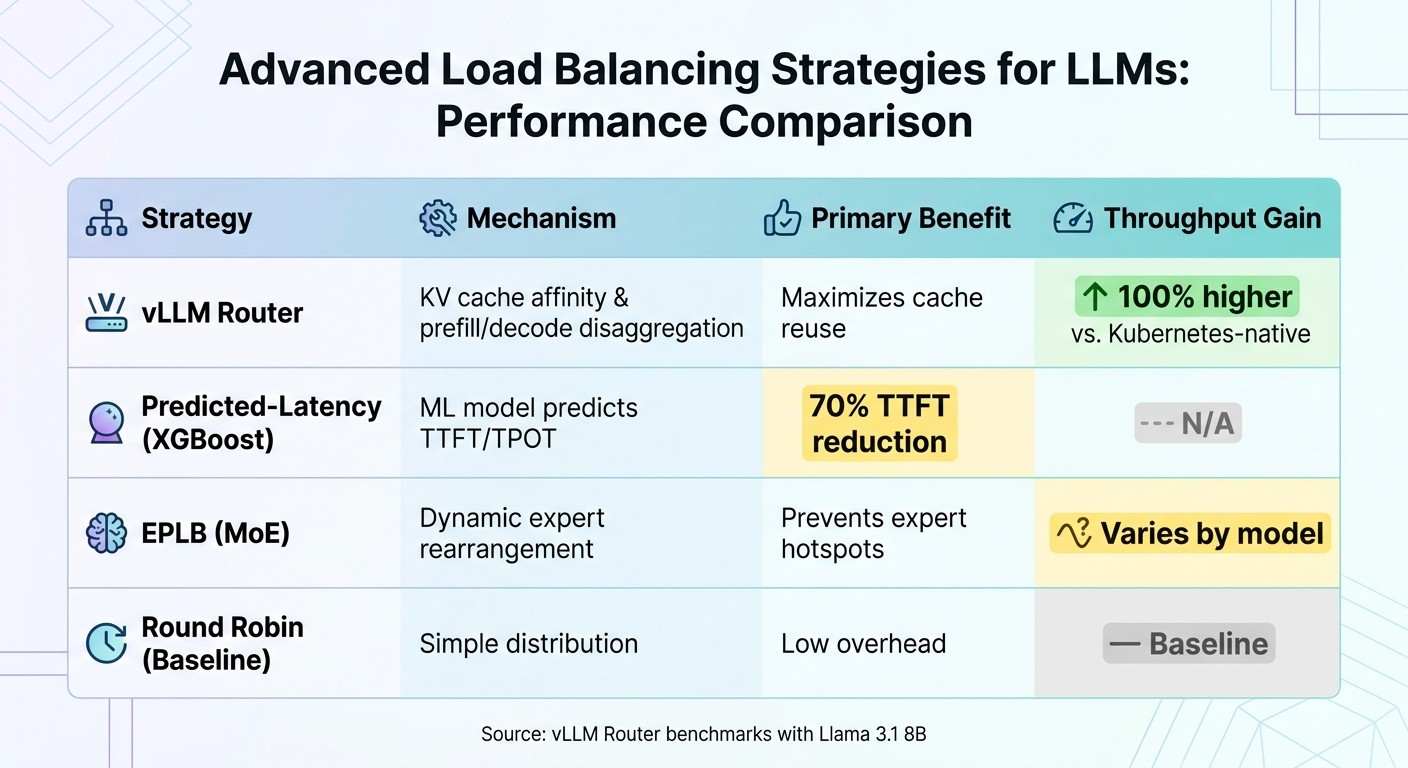
Load Balancing Strategies for LLM Performance: Comparison of Key Metrics
Building on the standard benefits of load balancing, these advanced strategies are designed to fine-tune throughput and reduce latency for specialized tasks involving large language models (LLMs).
Latency-Aware Routing with vLLM

The vLLM Router uses consistent hashing to manage sticky sessions. This means that when a user sends multiple requests during a single conversation, all those requests are routed to the same worker holding their key-value (KV) cache. By eliminating the need to rebuild context, this approach significantly reduces latency.
“For conversational workloads, routing subsequent requests from the same user to the same worker that holds their KV cache is critical for minimizing latency”.
Moreover, the router separates compute-heavy prefill tasks from memory-intensive decode operations by assigning them to specialized worker groups. For instance, benchmarks with Llama 3.1 8B using 8 prefill and 8 decode pods revealed that this Rust-based router achieved 25% higher throughput compared to llm‑d and doubled throughput relative to Kubernetes‑native balancers.
Google’s Vertex AI takes a different approach by using predicted-latency scheduling. Lightweight XGBoost models predict metrics such as Time to First Token (TTFT) and Time Per Output Token (TPOT) based on factors like prompt length and server load. With a prediction error of about 5%, this method has achieved up to a 70% reduction in TTFT.
While these methods are effective for general and conversational workloads, specialized models often demand unique balancing techniques.
MoE Expert Balancing
Mixture-of-Experts (MoE) models face unique challenges in routing tokens to specialized experts without creating bottlenecks. Earlier methods relied on auxiliary losses to ensure uniform token distribution, but this often compromised model quality. DeepSpeed‑MoE addressed this by introducing capacity factors - commonly set at 1.25 - to limit the token load per expert and prevent overload.
Newer architectures like DeepSeek‑V3 have moved away from heavy reliance on auxiliary losses. In June 2025, vLLM introduced Expert Parallelism Load Balancing (EPLB), which dynamically redistributes experts across nodes during inference. This system uses redundant experts - multiple copies of the same parameters - to avoid bottlenecks. Engineers can fine-tune this approach by adjusting parameters like --eplb-window-size and specifying the number of redundant experts (e.g., 32).
Comparison of Balancing Techniques
Here’s a breakdown of key differences among these advanced load balancing methods:
| Strategy | Mechanism | Primary Benefit | Throughput Gain |
|---|---|---|---|
| vLLM Router | KV cache affinity & prefill/decode disaggregation | Maximizes cache reuse | 100% higher vs. Kubernetes‑native |
| Predicted‑Latency (XGBoost) | ML model predicts TTFT/TPOT | 70% TTFT reduction | N/A |
| EPLB (MoE) | Dynamic expert rearrangement | Prevents expert hotspots | Varies by model |
| Round Robin (Baseline) | Simple distribution | Low overhead | Baseline |
The best load balancing strategy depends on the specific workload. Conversational models benefit most from consistent hashing to maintain KV cache affinity, heterogeneous GPU setups excel with predicted-latency scheduling, and MoE models like DeepSeek‑V3 thrive with EPLB to address token distribution challenges.
Latitude: Improving LLM Reliability with Observability

When it comes to improving the reliability of large language models (LLMs), observability platforms like Latitude play a critical role. While load balancers are great at optimizing traffic flow, they don’t diagnose failures or prevent issues from recurring. This is where Latitude steps in. As an open-source AI engineering platform, Latitude helps teams uncover hidden failure modes - like hallucinations, infinite reasoning loops, or stalled conversations - and ensures that reliability improvements stick through continuous evaluations.
How Latitude Works with Load Balancers
Latitude doesn’t just monitor; it actively enhances how load balancers handle traffic. By providing real-time data on latency, error rates, and output quality, it spots anomalies before they become real problems. For example, if a specific model instance shows an uptick in hallucinations during peak load, Latitude flags it immediately. This allows teams to adjust routing rules proactively, ensuring users remain unaffected.
The platform uses multi-step tracing to collect detailed execution data, helping engineers pinpoint exactly where failures occur. With its ability to group recurring issues into patterns using as few as 10 traces, Latitude makes it easier for teams to prioritize fixes efficiently. These insights enable targeted interventions, making it an essential tool for AI engineers.
Features for AI Engineers
Latitude offers a suite of features that work hand-in-hand with load balancing strategies:
-
Automated eval generation : This feature creates test cases based on real-world production issues rather than synthetic benchmarks, ensuring evaluations align with the actual challenges models face in production.
-
Human annotation queues : Domain experts can review ambiguous LLM outputs and flag errors. These insights can then inform load balancer routing rules, helping to avoid sending traffic to underperforming model instances.
-
Alignment metric tracking : Latitude monitors key indicators like reward model scores and human preference alignments, ensuring that reliability improvements remain consistent even in load-balanced environments.
Teams using Latitude report impressive results, including 80% fewer critical errors, a 25% boost in accuracy within two weeks, and 8× faster prompt iterations thanks to its GEPA algorithm.
Plans and Pricing
Latitude offers flexible pricing options to suit different operational needs:
-
Free plan ($0/month): Includes 5,000 traces per month, 500 trace scans per month, 50 million eval tokens per month, 7-day data retention, and unlimited seats. This plan is perfect for early-stage development.
-
Team plan ($299/month): Scales up to 200,000 traces per month, 20,000 trace scans per month, 500 million eval tokens per month, 90-day retention, unlimited annotation queues, and priority support.
-
Enterprise solutions : Custom pricing is available for large organizations with high traffic volumes. Features include on-premises deployment, SOC2 and ISO27001 compliance, SAML SSO, and dedicated support.
Latitude’s combination of observability, actionable insights, and flexible pricing makes it a powerful tool for improving LLM reliability in a variety of operational contexts.
Conclusion
Key Takeaways
Load balancers play a crucial role in ensuring the reliability of large language models (LLMs) in production environments. Without them, deployments face challenges like uneven traffic distribution, latency spikes, and service outages - all of which negatively impact user experience. Through features like latency-based routing , multi-provider distribution , and dynamic failover , load balancers efficiently manage requests across multiple model instances and service providers.
For instance, geographic routing can reduce latency by about 40 milliseconds for users in the EU, while multi-provider distribution increases throughput beyond the limits of a single provider’s TPM (tokens per minute) and RPM (requests per minute) capacity. Advanced approaches, such as predicted-latency-aware scheduling, have shown to lower Time to First Token (TTFT) and inter-token latency by as much as 40%.
That said, load balancers alone aren’t foolproof. They can’t detect issues like silent failures or gradual quality degradation. This is where observability platforms, such as Latitude, come into play. These tools monitor key metrics like latency, error rates, and output quality in real time, helping teams catch anomalies before they spiral into bigger problems. Together, load balancers and observability tools form a dynamic reliability framework.
Future Outlook
The future of LLM reliability will lean heavily on AI-driven scheduling and observability. Predicted-latency models, for example, are already achieving a Mean Absolute Percentage Error (MAPE) of around 5% when forecasting LLM latency. This precision allows for smarter scheduling that aligns with Service Level Objectives (SLOs), ensuring requests are allocated efficiently.
Tools like Braintrust’s “Loop” are paving the way by using AI to analyze millions of traces and provide actionable recommendations - such as prompt adjustments or routing optimizations - through natural language interfaces. The growing importance of this technology is reflected in recent investments, like Braintrust’s $80 million Series B funding round in February 2026, which valued the company at $800 million.
As production demands continue to grow, the integration of load balancers with advanced observability platforms will become essential for maintaining uptime and preserving user trust. Teams that embrace these innovations will be better positioned to meet the reliability challenges of tomorrow.
FAQs
What is token-aware load balancing, and why is it better than round-robin for LLMs?
Token-aware load balancing allocates requests based on the number of tokens in an input prompt. This approach aligns traffic with the actual computational demands of each request. Unlike round-robin, which distributes requests evenly without factoring in processing requirements, token-aware balancing helps prevent server overload and minimizes head-of-line blocking. By tailoring resource allocation to the token workload, it reduces latency and ensures more consistent performance for large language models (LLMs).
How does sticky routing to a KV cache reduce Time to First Token (TTFT)?
Sticky routing to a KV cache helps cut down Time to First Token (TTFT) by directing requests to the GPU that already has the necessary cache. By skipping the prefill phase and reusing previous computations, this method dramatically reduces latency. It ensures better resource efficiency and accelerates response times, making it ideal for large language model (LLM) deployments.
When should you route across multiple LLM providers instead of using just one?
Routing across multiple LLM providers is a smart strategy to ensure reliability and avoid potential disruptions. By distributing traffic across several providers, you can minimize the risk of outages, handle rate limits more effectively, and maintain consistent service without interruptions. This approach also helps reduce dependency on any single provider, offering a more balanced and resilient system.