
By Latitude · April 14, 2026
Key Takeaways
-
The most common evaluation mistake: building the eval suite first and hoping it covers production reality. The right approach is the opposite — start with production observations, build evals from what you see.
-
Named failure modes are the unit of AI quality management. Failure modes that aren’t named, tracked, and measured can’t be systematically improved.
-
Eval quality is not binary. MCC gives you a continuous measure of how well each evaluator aligns with human judgment — and it changes over time as more annotations accumulate.
-
The annotation-to-eval pipeline has a compounding return: each annotation cycle improves existing evals and generates new ones, so the system gets better with every week of operation.
-
Demonstrating improvement requires baselines. Track failure mode frequency from the beginning — “we reduced the hallucination rate from 2.1% to 0.4%” is a concrete result; “our AI is better” is not.
Heads of AI are responsible for AI quality in a way that’s harder to measure and demonstrate than most other engineering functions. “Is our AI better than it was 6 months ago?” is a question that many teams struggle to answer with data — which makes it harder to justify investment in quality infrastructure and harder to demonstrate impact to leadership.
This guide covers how to build an evaluation system that produces real measurements — not benchmark scores that don’t correlate with production quality, but failure mode frequency data that tells you whether the things that were going wrong are going wrong less often.
Why Evaluation Systems Fail
Most AI evaluation systems fail one or more of these conditions:
They test what was anticipated, not what happened
Evaluation suites built before production deployment test the failure modes the team expected. Production surfaces the failure modes that actually occur. These overlap, but the gap between them is significant — and the failure modes in the gap are invisible to the eval suite.
An evaluation system that doesn’t grow from production observations will drift further and further from production reality over time. It will show stable or improving scores while production quality may be degrading in ways it doesn’t cover.
They use proxies instead of direct measurement
Coherence, relevance, fluency — these are proxies for quality, not direct measurements of whether the AI accomplished its purpose. An AI support agent that gives coherent, relevant, fluent responses to billing questions while providing incorrect billing information will score well on all three proxies and fail on the dimension that actually matters.
Direct quality measurement requires product-specific criteria: did the agent complete the task correctly? Did it follow the policy accurately? Did it make the right tool call given the context? These criteria require human definition and human validation — there’s no generic metric that captures them.
They don’t measure eval quality
An evaluator that doesn’t correlate with human judgment is worse than no evaluator — it gives false confidence while consuming compute. Most teams that use LLM-as-judge evaluators have never measured how well their judges align with what humans would say. MCC is the correct metric for this alignment, and it should be tracked for every evaluator in the suite.
Building the Annotation Pipeline
The annotation pipeline is the core of a production-based evaluation system. It has three components:
Trace prioritization
Before annotation can happen, the right traces need to be surfaced. Anomaly signals — unusual session lengths, high token counts relative to task complexity, low-confidence language patterns in outputs, tool call sequences that deviate from expected patterns — identify traces more likely to contain failure modes. The annotation queue is filtered by these signals so annotators see the highest-value traces first.
Annotation interface
Annotators need enough context to make a judgment: the full session trace (not just the final turn), any relevant product policies or quality criteria, and the specific failure mode categories to assess. Good annotation interfaces reduce cognitive load — structured classification forms rather than free-text, contextual reference material accessible without leaving the annotation view, and clear definitions of what each failure mode category means.
Annotation quality control
Annotation quality degrades when annotators are rushed, when failure mode definitions are ambiguous, or when there’s no calibration across annotators. For critical failure mode categories, inter-annotator agreement should be tracked periodically — disagreement between annotators on the same trace signals that the failure mode definition needs clarification, not that the AI performed differently for different reviewers.
Managing the Eval Suite
Prioritizing coverage
Not all failure modes deserve equal eval investment. Prioritize based on:
-
Severity: What’s the impact on users when this failure mode occurs? Safety violations and high-stakes factual errors rank highest.
-
Frequency: How often does this failure mode occur? High-frequency, lower-severity failures aggregate to significant user impact.
-
Recurrence risk: How likely is this failure mode to recur after a fix? Issues that recur easily (sensitive to small model changes) need robust eval coverage.
Start with the 3–5 highest-severity failure modes and build evaluators for those first. Expand coverage from there as annotation volume grows.
Tracking coverage over time
Eval suite coverage — what percentage of active tracked failure modes have a corresponding evaluator with acceptable MCC — should be tracked as a KPI. Low coverage means gaps where regressions can occur undetected. A coverage trend that’s consistently rising shows the team is building systematic protection over time; a flat or declining trend means eval maintenance isn’t keeping up with failure mode discovery.
Retiring stale evals
Evals for failure modes that have been resolved and not recurred in 90+ days are noise — they consume CI compute and add cognitive overhead to result interpretation. Periodically audit the eval suite and archive evals for resolved failure modes. The active eval suite should reflect current failure mode risk, not a historical archive of everything that ever went wrong.
Demonstrating Impact
The metrics that make AI quality improvement demonstrable:
-
Failure mode frequency over time: For each tracked failure mode, graph occurrence rate per 1,000 sessions over time. A declining rate following a fix provides clear before/after evidence.
-
Issue resolution velocity: Average time from failure mode first observed to verified fixed. Improving resolution velocity shows the team is getting better at turning observations into improvements.
-
Eval suite coverage expansion: Coverage percentage over time. A rising trend shows systematic protection is increasing.
-
Regression catch rate: Of regressions that occurred in the past period, what percentage were caught by the eval suite before deployment vs. discovered post-deployment from user reports? A rising catch rate shows the eval suite is increasingly effective as coverage and eval quality improve.
These metrics convert subjective quality improvement into data that communicates clearly to engineering leadership, product leadership, and stakeholders who aren’t close to the technical details.
Frequently Asked Questions
How should Heads of AI approach building an evaluation system?
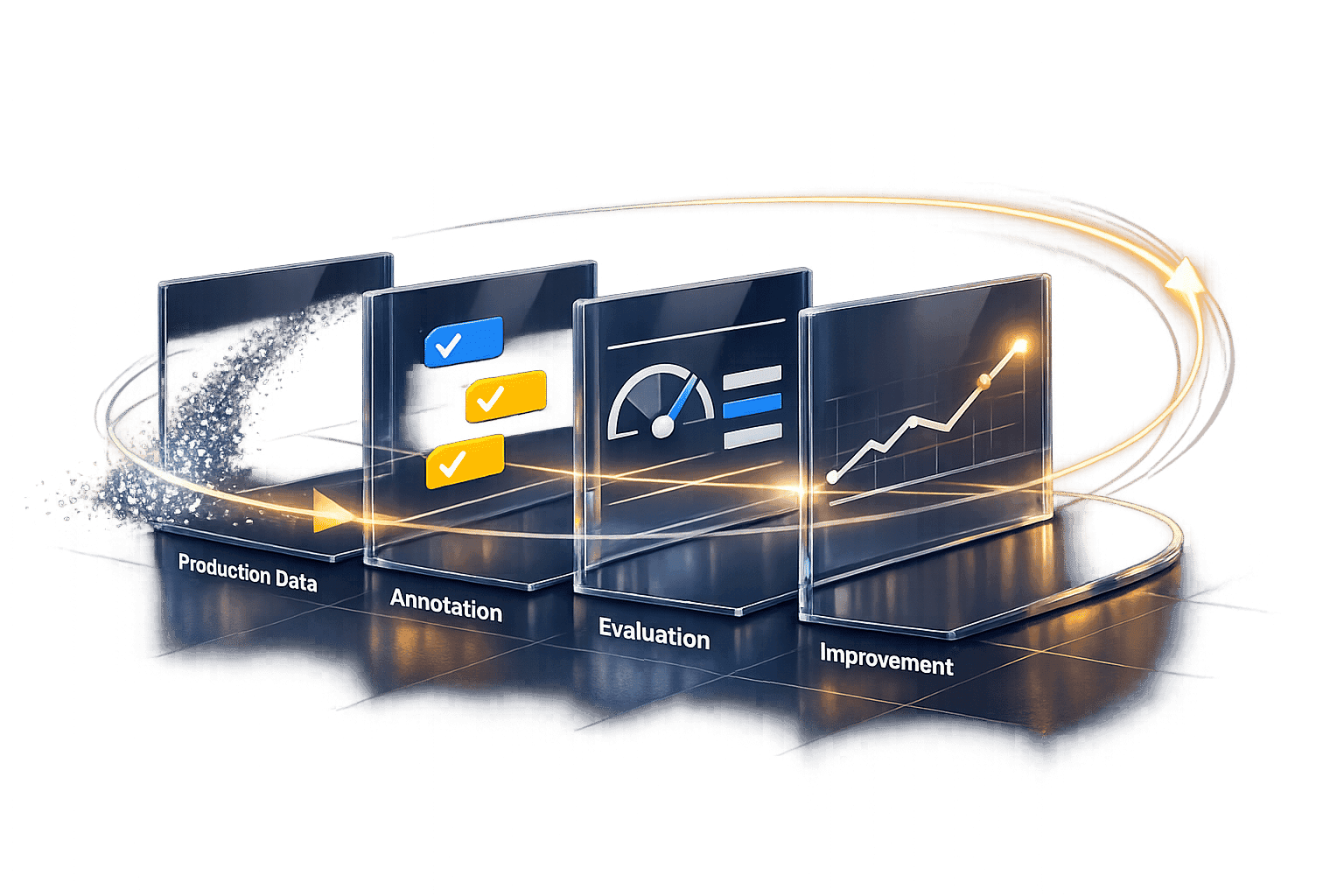
Heads of AI should build evaluation systems from the outside in — starting with production observations and working backward to eval generation, rather than starting with synthetic test cases and hoping they cover production reality. The practical process: (1) Instrument production to capture full session traces. (2) Review a sample of production sessions to identify the 5–10 most common failure modes. Name and document each one explicitly. (3) Build annotation queues that surface traces likely to contain those failure modes. (4) Run annotation cycles (2 hours per week minimum) to build the labeled dataset. (5) Use GEPA or equivalent to generate evaluators from annotations. (6) Validate evaluator quality with MCC before deploying as gates. (7) Track eval suite coverage — what percentage of active failure modes are covered?
What is the right number of evals for a production AI system?
The right number of evals is however many it takes to cover your active failure mode profile with high-MCC evaluators. A typical production AI system in the first 6 months will surface 10–20 distinct failure mode categories. Each should have at least one corresponding evaluator. The practical threshold for a well-covered eval suite is: all critical/high severity failure modes have an evaluator with MCC above 0.6; overall eval suite coverage is above 80%; the most recent 3 months’ worth of production incidents each have a corresponding evaluator that would have caught them pre-deployment. Coverage relative to your actual failure mode profile is the correct measure — not a fixed number.
Latitude gives Heads of AI the full production evaluation stack: trace collection, annotation queues, GEPA eval generation, MCC quality measurement, and coverage tracking. Get started free → or see pricing →