AI agent monitoring for Heads of AI: systematic quality management for production AI — connecting observability to eval generation and measurable improvement.

César Miguelañez
By Latitude · April 9, 2026
Key Takeaways
Heads of AI own the quality of production AI — not just its existence. That requires a systematic process, not reactive firefighting.
The failure modes that matter most in AI agents are semantic, not structural. They don't show up as errors; they show up as wrong answers that look right.
Issue tracking for AI is the equivalent of bug tracking for software — it gives failure modes a lifecycle (observed → annotated → tested → resolved → verified) instead of letting them recur indefinitely.
The annotation workflow is the bottleneck and the lever. Better annotation quality and prioritization produces better evals, which produces better deployment confidence.
Measurable improvement requires baselines. Without tracking failure mode frequency over time, you can't demonstrate that your AI quality work is producing results.
The role of Head of AI has evolved quickly. Two years ago, the job was primarily about building: selecting models, designing architectures, getting things to work. Today, for most organizations with AI in production, the job is at least equally about reliability: maintaining quality as models update, scaling systems as usage grows, and systematically reducing the failure modes that affect users.
This guide covers the monitoring and observability infrastructure that makes systematic AI quality management possible — specifically for Heads of AI who own production AI systems and need to demonstrate measurable improvement over time.
The Quality Management Problem
Most Heads of AI running production systems know the problem from experience. You have traces. You have cost and latency dashboards. You have logs. And you still can't answer the questions that matter:
What are the most frequent failure modes in production right now?
Which failure modes are getting worse?
Is this model update actually an improvement, or did we regress somewhere we weren't looking?
What percentage of our known failure modes do our evals actually cover?
These questions require more than observability infrastructure — they require an issue tracking mindset applied to AI quality. The same discipline that software engineering uses for bugs (observe → reproduce → fix → test → close) needs to be applied to AI failure modes, with the added complexity that AI failures are probabilistic, often hard to reproduce, and require human judgment to classify.
The Anatomy of AI Agent Failures
For Heads of AI running agent workflows, the failure taxonomy matters. Different failure modes require different detection approaches and different fixes.
Tool use failures
Wrong tool selected, correct tool called with wrong parameters, or correct tool called correctly but the response misinterpreted. The third category is the most dangerous: the system appears to be working at every observable layer while building downstream reasoning on a wrong premise. Detection requires tracing not just the tool call but the agent's subsequent reasoning about the tool's response.
Context degradation
Agents lose track of constraints, preferences, or facts established earlier in the session as context windows fill. This is a slow failure — it doesn't appear in early turns and can be hard to reproduce. Detection requires session-length-stratified quality analysis: comparing task completion rates across short, medium, and long sessions to find where coherence degrades.
Goal-level failures
The agent produces individually well-formed responses at every turn but fails the user's actual goal. This is invisible to response-level evaluations and requires session-level outcome assessment. It's also the most common failure mode for complex agent tasks, and the hardest to evaluate automatically.
Hallucinations and grounding failures
The agent asserts facts, policies, or information that doesn't exist in its knowledge base or the retrieved context. For enterprise AI, this is often the highest-severity failure category — wrong policy information or incorrect factual claims create compliance and reputational risk.
Safety and scope violations
The agent crosses defined boundaries — appropriate topic scope, tone, escalation triggers, or explicit content policies. These can be explicit (agent responds to out-of-scope requests) or cumulative (multi-turn manipulation that crosses a boundary no single turn would trigger). Detection requires both rule-based guardrails for deterministic violations and LLM-as-judge review for semantic violations.
Building an Issue-Centric Quality Process
The shift from monitoring to systematic quality management is fundamentally an organizational one: treating AI failure modes as tracked issues rather than incidents to forget after they're fixed.
Name and track failure modes explicitly
Each recurring failure pattern should have a name, a definition, and a tracking entry. "The agent sometimes gives wrong answers" is not a tracked failure mode. "Tool response misinterpretation: agent misreads the billing API's 'pending' state and reports it to users as 'active'" is a tracked failure mode. Named failure modes can be annotated consistently, measured over time, and evaluated against in CI.
Track lifecycle states
Each failure mode should move through lifecycle states:
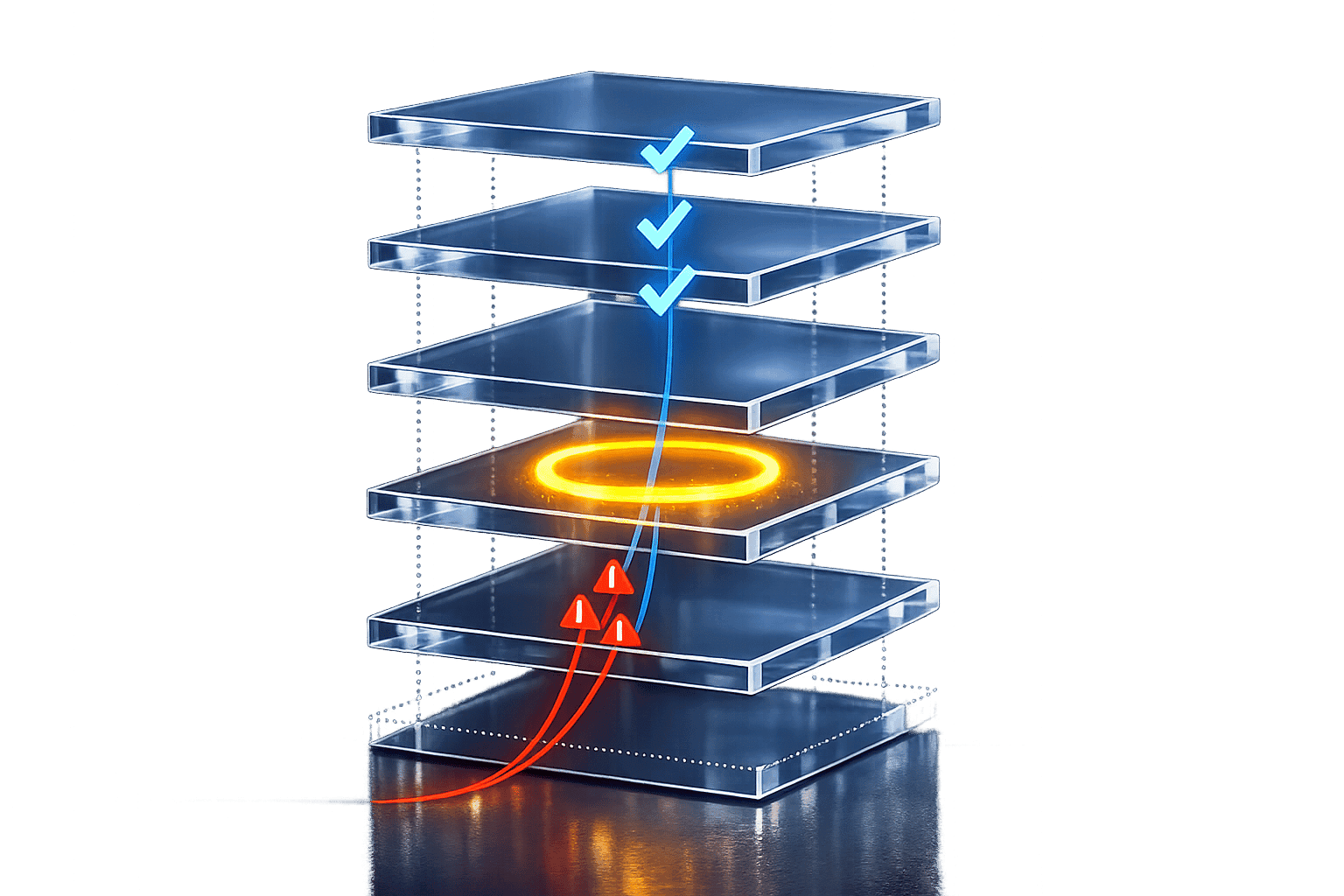
Open — observed in production, not yet analyzed
Annotated — domain experts have reviewed examples and confirmed the pattern
Tested — an eval has been generated and added to the CI suite
Fixed — a change was deployed that is expected to address the failure mode
Verified — post-deployment monitoring confirms the failure rate has decreased and the eval now passes consistently
This lifecycle gives the Head of AI a dashboard view of quality trends: how many open failure modes exist, how fast are they moving through resolution, how many are verified fixed versus recurred. Without lifecycle tracking, the same failure modes get rediscovered repeatedly.
Connect annotation to eval generation
The annotation workflow is where human judgment enters the system. Domain experts reviewing annotated traces aren't just quality-checking — they're generating the training signal for automated evaluators. Each annotation that classifies a trace as "bad" and identifies the failure mode is a data point for GEPA to learn from.
The connection should be automatic: annotation produces annotated examples → GEPA uses those examples to generate or refine the corresponding evaluator → the evaluator's quality (MCC alignment with human annotations) is tracked over time → when MCC drops, more annotation is surfaced for that failure mode.
The Eval Suite as Quality Infrastructure
For Heads of AI, the eval suite is the primary quality infrastructure. It's the artifact that encodes your team's knowledge of what can go wrong — and it should grow continuously as production teaches you more.
Three properties determine whether a eval suite is doing its job:
Coverage: What percentage of your active, tracked failure modes have a corresponding eval? Coverage gaps are deployments that can regress without being caught.
Alignment: For each eval, what is its MCC score against human annotations? Misaligned evals give false confidence. Track alignment for every evaluator, not just overall pass rates.
Freshness: Are your evals still testing relevant failure modes? Evals for resolved failure modes that haven't recurred in 90 days should be deprioritized or archived. New failure modes should produce new evals within days, not weeks.
Demonstrating Impact
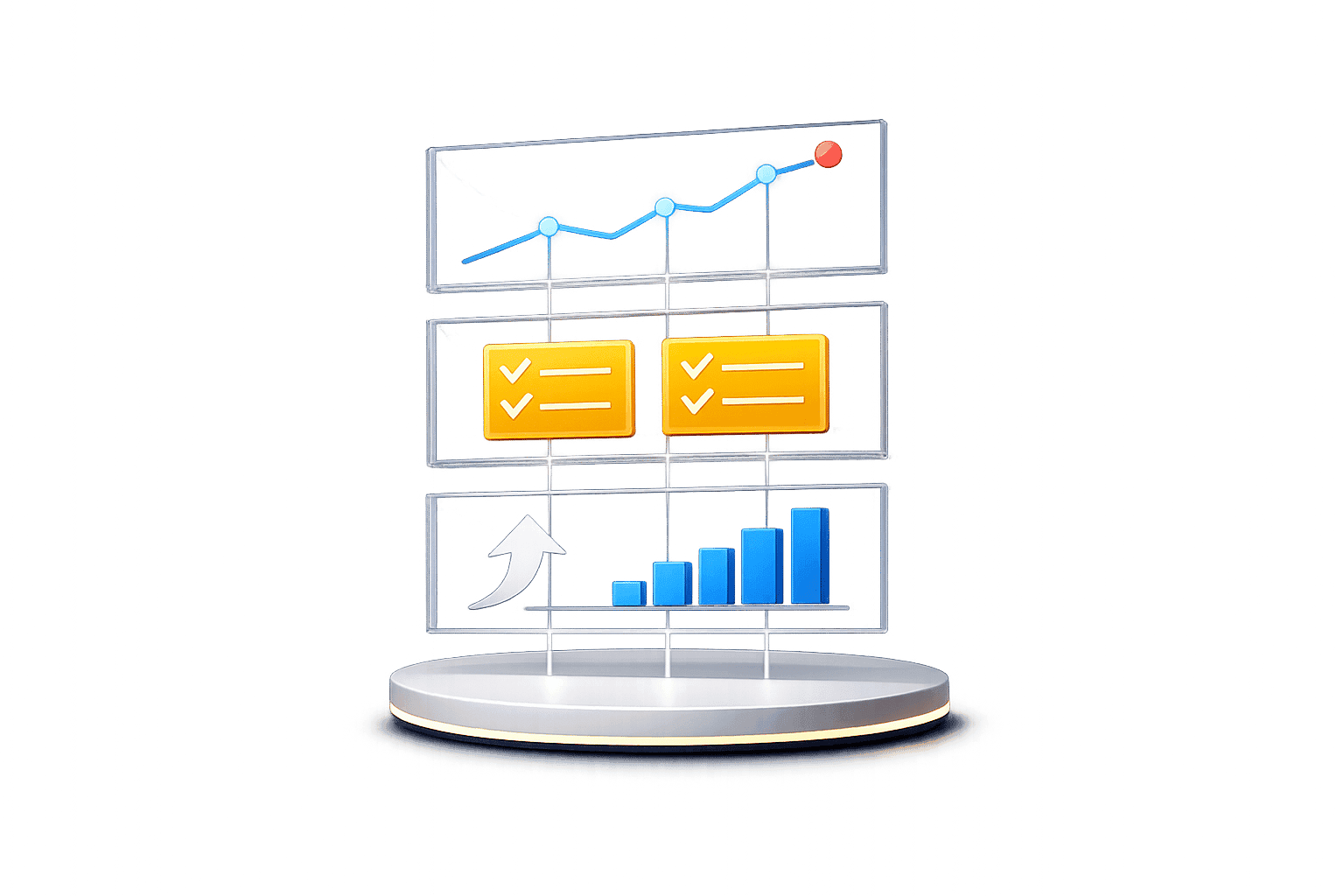
Heads of AI are increasingly expected to demonstrate measurable impact from quality investments. The metrics that make this possible:
Active failure mode count over time: Is the number of open, unresolved failure modes decreasing? Are newly discovered failure modes being resolved faster than they're being discovered?
Failure mode frequency per cohort: For your highest-severity failure modes, how often do they occur per 1,000 sessions? Is that rate decreasing after each improvement cycle?
Eval suite coverage over time: Is coverage growing? A coverage metric that consistently increases shows the team is building systematic protection, not just reacting to incidents.
Regression-free deployment rate: What percentage of deployments in the last 90 days triggered no regressions on the eval suite? A rising rate shows the team is getting better at predicting quality impact.
These metrics convert the subjective ("our AI is better than it was") into the objective ("our active failure mode count is down 40% since Q4 and our highest-severity failure mode occurs at 0.3% of sessions, down from 1.8%").
Frequently Asked Questions
What does AI agent monitoring look like for a Head of AI?
For a Head of AI, monitoring goes beyond uptime and latency. The questions that matter are: What failure modes are currently active in production? Which ones are increasing in frequency? Are our evaluations actually aligned with what good looks like for our product? Are we improving measurably after each iteration cycle? This requires an issue-centric platform that tracks failure modes end-to-end — from first sighting through annotation through eval generation through resolution — and gives quality metrics that are grounded in human judgment, not just automated scores.
How do you build a systematic quality improvement process for production AI?
Systematic AI quality improvement requires a closed loop with five stages: (1) Observe — capture full production traces including multi-turn sessions and tool calls. (2) Prioritize — surface the traces most likely to contain failure modes using anomaly signals, not random sampling. (3) Annotate — domain experts review prioritized traces and classify failure modes, building the ground truth dataset. (4) Evaluate — convert annotated failure modes into automated evaluations using GEPA or similar, and run them in CI. (5) Iterate — use eval results and post-deployment monitoring to direct the next improvement cycle.
What is the difference between monitoring and observability for AI agents?
Monitoring typically means tracking metrics over time — latency, error rates, cost, uptime. For AI agents, monitoring is necessary but insufficient: a system can pass every monitoring check while delivering consistently incorrect or misleading outputs, because semantic quality failures don't appear as errors. Observability adds the layer above monitoring: the ability to understand why outputs are failing, which failure patterns recur, what the failure modes look like in detail, and whether improvements are actually reducing their frequency. Observability for AI agents requires full session tracing, issue clustering, human annotation workflows, and quality baselines — not just dashboards of operational metrics.
Latitude is built around the issue-centric quality management workflow described in this guide. Start for free → or see pricing →
Related Blog Posts
AI Agent Failure Modes in Production: Detection Playbook + Tooling Stack
AI Agent Monitoring Playbook: Metrics, Alerts, and Reliability Operations for Production Teams
How to Monitor AI Agents in Production: A Complete Guide for Engineering Teams
AI Agent Observability for CTOs: What to Know Before You Scale